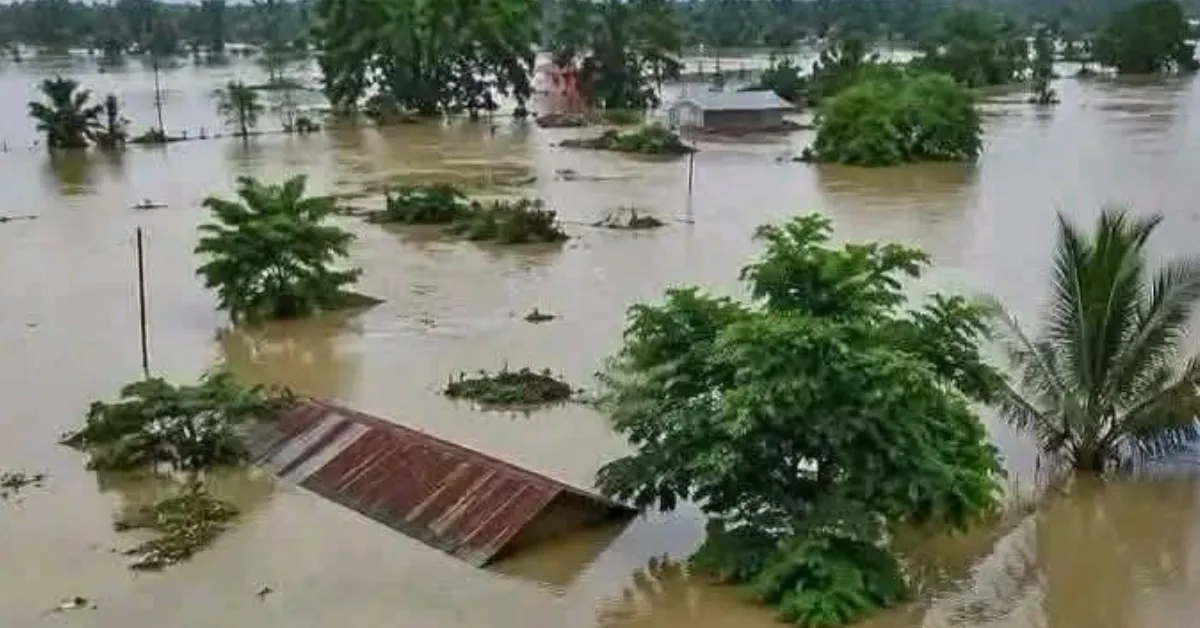
At around 7 pm on 21 July, floodwaters entered Rohini Duwara’s home in Lakwa Abhayapuri village in Assam’s Charaideo district.
His family tried to move towards higher ground as the powerful current rose around them.
Rohini’s wife, Tutumoni Duwara, and their daughter, Bidisha, were swept away first. His sons, Bidyut and Biplab, entered the water in an attempt to save them, but the current carried them away too.
In a matter of minutes, Rohini was separated from his wife and three children.
The bodies of Bidisha, Bidyut and Biplab were later recovered, while the search for Tutumoni continued at the time of the latest available report.
Across Assam, thousands of families are living through their own hours of fear. Homes have disappeared under floodwater, livelihoods have been washed away, and people have waited for rescue on rooftops, embankments and patches of higher ground.
The floods have left behind staggering numbers. Behind each one is a family wondering where it will sleep, how it will protect its children and what will remain when the water recedes.
For many, the first step towards surviving the coming days begins with finding a roof.
The Better India has joined hands with DonateKart to support the Assam-based Association of Social and Human Activists, or ASHA, in procuring emergency tents for displaced families.
Your contribution can give a family a dry place to sleep, protect its food and medicines, and stay together while floodwaters continue to surround their home.
When rivers spread through villages, farms and homes
Weeks of intense rainfall across Assam and the upstream hill catchments have swollen the Brahmaputra and its tributaries far beyond their usual courses.
Rivers such as the Dikhow, Disang and Janji have overflowed, sending water through villages, tea estates and farmland in parts of Upper Assam where residents say they have rarely witnessed flooding on this scale.
Satellite imagery shows how dramatically the landscape has changed.
Near Jorhat, the apparent inundated corridor of the Brahmaputra widened to almost 21 kilometres, around three times its earlier visible extent. This measurement represents the total spread of water along the selected stretch, including flooded sandbars, fields and nearby settlements, rather than the permanent river channel alone.
According to the latest report from Assam’s Disaster Reporting and Information Management System cited on 24 July, more than 7.21 lakh people across 11 districts and nearly 900 villages had been affected.
At least 47 people had lost their lives, while several others remained missing. Around 25,375 hectares of cropland had been submerged, more than 24,000 people were staying in relief camps and nearly 1.39 lakh animals had been affected.
Assam Drowns in Deadly Floods.
41 dead, over 7 lakh people affected as floods swallow 11 districts. Rivers still rising.
Assam is hurting. Homes are gone, lives have been changed forever and even innocent animals have been lost.
Please keep every affected family in your… pic.twitter.com/yAt3PCkyvb— زماں (@Delhiite_) July 24, 2026
Sivasagar was the worst-affected district, with approximately 3.92 lakh people impacted. Charaideo followed with 1.10 lakh people affected, while nearly 97,700 people were impacted in Jorhat.
The exceptional rainfall across Upper Assam has added enormous volumes of water to rivers already struggling to contain it.
India Meteorological Department data showed that Charaideo received around 170 mm of rain during the period analysed, which was 436% above normal. Golaghat recorded 147.9 mm, Jorhat 105.2 mm and Sivasagar 93.2 mm.
For the families living through the flood, these figures describe only a fraction of what has been lost.
‘People need shelter and drinking water too’
Rescue operations are continuing across affected districts.
The National Disaster Response Force, State Disaster Response Force, Army, Border Security Force, local police and other agencies have been evacuating stranded families. Helicopters have also been used to deliver food packets to villages that remain inaccessible by road.
ASHA is among the organisations supporting relief efforts on the ground through its partnership with DonateKart.
Speaking to The Better India, Rajib Kalita, Managing Director of ASHA, says rescue calls continue to arrive from communities across the state.
“People are calling the SDRF and NDRF continuously, asking to be rescued. Every agency is trying its best, but the sheer volume of water has made rescue operations extremely difficult,” he says.
Food is reaching many affected areas through air drops. Keeping it dry and safe to eat poses another challenge.
/filters:format(webp)/english-betterindia/media/media_files/2026/07/24/assam-2-2026-07-24-17-13-55.png)
“Food packets are dropped from helicopters, but many become wet after falling into floodwaters. Even when food reaches families, they do not have a dry place to keep it or eat it,” Kalita explains.
The requests heard by relief workers reveal what families urgently need alongside food.
“People keep telling us, ‘Do not think only about food. What we need right now is drinking water and shelter too,’” he shares.
Families need a protected place where they can eat, sleep and keep essential supplies dry. A temporary tent can provide that immediate support while rescue and relief work continues.
How your contribution will help
To meet one of the most urgent needs identified by relief workers, The Better India has joined hands with DonateKart to support ASHA’s relief efforts.
The fundraiser aims to raise Rs 2 lakh, which will be used to procure emergency tents for families displaced by the Assam floods.
ASHA and its partner organisations working in flood-hit villages will distribute these temporary shelters among affected families.
Many people have fled submerged homes with few belongings. Others remain stranded on tin rooftops or patches of higher ground as the water surrounds their villages.
Even where food reaches families through rescue operations, they often have no dry place to store it, cook a meal or sleep safely.
Every contribution will help procure a temporary shelter that can give a family:
-
A dry place where children and elderly people can sleep
-
Protection from rain, mosquitoes and contaminated floodwater
-
A secure space to store drinking water, food, clothes and medicines
-
Temporary accommodation while the family waits for the water to recede or prepares to rebuild
Your donation will directly support the procurement of emergency tents for flood-affected families in Assam.
When a tent becomes the safest place a family has
Floodwater takes away many of the small certainties that shape everyday life.
A bed becomes unusable. Clothes and documents remain soaked. Medicines are lost, and food cannot be kept dry. Families lose the space where they once cooked, ate and slept together.
Across several villages, people have abandoned their homes after water entered every room. In some places, even pucca (permanent) houses have offered little protection, forcing residents to spend hours on their rooftops while they wait for rescue boats.
“Even people with pucca houses are sitting on their roofs because everything below is underwater,” says Kalita.
Families without shelter remain exposed to continued rainfall, mosquitoes, contaminated water and illness.
Children have no dry place to sleep. People with medical conditions have nowhere safe to keep medicines. Families cannot protect clothes, food packets or the few belongings they managed to carry.
Relief workers have therefore identified tents as one of the most urgent needs.
“If families have a tent, they at least have a place where children can sleep, where food can remain dry and where they can live with some dignity until the water recedes,” Kalita explains.
A tent offers immediate protection while a family waits to understand whether its home can be entered, repaired or rebuilt.
Rescue is only the beginning
Floodwaters will eventually begin to fall, but displacement can continue for weeks.
Assam’s floods often remain across low-lying areas long after the first surge. Homes may be damaged, farms may remain covered in mud and drinking-water sources may become contaminated.
The India Meteorological Department has forecast further rain, thunderstorms and lightning in Assam through 29 July, increasing the risk of additional flooding in catchments that are already saturated.
Very heartbreaking scene from #AssamFloods, almost 500 cows swept away from a single village in Sivsagar district. The song lyrics in the background of late Zubeen da aptly describes the scene 👇
“By the string of fate… the floods have returned,
Sweeping away the entire… pic.twitter.com/1Z4AUrTEI5— Oxomiya Jiyori 🇮🇳 (@SouleFacts) July 24, 2026
For families who have already left their homes once, renewed flooding may force them to move again.
Kalita says these later weeks often receive less public attention, even as displaced families continue to need shelter and essential supplies.
“The water will not disappear tomorrow. Even after 10 days, many families will still be displaced. By then, media attention may reduce, but their problems will not,” he says.
A family living beside a road, on an embankment or in an overcrowded relief camp remains vulnerable long after its rescue has been completed.
Temporary shelter can offer a measure of protection during this uncertain period.
A safe roof for the days ahead
For Rohini Duwara, no relief material can undo what happened on the evening of 21 July.
His family’s story reflects the devastating human cost behind Assam’s flood maps and rainfall figures. It shows how quickly a familiar evening can turn into a loss that reshapes every day that follows.
Thousands of other families escaped with only the clothes they were wearing. Some continue to wait for boats. Others have reached higher ground but have no safe place to stay.
“The government has mobilised every possible agency, and many people are trying to help,” Kalita says. “But this is a disaster of enormous scale. Recovery will take time.”
Until families can return home, every emergency tent erected in a flood-hit community offers immediate protection.
It gives children somewhere dry to sleep. It gives parents a place to protect food, medicines and clothes. It allows families to remain together as they prepare for the days ahead.
The fundraiser aims to raise Rs 2 lakh to procure emergency tents for families affected by the Assam floods.
Your contribution can help give a displaced family a roof, safety and the space to begin recovering while the water recedes.
Sources:
‘Assam flood situation remains critical; 41 dead, over 6.5 lakh affected’: by PTI, Published on 23 July 2026
Disclaimer : This story is auto aggregated by a computer programme and has not been created or edited by DOWNTHENEWS. Publisher: thebetterindia.com