
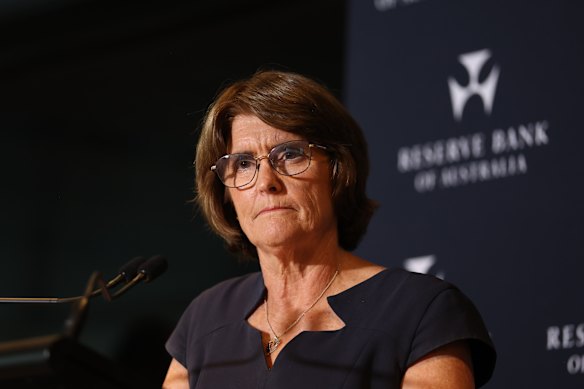
The Reserve Bank has lifted interest rates as insurance against an inflation breakout from the Iran war, while warning higher oil prices risk pushing the economy to the brink of a per-person recession.
On Tuesday, the RBA hiked the cash rate for the third consecutive time this year from 4.1 per cent to 4.35 per cent, taking it to the highest level in nearly 18 months. That adds nearly $100 in monthly repayments to an average $600,000 mortgage.
The bank pushed down its expectations for the country’s economic growth. In February, it was expecting GDP growth to come in at 2.1 per cent in the three months to June, falling to 1.6 per cent by the middle of 2027. In its latest forecasts, the Australian economy grows at 1.9 per cent in the June quarter, dropping to 1.3 per cent by the end of the year.
That means accounting for population growth, the Australian economy may barely grow in per-person terms in coming years.
The bank also sees quarterly inflation hitting 4.8 per cent within weeks as the effect of the Iran war on fuel prices flows through to broader prices relatively quickly.
“The large recent increase in energy prices is already adding directly to headline inflation through higher prices for retail fuel,” the bank said in its latest statement on monetary policy, noting the pass-through of cost increases to prices would occur relatively quickly given inflation – and inflation expectations – are already high and the labour market is tight.
While unemployment has hovered near record lows in recent years, tens of thousands of Australians could lose their jobs in the next two years. The RBA forecasts the unemployment rate to rise from 4.3 per cent in April to 4.4 per cent by the middle of next year and 4.7 per cent by the middle of 2028.
While inflationary pressures are set to spike this year, the bank expects headline inflation to fall from 4 per cent at the end of this year to 2.4 per cent by mid-2027. Trimmed mean inflation – which is the Reserve Bank’s preferred gauge of inflation, stripping out the impact of the biggest price movements – also falls gradually from the middle of this year, sliding back to the middle of the bank’s target range of 2 to 3 per cent by the end of next year.
Dwelling investment is also forecast to drop off, falling from 3.8 per cent in the June quarter this year to 1 per cent by the middle of next year, and slipping into reverse by the end of 2027. During the June quarter of 2028, the bank expects dwelling investment to fall 1.1 per cent.
While both household and business sentiment have dropped off substantially, the bank noted these measures do not tend to materially affect household spending or business investment.
More to come.
Cut through the noise of federal politics with news, views and expert analysis. Subscribers can sign up to our weekly Inside Politics newsletter.
 Shane Wright is a senior economics correspondent for The Sydney Morning Herald and The Age.Connect via X or email.
 Millie Muroi is the economics writer at The Sydney Morning Herald and The Age. She was formerly an economics correspondent based in Canberra’s Press Gallery and the banking writer based in Sydney.Connect via X or email.
From our partners
Disclaimer : This story is auto aggregated by a computer programme and has not been created or edited by DOWNTHENEWS. Publisher: www.smh.com.au


