- Global tech layoffs offer India a chance to retain talent.
- Companies shift budgets to AI, leading to workforce reductions.
- India’s tech ecosystem and large market offer unique advantages.
- Swift action by entrepreneurs, investors, and government is crucial.
Global technology companies are cutting jobs at the fastest rate since the pandemic. However, this crisis could be different for India. Instead of losing talent, India could finally manage to keep it. The real question is whether India will simply absorb these workers and move on, or if it will take this moment to create the next generation of world-class Indian companies.
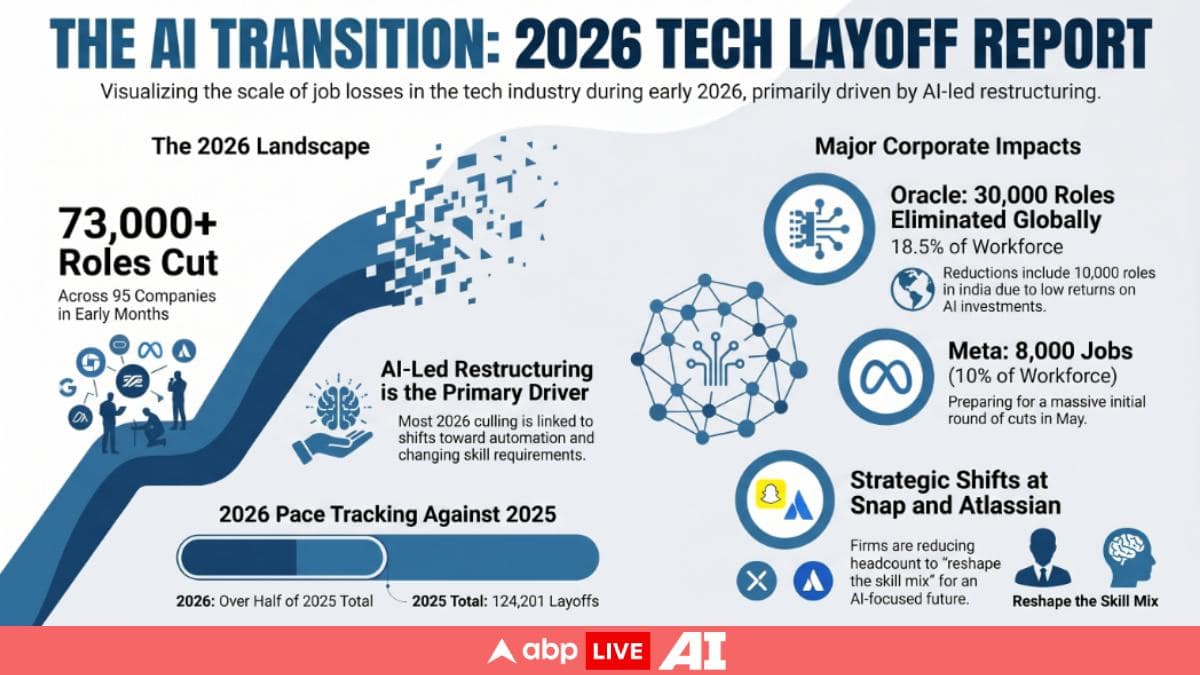
The scale of layoffs underlines the shift. More than 73,000 tech workers were laid off globally in the first quarter of 2026 alone, according to industry trackers. Companies such as Oracle have cut around 12,000 roles, while Meta and Google continue to trim teams as part of cost restructuring and AI-focused investments.
What appears to be a disaster in the West might actually be India’s biggest opportunity in decades.
For forty years, India has watched its best engineers leave. They built Silicon Valley. They created Facebook and Google. They designed the systems that power the world’s internet. Unfortunately, India received little in return. The money, credit, and global companies all remained overseas
This time, it doesn’t have to be that way.
ALSO READ: Oracle Layoffs Explained: How A $300 Billion OpenAI Deal Led To Job Cuts In India
Why This Is Not Just About AI
People often claim that artificial intelligence (AI) is replacing jobs, but that is not what is happening here. “Companies are shifting budgets toward AI investments at the expense of jobs,” Andy Challenger, workplace expert and chief revenue officer at career services firm Challenger, Gray & Christmas, told Forbes. “The actual replacing of roles can be seen in technology companies, where AI can replace coding functions. Other industries are testing the limits of this new technology, and while it can’t replace jobs completely, it is costing jobs.”
As a matter of fact, as per Challenger, 30,000 layoffs have been blamed on AI so far in 2026, in contrast with 55,000 cuts in the previous year.
According to the research firm Forrester, only 6 per cent of jobs will be fully automated by 2030. As per Boston Consulting Group, 50-55 per cent of jobs will be “reshaped” by AI, not replaced.
What companies are actually doing is cutting costs and directing money towards AI. They are letting go of middle managers and senior engineers to save money, not because machines can do their jobs. The workers being cut have significant experience: engineers with 15 years in the field, product managers who built apps for millions of users, and architects who have designed major tech systems.
For the first time, many of these workers are seeking jobs in India. They are not doing this because India was their last choice. Rather, it is starting to look like a viable option.
Why India Can Actually Do This Now
India has three key advantages today that it didn’t have ten years ago.
Advantage I: India’s Serious About Tech
India’s major companies are now serious about technology. Jio has transformed how millions of Indians access the internet. Tata, Mahindra, Adani, and Airtel have all created large tech teams.
When one of these firms hires a senior engineer, it doesn’t start from scratch. It presents a real problem to solve, real budgets, and millions of customers. A small team at Jio can reach tens of millions of people within weeks. This is an advantage that startups usually take years to develop. Indian companies haven’t had this level of deep tech talent before, but they do now.
Advantage II: A Growing Ecosystem
India’s startup ecosystem has become more substantial. Bengaluru, Delhi, and Hyderabad now have effective venture capital, experienced founders who have already built and sold billion-rupee companies, and enough success stories to attract funding without needing to hail from Silicon Valley.
When a seasoned engineering team starts a company in India, investors take them seriously in a way they didn’t before.
Advantage III: A Mega Deployment Economy
India’s market serves as an advantage. With 750 million people using the internet, creating apps for Indian customers, whether for banking, health, or cloud services, represents a massive opportunity. A massive deployment market, if you will.
Moreover, India’s government regulations on technology often outpace those in the West, giving Indian companies an edge.
What India Needs To Do

The true test is whether Indian business leaders and the government will act swiftly enough. Three actions are necessary:
For entrepreneurs: Stop creating companies just to sell them to foreign firms. The next TCS, the next Infosys, the next global Indian tech company will be founded by individuals looking to develop for the world from India, not those expecting to be bought. The talent is available. The market demands it. Investment funds are there.
For investors: Fund teams that include laid-off engineers and product managers. A small founding group with two ex-Google engineers, one ex-Meta product manager, and capable local engineers is not a risky startup anymore. It is a company that understands how to operate, has built real products, and possesses the funds to act quickly. Investors need to recognise this.
For the government: The window of opportunity is one to two months. After that, these workers will find jobs elsewhere, and the moment will pass. India must act now on three fronts: provide tax breaks for returning engineers investing in new firms, issue work visas for foreign team members these Indian leaders wish to hire, and streamline regulatory approval for fintech, healthcare, and AI companies where India already has established rules. The government has to move more quickly than usual. Every week matters.
India Has Done This Before
In the 1990s and 2000s, Indian outsourcing firms didn’t wait for permission. They hired people, established offices, invested in training, and captured global attention. Infosys, TCS, and Wipro didn’t ask if they could compete with the West. They simply got to work.
After all, Infosys founder NR Narayana Murthy did say, “The Indian entrepreneurship scene today is a lot better than what it was in 2000, which was better than what it was in the ’80s and ’90s.” That spirit is needed now, more than ever. But this time, India is not just providing services. It is creating world-class products.
What Is At Stake
If India can capture some of this talent and utilise it effectively, significant changes will occur. India will stop being a country that sends engineers abroad and transform into one that produces things the world uses. The next $10-billion Indian tech company will be built with Indian money, by Indian people, fueled by Indian ambition.
If India misses this opportunity, this talent will migrate to other nations and develop products for them. They will strengthen the technology ecosystems in the United States, Singapore, the Gulf, and increasingly, China.
Meanwhile, India will witness a generation of experienced engineers and product leaders advancing global innovation everywhere but in India. The real risk is not just brain drain. It is allowing China to solidify its rising influence in the software sector while India remains a mere supplier of talent instead of a creator of platforms.
For the first time, everything India requires to establish a global tech giant is within reach. The question is whether India will seize the opportunity.
Related Video
BREAKING NOW: Indore fire tragedy as EV short circuit triggers deadly explosions
Disclaimer : This story is auto aggregated by a computer programme and has not been created or edited by DOWNTHENEWS. Publisher: abplive.com