
Updated ,first published
THEATRE
84 CHARING CROSS ROAD
Ensemble Theatre, May 6
Until June 13
Reviewed by JOHN SHAND
★★★★
Given the depravity, cruelty, hatefulness, bullying, vulgarity and duplicity that fill our news cycle, how refreshing it is to encounter an affirmation of humanity’s better side. It turns out we’re not inherently such an appalling species: we just seem to default to behaving that way.
Helene Hanff’s 1970 epistolary memoir, from which James Roose-Evans adapted this play, is a love affair of sorts, but, more than a veiled flirtation between two people who never meet, it’s a shared love of books and the words within them – a passion that currently recedes each day.
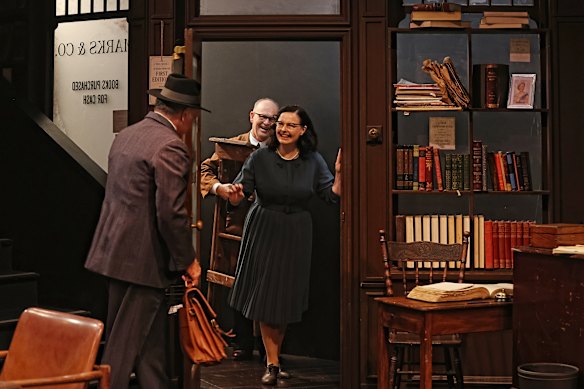
Mark Kilmurry’s production is so warm and cosy you could almost toast marshmallows on it, were you seated in the front row. Blazey Best plays Helene, the feisty, plain-speaking New York writer, who discovers buying the antiquarian books she craves is much easier and cheaper from Marks & Co of London than from her own city’s establishments.
The play exists exclusively in letters, nearly all of which Helene exchanges with Marks & Co’s Frank Doel, a polite, gentle soul with profound knowledge of his trade. Erik Thomson plays Frank, and the natural benignity of his face speaks volumes about the character, who tolerates Helene’s teasing with eternal good humour; who actually finds it rather gratifying not to be taken too seriously, given the shortages, greyness and stuffiness of post-World War II England.
Their correspondence spans 20 years, and as he slides from signing off his letters with “yours faithfully” to “love”, there’s the slightest frisson that Frank, married with two children, quietly longs for Helene to visit, being enchanted by the freedom with which this autodidact attacks life itself – as well as John Donne, Leigh Hunt and the rest. A vague, wispy sadness therefore clouds the play, but it’s not the main event.
Best is brash, loud and amusing. If she occasionally comes close to overcooking Helene, it’s crucial the contrast between the two cultures be as stark as possible, while the two individuals are united by books.
Although we never learn of Frank’s tastes, he’s across any author Helen requests, however arcane, and, besides, he’d never dream of showing off his knowledge. Helene’s banter about the classicists, meanwhile, oozes enthusiasm and wide-eyed curiosity.
It’s difficult to imagine a better Frank than Thomson, who understates his compassion, stoicism and good humour, as well as gratitude for Helene’s many kindnesses, which are shared with his bookshop colleagues, played by Katie Fitchett, Brian Meegan and Angela Mahlatjie (the latter with particular panache).
Nick Fry’s set embeds Helene’s backstairs apartment within the old shop’s high-rise shelves of leather-bound books, and his costumes could almost speak the lines without an actor inhabiting them.
This is art of such infinitely gentle charm, muted drama and mellow comedy as now might seem slight or unfashionable, yet it’s the perfect antidote to the world around us.
MUSIC
Symphonic Cinema: The Planets
Sydney Symphony Orchestra
Sydney Opera House, May 1
Reviewed by PETER McCALLUM
★★★½
The role of music in cinema is usually to intensify salient moments and establish a mood (a single chord can tell you whether a scene is going to be tender or terrifying).
Symphonic Cinema, founded by Lucas Van Woerkum, broadly reverses that process, by backfilling an existing symphonic work with images and a wordless narrative, synchronised to a live performance by digital technology.
Van Woerkum’s Loss, receiving its first performance from the SSO under Benjamin Northey, overlaid Holst’s orchestral suite, The Planets with breathtaking images of cliffs, birds and the sea, dance sequences from Arts Umbrella Vancouver, and a wordless narrative of loss and grief enacted by cinematic stars Emma Thompson and Greg Wise.
For some listeners (novelist EM Forster put himself in this category), music is always a background to other thoughts, and the beautiful scenery and Thompson’s and Wise’s sensitive performances may provide a sympathetic stimulus and enrichment to their own imaginings.
For others, great musical works spin their own compelling, uniquely musical narrative, and such images and stories are at best extraneous and at worst distracting. Although the images were beautiful and the story discerningly performed, I found the film and music sat awkwardly with one another, each evoking different types of emotionalism.
In the opening movement, Mars: the Bringer of War, dancers writhed in the earth, abstract shapes mutated and, at the climax, Thompson, nervous and uncertain, was joined in a procession by dancers hooded like an angel of death. In Venus, the Bringer of Peace, Thompson walked through an artist’s studio perched vertiginously on shoreline cliffs, conveying alienation from her own space.
Later movements became a little more explicit but spoilers are best avoided. Northey and the SSO projected the bellicose rhythms of Mars with weight and heft. The slower music had transparent clarity, nowhere was it unduly rushed. The closing texture of Neptune, the Mystic, sung by the women of Sydney Philharmonia Choirs from the northern galleries, receded ethereally into the infinite.
The concert also began by peering into the infinite with Charles Ives’s searching short piece, The Unanswered Question. Then came a grippingly energised performance by SSO percussionist Rebecca Lagos of Nigel Westlake’s percussion concerto When the Clock Strikes Me, reshaped from its original 2006 version.
Framed within clock-like ticking figurations, and combining a fast-slow-fast structure into a continuous movement, the work’s trajectory is reminiscent of one of those magical trips by a child into a dream world where things rapidly become wild and exaggerated, and the line between vivid reality and impossible fantasy blurs.
In Lagos’s immensely capable hands, it was not only a brilliant tour-de-force. With fluid ease of limb and wrist, minute precision, and innately musical rhythmic sense, she darted, Ariel-like, around an intimidating array of instruments, drawing listeners into Westlake’s hypnotic world of constantly mutating rhythmic organisms until the dream suddenly ended with a rushing final clap.
MUSIC
Deftones
Qudos Bank Arena, May 2
Reviewed by ROD YATES
★★★★
Sacramento’s Deftones are one of the most gleefully enigmatic heavy music bands of all time.
Their 1995 debut album, Adrenaline, has long had them regarded as forefathers of nu metal, even as they’ve progressively moved away from that sound into one that is uniquely their own.
They are a metal band for whom Depeche Mode and The Cure are as influential as Black Sabbath.
A group that, more than three decades into their career, are a bigger live draw now than ever, as evidenced by this, the first of two Sydney arena shows.
They are also one of the rare acts that has brought the mainstream to them, rather than cater their sound to it.
On this night, that is evident not only in the way they traverse material from eight of their 10 studio albums – no sticking to the greatest hits here – but also in the fact the audience is equally engaged throughout.
The musical eras veer from the primitively heavy aggression of closer 7 Words (the sole representative from their debut album) to the cinematically atmospheric Change (In the House of Flies); from the groove-laden Swerve City to the discordantly melodic opener Be Quiet and Drive (Far Away).
Sensual might be a strange adjective to use for a band that delights in primordially heavy riffing, yet it’s oddly fitting.
On a surface level, we can thank the ethereal video projections that add a sense of Lynchian noir to proceedings.
But it’s deeper than that.
It’s in the soundscapes carved out by keyboardist/turntablist Frank Delgado and touring guitarists Shaun Lopez and Lance Jackman (deputising for Stephen Carpenter, who no longer tours outside of America).
It’s also due to 52-year-old frontman Chino Moreno, a whirlwind of perpetual energy and one of metal’s most distinctive voices – haunting and melodic in Mascara and Digital Bath, suitably intense in My Own Summer (Shove It) and Around the Fur.
Concluding the pre-encore set with the similar-paced Genesis and Departing the Body creates a rare lapse in momentum, but it’s a rare misstep from one of metal’s most intriguing acts.
MUSIC
Jessica Mauboy – The Story of Me: A Musical Journey Through My Career
City Recital Hall, May 1
Reviewed by NICOLE ECONOMOS
★★★★
In the two decades since her Australian Idol audition, Jessica Mauboy has established herself as one of our most celebrated contemporary artists both here and on the international stage.
So it’s hard to credit the Kuku Yalanji woman’s need still to “fight for [creative] control” in recent years. So, too, were the “nerves” mentioned, but well concealed, during the minimalist set.
After going independent last year, there’s renewed vigour, vulnerability and authenticity on display as Mauboy blends witty and intimate storytelling with a commanding stage presence and vocal delivery.
A spellbinding opening set from Gumbaynggirr and Bundjalung woman Jem Cassar-Daley and an emotive Welcome to Country from Gadigal performer Nana Miss Koori set the tone for an evening celebrating identity, community, growth, family and liberation.
Mauboy spent the first hour reminiscing on her teen years, weaving tales and short renditions of the classics that defined her journey from discovery in Darwin to stardom. There was a soulful version of Trisha Yearwood’s How Do I Live and a soaring cover of Shania Twain’s From This Moment On, a breakthrough track at the Tamworth Country Music Festival.
Mauboy was most at home in the latter hour, when she performed her own material. Where the stories veered into unrestrained territory, the impact of being labelled “jelly belly” on Idol and her mother’s defiant shoe-throwing at a manager, the vocal control remained precise. There was a guitar-led Burn, the crowd-pleasing Pop a Bottle, a soulful version of Running Back and her anthemic Eurovision entry We Got Love, showcasing her slick vocal runs and an uninhibited energy that was matched by the audience’s dancing.
Mauboy closed with a showcase for her voice – a bewitching Glow, the profound ballad Little Things, and the uplifting, pertinent Give You Love – leaving little doubt that her legion of fans is ready to embrace the new liberated terms and light Mauboy has stepped into.
 Nicole Economos is a Social Media Producer/Journalist for The Sydney Morning Herald and The Age.Connect via email.
 John Shand has written about music and theatre since 1981 in more than 30 publications, including for Fairfax Media since 1993. He is also a playwright, author, poet, librettist, drummer and winner of the 2017 Walkley Arts Journalism AwardConnect via X.
From our partners
Disclaimer : This story is auto aggregated by a computer programme and has not been created or edited by DOWNTHENEWS. Publisher: www.smh.com.au


