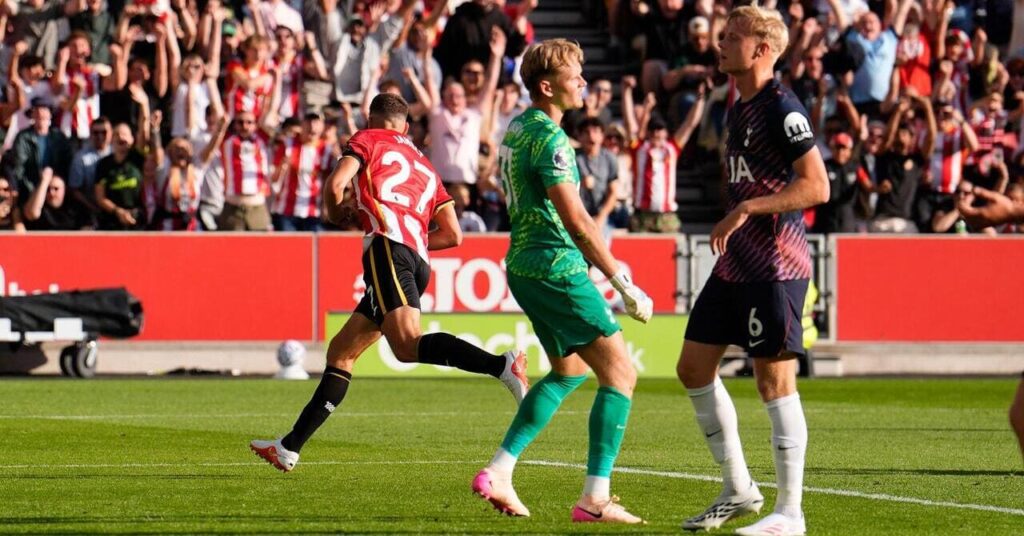
Tottenham are bottom of the Premier League after five matches. They have not won a game while scoring only twice, conceding eight times and collecting two points.
It is the club’s worst start to a Premier League season after five games, surpassing the 2008-09 campaign when they also had two points but a slightly better goal difference of -3.
They have also lost 22 home league matches since the beginning of 2024-25, only one fewer than they had suffered across the previous four seasons combined.
Yet the league table only tells part of the story.
Across their first five league games, Spurs have taken 71 shots, with 19 on target, while averaging 60.4% possession. Their 4.47 expected goals is more than twice the two goals they have actually scored. At the other end, they have conceded eight goals from 9.22 expected goals against.
The attacking output remains poor. An average of 0.89 xG per game is nowhere near the level expected from a side who spent more than £300 million rebuilding their squad in the summer.
The numbers do show a team capable of getting into useful positions.
The first match, a 3-0 defeat at Brentford, was poor. Spurs managed only nine shots and generated just 0.47 xG, while Brentford produced 25 shots and more than four times as much expected goal value.
The next three league games produced more encouraging attacking numbers.
Against Newcastle, Spurs lost 2-0 despite having 17 shots and six on target. They had 57.5% possession and created 1.05 xG. At Nottingham Forest, they had almost 60% possession and 11 attempts but failed to put a single shot on target.
Against Everton, they had 62.3% possession, 14 shots and 37 touches inside the opposition box. They did not score. Then came Aston Villa.
Tottenham lost 3-2, but had 20 shots and seven on target, controlled 63.8% of possession and won 11 corners.
The problem is conversion. Tottenham’s first Premier League goal did not arrive until their 67th shot of the campaign, when Conor Gallagher finally scored against Villa.
It ended a 492-minute drought dating back to Joao Palhinha’s strike against Everton on the final day of last season.
That is a serious attacking issue, although it is one that can change quickly with better finishing, a settled front line and the integration of new players.
- Position 1, 2, 3, 4 : Promotion – Champions League (League phase)
- Position 5 : Promotion – Europa League (League phase)
- Position 18, 19, 20 : Relegation – Championship
Rebuilds require time
The scale of Tottenham’s summer overhaul is the main focus of any assessment of their start.
More than £300 million was spent, with Sandro Tonali, Mateus Fernandes, Jan Paul van Hecke, Marcos Senesi, Andy Robertson, Savio and Omar Marmoush among the arrivals.
Savio and Marmoush were signed after the opening-day defeat at Brentford, so two of the most significant attacking additions were not available for the first fixture.
The defensive unit changed too. Robertson, Senesi and Van Hecke arrived while Cristian Romero, Djed Spence and Guglielmo Vicario departed. Antonin Kinsky became the first-choice goalkeeper.
This was a fundamental change of direction rather than a routine transfer window, which usually consists of adding weapons to an already existing firing squad.
De Zerbi admitted as much after the opening-day defeat at Brentford when he said: “We are not a team yet.” Four new defenders had started that game and the squad was still being assembled at the time.
Opta’s analysis of the first four matches found that Spurs had made 12 changes to their starting XI from game to game, more than they had ever made in the opening four matches of a Premier League season.
They were also the 12th non-promoted side in Premier League history to give 20 or more starts in their first four matches to players who had not played for the club the previous season.
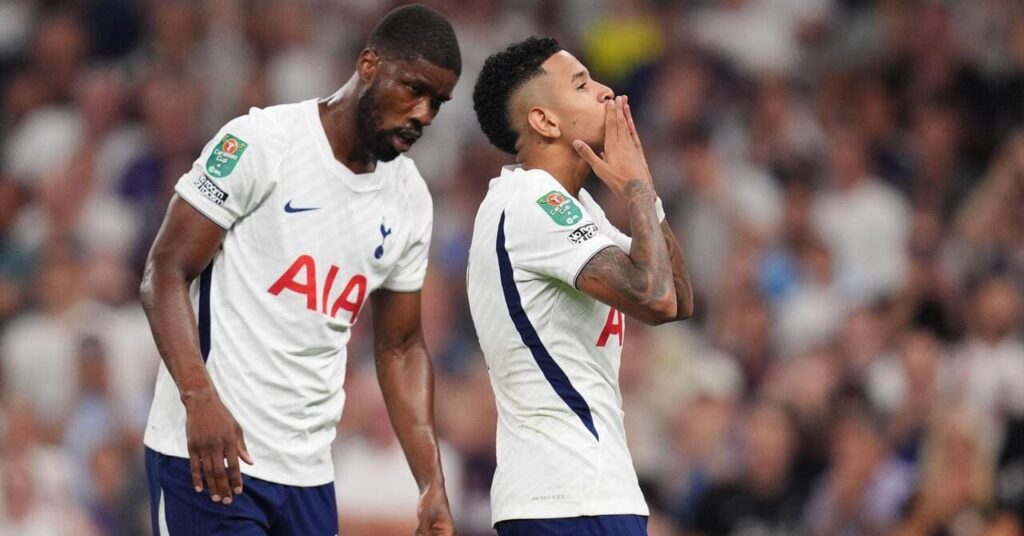
Of the previous 11, only five improved their league position from one season to the next.
That record does not guarantee Spurs will improve. It does illustrate how unusual their opening weeks have been.
There is another reason to expect the side to look different later in the season: last year’s Tottenham attack was already short of the required standard.
Spurs scored only 48 Premier League goals in 2025-26, their lowest total over the previous four seasons, while finishing with a -9 goal difference.
Set pieces carried a huge portion of the attacking workload. 36.9% of Tottenham’s expected goals and 39.6% of their actual goals came from set plays, the highest proportions in the league.
That route has been reduced by the departures of players such as Palhinha and Romero. The new Tottenham is designed to create more through controlled possession and positional play instead of relying so heavily on dead-ball situations.
De Zerbi’s record at Brighton provides some evidence for what Tottenham are attempting to build.
From his first Premier League game in charge in October 2022, Brighton averaged 1.97 non-penalty expected goals per game, the best figure in the division over that period at the time.
His first full season ended with Brighton finishing sixth, scoring 72 goals and collecting 62 points, all club records at the time.
There were obvious risks in his approach. Brighton regularly invited pressure in their own half before trying to play through it. Over almost two seasons under De Zerbi, only three Premier League teams had more high turnovers than Brighton, while only two had conceded more high turnovers that led to an opposition shot.
That risk has appeared at Tottenham as well. The difference is that De Zerbi now has a group recruited specifically to execute his ideas.
Patterns from last season
De Zerbi is not starting from zero at Tottenham. He already had seven Premier League matches in charge at the end of last season.
That spell produced three wins, two draws and two defeats. He collected 11 points and kept Spurs in the Premier League on the final day with a 1-0 win over Everton.
So far this term, De Zerbi has taken two points from five league games, leaving questions over whether his methods are translating quickly enough into results.
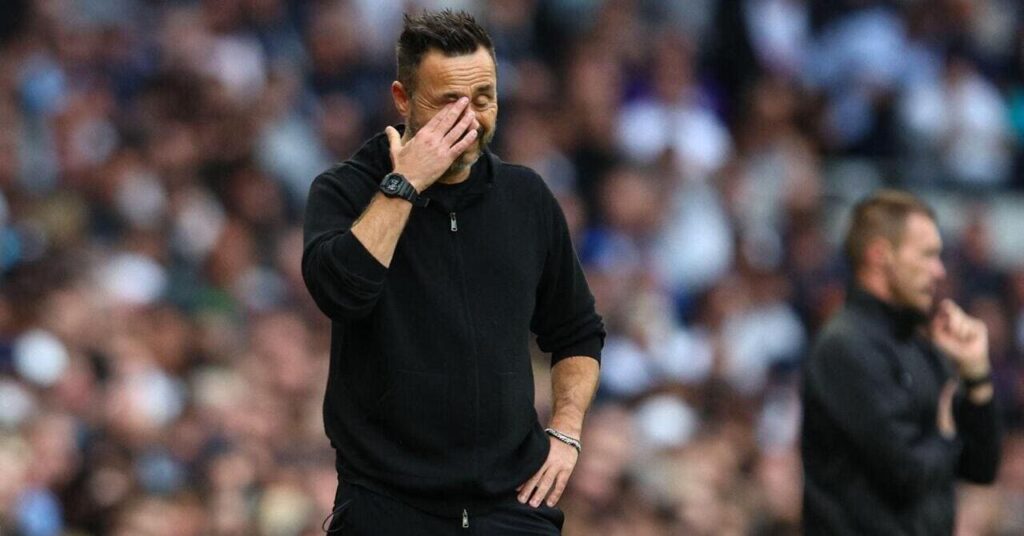
He has had a full pre-season, substantial financial backing and a squad strengthened around his tactical preferences. Spurs remain vulnerable when matches become chaotic and have struggled to convert long periods of possession into goals.
Tottenham’s first four league matches produced just 2.22 xG from open play, the lowest figure in the Premier League at that stage. Their set-piece xG stood at only 1.22, also among the lowest figures in the division.
That means the argument cannot simply be that Spurs have been unlucky in front of goal.
There are signs of a side that is still becoming familiar with the new system. James Maddison is an important example.
Maddison only returned to team training shortly before the Aston Villa game after a lengthy absence and had played just 15 minutes against Liverpool in the Carabao Cup.
His return is relevant because Tottenham have been short of creativity in central areas. A fit Maddison gives De Zerbi another player capable of dictating the tempo and finding passes between the lines.
Tottenham’s next five games will reveal all
The international break gives De Zerbi another period to work with the squad.
Tottenham will not play another Premier League fixture until October 10, when they travel to Manchester United. They then face Coventry City at home, Chelsea away, Crystal Palace at home and Leeds United away before November.
There is little margin for more bad results, but there is time for the team to settle.

Savio has already started four of Spurs’ five league matches. Marmoush has played regularly. Tonali has become a central figure in midfield. Maddison is back in the group. Mohammed Kudus is finally fit again.
Spurs are creating more territory than their position suggests, averaging 60.4% possession and 14.2 shots per game across the opening five matches. They took 37 touches inside the Everton box and produced 20 shots against Villa. Their 4.47 xG is not remotely compatible with only two goals unless the finishing and final ball are major problems.
The defensive figures are less alarming than the scoreline either. Eight goals conceded from 9.22 xGA suggests Spurs have not consistently been overwhelmed by chance quality. Individual errors and lapses have proved expensive.
Five matches is also a tiny sample when compared with an entire season. Tottenham themselves provide a historical reminder. They were bottom of the Premier League after five matches in 2008-09 and eventually finished eighth.
That should not be used as a forecast for De Zerbi’s team, as the circumstances are completely different. It does show how quickly an early table can change.
The more relevant question is whether Tottenham’s current squad possesses the ingredients for a substantial improvement.
The attack needs to become far more productive. Two goals from 71 shots cannot continue. The defence has to cut out cheap mistakes. De Zerbi also has to demonstrate that his possession-heavy style can survive the Premier League’s physical demands.
Disclaimer : This story is auto aggregated by a computer programme and has not been created or edited by DOWNTHENEWS. Publisher: 101greatgoals.com