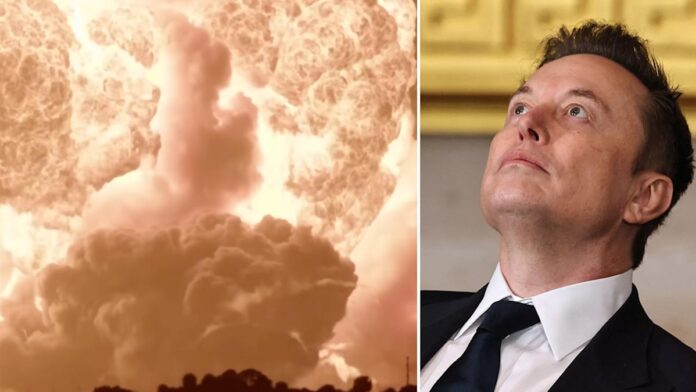
When Jeff Bezos’ New Glenn rocket erupted into a fireball on a Cape Canaveral launch pad late on May 28, the reaction that traveled fastest came from his chief rival.
“Most unfortunate. Rockets are hard,” Elon Musk wrote on X. (1)
Must Read
It was rare solidarity between two billionaires who’ve spent a decade trading jabs over space. And it came as Musk’s SpaceX sits days from what could be the largest IPO in history, while Blue Origin stares down months on the ground.
What caused the Blue Origin New Glenn explosion
Footage from Spaceflight Now shows Blue Origin’s New Glenn rocket exploding during a hot-fire test. Fully fueled, the engines were ignited while the vehicle stayed bolted to the pad, causing one of the largest rocket explosions in US history ahead of a launch planned for the following week. (2)
Residents along Florida’s Space Coast reported feeling their homes shake, and Blue Origin later warned debris could wash ashore on local beaches. No one was hurt, but Launch Complex 36, Blue Origin’s only operational New Glenn pad, sustained heavy damage. (3)
“All personnel are accounted for and safe,” Bezos wrote on X. “It’s too early to know the root cause but we’re already working to find it. Very rough day, but we’ll rebuild whatever needs rebuilding and get back to flying. It’s worth it.” (4)
Musk replied underneath: “Ad astra per aspera” — through hardships to the stars. (4)
New Glenn’s second failure in six weeks
The explosion was Blue Origin’s second New Glenn setback in roughly six weeks. On April 19, during the rocket’s third flight, the first-stage booster landed successfully on a sea-based platform. But the upper stage malfunctioned and failed to deliver AST SpaceMobile’s BlueBird 7 satellite to a usable orbit — a total loss. (2) The FAA opened a mishap investigation, and its grounding had been lifted only about a week before the pad explosion. (5)
The destroyed rocket was meant to fly New Glenn’s fourth mission, carrying 48 satellites for Amazon Leo (formerly Project Kuiper), the broadband constellation Amazon (NASDAQ:AMZN) is building to rival Starlink. (2) It was the first of 24 launches Amazon had booked with Blue Origin.
Amazon’s FCC license requires it to deploy half its roughly 3,200-satellite constellation, about 1,618 satellites, by July 30, 2026, or risk losing its authorization. (6) With only around 230 in orbit, Amazon was already far behind and has asked the FCC for a two-year extension, which analysts widely expect to be granted.
Amazon downplayed the hit. It said New Glenn accounts for about 25% of its more than 100 booked launches, and that four other rockets remain on its manifest. The night after the explosion, a United Launch Alliance Atlas V carried another batch of Amazon Leo satellites to orbit from a pad near the blast site. (3)
New Glenn is also tied to NASA’s Artemis program. Blue Origin holds a $3.4 billion contract to build a crewed lunar lander, and on May 27, it won a $188 million award, part of nearly $1 billion NASA split among four companies, to deliver rovers to the moon as early infrastructure for a permanent lunar base. (5)
SpaceX’s $1.8 trillion IPO is going the other way
While Blue Origin reckons with months of investigations, Musk’s SpaceX is accelerating toward the public markets. Bloomberg reported the company had trimmed its target to a floor of at least $1.8 trillion after talks with investors. Musk shot the report down on X as “false,” insisting SpaceX is still aiming above $2 trillion. (7)
Either figure would make SpaceX’s planned raise of up to $75 billion the largest IPO ever, with a roadshow expected in early June ahead of a Nasdaq debut under the ticker SPCX.
The financials are messier than the valuation suggests. Revenue rose to $18.7 billion in 2025 from about $14 billion, but the company swung to a $4.94 billion loss after a 2024 profit. (8)
It helps to think of SpaceX as several companies stapled together. Starlink is the telecom division and the engine; its connectivity segment booked $11.4 billion in 2025, about 61% of total revenue, and it throws off the cash that funds everything else. (9)
The launch business added roughly $4 billion, much of it from Pentagon and NASA contracts. (9)
Then there’s xAI, the AI company SpaceX absorbed in a February merger that folded in Grok and the X platform. The AI segment lost more than $6 billion in 2025, the swing that pulled the whole company into the red. (8)
Even Starlink’s growth has a catch. Subscribers have roughly doubled every year, topping 10 million by March 2026, but average revenue per user has fallen three years running, from $99 a month in 2023 to $66 by early 2026, as Starlink cuts prices and pushes into cheaper overseas markets. (9) Volume is outrunning the per-user decline for now. Investors are being asked to price a profitable telecom business carrying a money-losing AI bet.
Space stocks sell off after the explosion
Investors had bid up anything with “space exposure” for weeks ahead of the SpaceX listing. The Blue Origin explosion stopped the rally cold.
The hardest hit was AST SpaceMobile (NASDAQ:ASTS), the satellite-to-phone company whose payload was lost in April. Its shares fell as much as 18% intraday. (10) Rocket Lab (NASDAQ:RKLB) slid more than 6%, while Planet Labs (NYSE:PL), Intuitive Machines (NASDAQ:LUNR) and Voyager Technologies (NYSE:VOYG) each dropped more than 5%. The Procure Space ETF (UFO), up more than 100% over the past year, was on pace for its worst session of the year. (10)
The exception was Virgin Galactic (NYSE:SPCE), which closed up roughly 40%. (11) That rally ran mostly on its own catalysts: a VSS Unity glide flight on May 27 that marked its return to flight after a two-year pause, and reopened ticket sales. The Blue Origin setback added fuel, with traders betting a pause in New Shepard tourism could push customers toward Virgin’s manifest.
The sell-off showed how tightly these names trade together. But rivals can’t simply absorb New Glenn’s lost capacity, because most of them don’t fly in its class. New Glenn is a heavy-lift rocket, hauling about 45 tons to low Earth orbit through a 23-foot fairing.
Rocket Lab’s upcoming Neutron is a medium-lift vehicle in the 13-ton range, a Falcon 9 competitor, not a New Glenn one. And it isn’t expected to fly until late 2026 at the earliest, after a propellant-tank rupture in testing in January. (12) For heavy-lift work, only SpaceX has capacity ready to fly today.
You May Also Like
Join 250,000+ readers and get Moneywise’s best stories and exclusive interviews first — clear insights curated and delivered weekly. Subscribe now.
Article Sources
We rely only on vetted sources and credible third-party reporting. For details, see our ethics and guidelines.
X (1), (4); CNN (2); CNBC (3); NBC News (5); SpaceNews (6), (7); Bloomberg (8); Yahoo Finance (9), (10), (11); Satellite Today (12)
This article originally appeared on Moneywise.com under the title: ‘Rockets are hard’: Elon Musk responds to Jeff Bezos’ rocket explosion as his own SpaceX glides to a $1.8T IPO
This article provides information only and should not be construed as advice. It is provided without warranty of any kind.
Disclaimer : This story is auto aggregated by a computer programme and has not been created or edited by DOWNTHENEWS. Publisher: finance.yahoo.com