Now, it’s the last day of the electoral campaign in Serbia today ahead of this Sunday’s closely contested parliamentary election.
6.5 million voters go to the polls on 25 October in a watershed race characterised by civil unrest, a new political landscape, allegations of irregularities, an uncertain outcome and the potential of far-reaching consequences.
Jon Henley has this explainer for you:
“Two events frame this election. The first was the collapse of the Novi Sad railway station canopy in November 2024, which killed 16 people and uncovered massive government and institutional corruption, setting off two years of anti-government protests.
The second was the hero’s funeral accorded to the Serbian general Ratko Mladić, the “Butcher of Bosnia”, who was convicted of orchestrating Europe’s worst massacre since the second world war but buried with military honours in Belgrade last month.
Amid international outrage but intense Serb nationalist pride, the increasingly authoritarian president, Aleksandar Vučić, who has dominated Serbia’s politics for 14 years, resigned to lead his ruling Serbian Progressive party (SNS) list in an attempt to become prime minister.
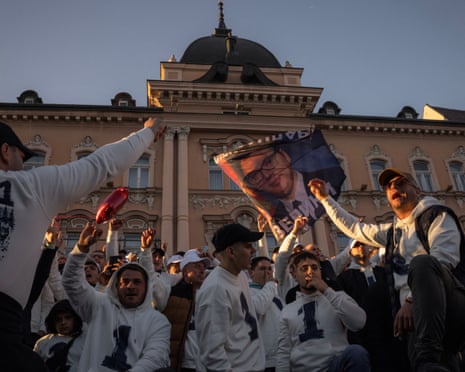
Against him is the Student List, a grassroots, decentralised, student-led coalition that has evolved from a spontaneous protest movement after the Novi Sad disaster into a serious parliamentary challenger offering a clear alternative to the traditional parties.
It matters because Serbia is an EU-candidate country that continues to balance ties with the west, Russia and China. Media bias, voter intimidation and electoral list irregularities mean any result could be contested, prompting mass protests and exacerbating regional instability.”
And, on that note, we will be closing the blog for today.
Make sure to join us on Sunday night for our live blog covering the Serbian parliamentary election as strongman Aleksandar Vučić faces the biggest test of his 12 years of increasingly authoritarian rule in the country (16:54).
Here is your summary of today’s events:
-
It’s the last day of the electoral campaign in Serbia today ahead of this Sunday’s closely contested parliamentary election characterised by civil unrest, a new political landscape, allegations of irregularities, an uncertain outcome and the potential of far-reaching consequences (16:10, 16:20, 16:27, 16:35, 16:40, 16:44).
Elsewhere,
-
French president Emmanuel Macron has condemned “ultra left” for “seditious acts … aiming to bring down the Republic,” after consulting with intelligence and security authorities ahead of more protests planned this weekend (12:30).
-
Macron said the government would ban demonstrations not organised by trade unions as it seeks to contain the civil unrest that rocked the country in recent weeks (11:33, 11:47, 12:34).
-
But first attempts to block some demonstrations already face legal challenges as more protesters took to the streets today (15:53).
Meanwhile,
-
A Ukrainian national has been arrested in Germany on suspicion of spying for Russia, local prosecutors in Karlsruhe announced (13:28).
-
German chancellor Friedrich Merz said he was not surprised by the arrest, as “Germany is a target of intensive espionage activity” all the time (14:02).
If you have any tips, comments or suggestions, email me at jakub.krupa@theguardian.com.
I am also on Bluesky at @jakubkrupa.bsky.social and on X at @jakubkrupa.
We will be live blogging the election night in Serbia on Sunday, so make sure to join us Sunday evening for all the latest including first projections and reactions after the polls close.
Presented by Helen Pidd with Tom Burgis
In the heart of Belgrade, near the banks of the Danube, stands the General Staff building. Built in the 1960s, it embodies the difficult history of Serbia. It was designed to resemble a canyon of the Sutjeska River, where one of the most significant battles of the second world war was fought.
Then suddenly, in November 2024, it was announced that the building was no longer protected from development. Instead, a tower with Donald Trump’s name on it would go up in its place.
Protests and prosecutions followed, as opposition to the plan mounted. Investigations correspondent Tom Burgis tells Helen Pidd:
“This isn’t just about the fate of a building, important though that kind of monument to Serbia’s history is. It’s about what is happening to the world when the US president is open for business.”
The Trump family insist no political favours were sought or received in Serbia and that all they ever wanted to do was transform the site into “a symbol of healing and reconciliation”.
But what does the murky tale of the Trump tower that was never built tell us?
A former central Europe correspondent for the Guardian and the BBC
History may not be about to repeat itself in Serbia, but it is beginning to rhyme.
Just over a quarter of a century ago, Serbian citizens turned out to vote in large numbers to inflict a historic defeat on the then strongman in Belgrade, Slobodan Milošević, who was seeking re-election as president. He lost despite his extensive control over the media, the judiciary and the security forces. When he was reluctant to leave office, Serbs poured on to the streets in their hundreds of thousands, finally forcing him to go.
On Sunday, a new generation could have the decisive voice in an equally fateful election, this time for the national parliament. Today’s strongman, Aleksandar Vučić, recently resigned as president to fight the election with the aim of swapping the locus of power from the presidency to the prime minister’s office.
But Vučić, who has been in almost total control of Serbia for 14 years, finds himself on the back foot for the first time since he assumed power, just as Milošević did in 2000.
Like his close friend, Viktor Orbán, who was decisively beaten in elections earlier this year, Vučić has felt compelled to pull out all the stops to halt the opposition electoral coalition, known as the Student List (SL).
Vučić is throwing the kitchen sink at the campaign to skew the result his way.
If despite all this the Student List emerges victorious at the election, the shock waves will be felt as powerfully across Europe as they were when Orbán was defeated.
in Belgrade
The Student List has rocked Serbia with two years of constant protests. On Sunday, the group will represent the most serious challenge Aleksandar Vučić has faced in his 12 increasingly authoritarian years in power, by putting forward their own candidates in parliamentary elections.
They hope to emulate the defeat of Vučić’s ally, Viktor Orbán, in neighbouring Hungary six months ago, in a domino effect that could bring a democratic resurgence to central Europe.
Opinion polls have varied wildly, but many expert observers say a close race is quite possible, with neither side prepared to accept a loss as a legitimate result, raising the risk of post-election unrest and clashes.
In order to win, the students’ list of 250 candidates would have to break the mould of Serbian politics, along with Vučić’s grip on the country. He stepped down as president last month, five months before the end of his second and last term in office under the constitution, but only with the aim of extending his hold on power as prime minister at the head of his Serbian Progressive party (SNS).
Corruption remains the most frequent single complaint on the doorstep. On the corruption index run by Transparency International, Serbia ranks far worse than any of its neighbours, as the most corrupt country in Europe bar the dictatorships in Belarus and Russia.
There are frequent allegations of links between the SNS and organised crime, and the Student List’s slogan confronts that widespread perception head on, posing the question: “Serbia or Mafia?” The government denies all accusations and officially claims to be tackling organised crime.
The economy has been growing in recent years, but there is a widespread opinion that the fruits are not being fairly distributed. Porsche and Land Rover car showrooms have been established in Krnjača but public spaces look neglected. Some of Belgrade’s trams are more than 50 years old.
Vučić himself shows signs he is taking the political threat seriously enough to throw himself into the campaign, making 129 live television appearances in August, more than four times the previous month’s total.
Previous elections have seen multiple allegations of various forms of rigging, including vote-buying, voter intimidation and ballot box stuffing, so the Student List is planning to deploy an unprecedented number of opposition monitors on Sunday.
One of the curious quirks (to put it, erm, diplomatically) of this year’s election is that Serbian voters overseas are facing major hurdles in casting their ballots in a tight parliamentary election this weekend, as reported by AP.
The authorities decided that the overseas vote will be open in line with the Serbian time zone, forcing voters in Canada or the US to cast their ballots in the middle of the night.
Some 100,000 people have registered to vote abroad this year, up from 39,000 in 2023.
Critics say it’s a deliberate move to discourage voters abroad, who may be less supportive of populist strongman Aleksandar Vučić, but authorities insisted that wasn’t the case, AP said.
Foreign minister Marko Đurić has said on X that the changes were guided “not only by the number of registered voters, but also by logistical, security, spatial, (and) staffing” criteria.
(Side-eye.)
Europe correspondent
Opinion polls in Serbia are conflicting and not especially reliable, and there are significant concerns about electoral integrity, with allegations of state violence against opposition activists and government manipulation of voter registration lists and overseas voting arrangements.
Over the past few months some polls have put SNS ahead, some the Student List, and others have forecast a neck-and-neck race. There is therefore a serious risk that whoever claims a 126-seat majority in the 250-strong parliament, the result will be contested.
Analysts at the European Council on Foreign Relations suggest five main possible scenarios. The SNS could score a convincing victory, with the Student List entering parliament as a strong opposition; or a narrower, contested win, leading to street protests and legal challenges.
The result could be inconclusive, with neither main coalition securing a majority. In that case, smaller traditional parties such as the Socialists could become kingmakers, or the election could be re-run.
The Student List could win a majority, but find the result contested by Vučić and the SNS, again leading to protests and possible violent repression; or it could secure a clear mandate allowing a peaceful transfer of power and setting Serbia on a very different course.
Polling stations open on Sunday at 7am local time and close 8pm, with early independent and unofficial projections expected from about 9pm and preliminary official results from the electoral commission in the early hours of the morning.
Now, it’s the last day of the electoral campaign in Serbia today ahead of this Sunday’s closely contested parliamentary election.
6.5 million voters go to the polls on 25 October in a watershed race characterised by civil unrest, a new political landscape, allegations of irregularities, an uncertain outcome and the potential of far-reaching consequences.
Jon Henley has this explainer for you:
“Two events frame this election. The first was the collapse of the Novi Sad railway station canopy in November 2024, which killed 16 people and uncovered massive government and institutional corruption, setting off two years of anti-government protests.
The second was the hero’s funeral accorded to the Serbian general Ratko Mladić, the “Butcher of Bosnia”, who was convicted of orchestrating Europe’s worst massacre since the second world war but buried with military honours in Belgrade last month.
Amid international outrage but intense Serb nationalist pride, the increasingly authoritarian president, Aleksandar Vučić, who has dominated Serbia’s politics for 14 years, resigned to lead his ruling Serbian Progressive party (SNS) list in an attempt to become prime minister.
Against him is the Student List, a grassroots, decentralised, student-led coalition that has evolved from a spontaneous protest movement after the Novi Sad disaster into a serious parliamentary challenger offering a clear alternative to the traditional parties.
It matters because Serbia is an EU-candidate country that continues to balance ties with the west, Russia and China. Media bias, voter intimidation and electoral list irregularities mean any result could be contested, prompting mass protests and exacerbating regional instability.”
in Paris
Awa, 18, stood in the dock in the tribunal de Paris, a small, mute and bewildered figure seeming unable to understand, let alone answer, the simplest of questions.
The court was told she had joined young people who looted an Yves Saint Laurent store on Boulevard Saint Germain in Paris’s Left Bank late on Sunday and stripped it bare within minutes.
Awa was arrested at a nearby Métro station with a black balaclava and black gloves in her backpack along with four YSL handbags worth a total of €5,000 (£4,200).
In the dock, dressed entirely in black – the clothes she was wearing when arrested two days earlier – she appeared panicked, clutched at her hair, picked her lip. Unable to speak, she covered her face and began to weep; first silently, then uncontrollably, her sobs punctuating an almost palpably painful silence.
Awa was just one of 2,500 people arrested during last weekend’s rioting and looting across the country, more than 900 of whom are being fast-tracked through the courts using a procedure called comparution immédiate (immediate appearance). It sends them to trial straight or shortly after being taken into custody, or within three days if they are held in pretrial detention.
The process of handling this sudden influx of cases has overwhelmed the courts and angered defendants’ lawyers, who say they have no time to meet clients.
Dozens of protesters took to the Paris streets on Thursday despite bans on demonstrations ordered in multiple French cities following a weekend of clashes and widespread looting that marked France’s most violent unrest in years, AP reported.
Organisers of the Paris protest said an administrative court in the city overturned a ban issued by police.
The Paris police prefecture previously said the ban was necessary, given the risk of street violence after groups of masked youth clashed with police forces, looted shops and torched cars over the weekend.
But the group successfully challenged it through the courts, Le Figaro reported.
Germany’s council of tax experts expects €43.4bn more in tax revenue for the state as a whole over 2026 to 2030 than forecast in May, updated projections show.
Reuters reports finance minister Lars Klingbeil said:
We are in a robust position … overall, we will not gain any new fiscal room for manoeuvre in 2027, but neither will we have to close any new gaps.
Ukrainian President Volodymyr Zelenskyy said on Thursday that Russia hit Kyiv overnight with three ballistic missiles carrying cluster munition warheads.
Reuters reports that Zelenskyy said such missiles were designed to detonate in the air as they approach their targets, spreading damage across an area 400 meters in diameter. He added that one of them struck Kyiv’s historic district, hitting the area near the monastic buildings of Kyiv-Pechersk Lavra.
Ukraine’s president also said that Russia had kept targeting Ukrainian energy infrastructure with more than 170 strikes on critical energy facilities since 11 October.
Disclaimer : This story is auto aggregated by a computer programme and has not been created or edited by DOWNTHENEWS. Publisher: theguardian.com