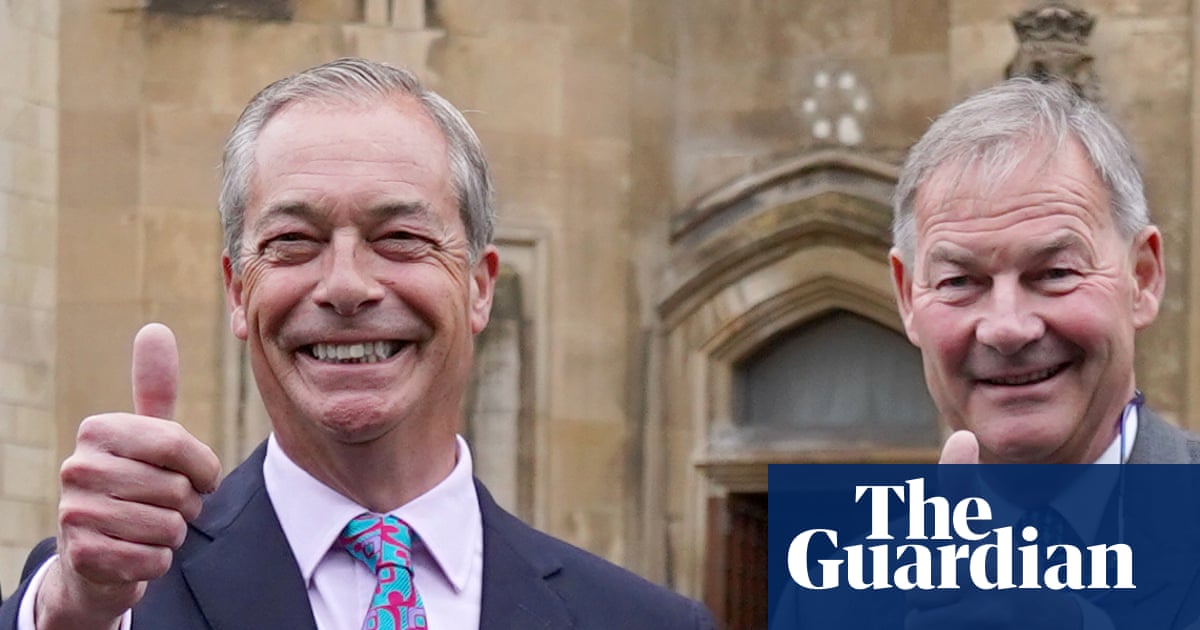
Even by the standards of their rivalry, the speed at which Rupert Lowe’s olive branch to Nigel Farage morphed into fresh recriminations between the two was swift.
It began with a softly lit 12-minute video posted on Sunday by the Restore Britain leader, looking straight to camera and referring to “Nigel” as he suggested his party could be willing to cast aside its differences with Reform UK and work together.
Despite being suspended by Reform in March 2025, and going on to start his own party to chip away at Farage’s vote, Lowe said the two men should put “personalities and our past disagreements aside for the good of the country”.
But Farage did not appear to be tempted. Speaking at a press conference on Monday, he in effect accused Lowe of bad faith, wondering aloud about the circumstances of the “offer” and accusing him of “screaming” and “threatening” colleagues when he was in the party ranks.
By midday, Lowe had accused Farage of lying when he said he had been in touch with the Restore leader. But Lowe posted a screenshot of a curt “will call later” message from Farage on social media.
Whatever the truth, the exchanges are a reminder of how Restore has emerged as a very real obstacle in Farage’s road to Downing Street.
Lowe’s offer to work together came after Restore finished fourth in the Greater Manchester mayoral election, ahead of the Liberal Democrats and Tories – a relatively impressive feat for an electoral startup only months old.
The party also finished third in the Makerfield byelection, the strongest Westminster electoral performance since at least 2010 by a party that has not only endorsed explicitly far-right positions but welcomed far-right activists into its ranks.
Many of its policy positions – a referendum on the death penalty, bans on halal and kosher slaughter and a deportation policy informed by an ethnonationalist view of British identity – make any deal with Restore almost impossible for Reform if the latter is going to broaden its base.
That’s even aside from Lowe’s other demand: that the former Tory ministers in Reform’s ranks – such as Robert Jenrick – are denied a place in any Reform government.
Yet the enduring popularity of Lowe among a chunk of rightwing British voters, including Reform supporters, means Farage has to at least pay lip service to his rival’s overtures.
While Restore’s vote share in Manchester and Makerfield – 8.7% and 6.8% respectively – indicated the party was a long way from winning seats, such results could cost Reform swathes of constituencies in a general election where the vote on the right was split.
Contrast Farage’s vitriol to the warmer words on Sunday of the Reform MP Andrew Rosindell, who told GB News: “A lot of what he [Lowe] says will resonate with Reform voters and with British people.”
It was “a matter for Rupert to talk to Nigel about”, the former Tory MP added, as he made a plea for unity on the “right of centre”.
At grassroots level the relationship is complicated. In a number of local authorities, including some of Reform’s flagships, Restore is home to disillusioned councillors from Farage’s party, who have sometimes teamed up with other parties to frustrate their former colleagues.
Yet on doorsteps, it’s not uncommon for canvassers to encounter voters who admire both parties and leaders.
Even those concerned by the rise of a hard-right party such as Restore credit Lowe with making a clever play which both addresses some of his own problems and adds to Farage’s pressures at a time when the Reform leader faces unprecedented questions about his finances.
“What Lowe’s move does for his own base, and Restore-curious types, is to negate the charge that he is splitting the vote on the right,” said Joe Mulhall, the director of research at the anti-fascism organisation Hope not Hate.
“He has, from one perspective, put an offer on the table, which considering how much they seem to hate each other, has the appearance of generosity.
“But from Lowe’s perspective, it’s also something which he can be pretty sure Farage would never have accepted, given that his route to power ultimately requires him courting centre-right votes. Having ethnonationalists behind him would mean endless questions.”
For now, negotiations to unite Britain’s hard right appear set to be consigned to X and the studios of GB News.
Just a month away too is Reform’s annual conference, an event where Lowe once enjoyed cult support from a considerable minority of activists. If questions persist about the future of both parties, it will be yet another shadow over what is meant to be a pivotal rallying point on Reform’s supposed path to power.
Disclaimer : This story is auto aggregated by a computer programme and has not been created or edited by DOWNTHENEWS. Publisher: theguardian.com