
Ukraine said it recaptured more of its territory than Russia had managed to seize this year, despite restrictions on US satellite services critical to its defence.
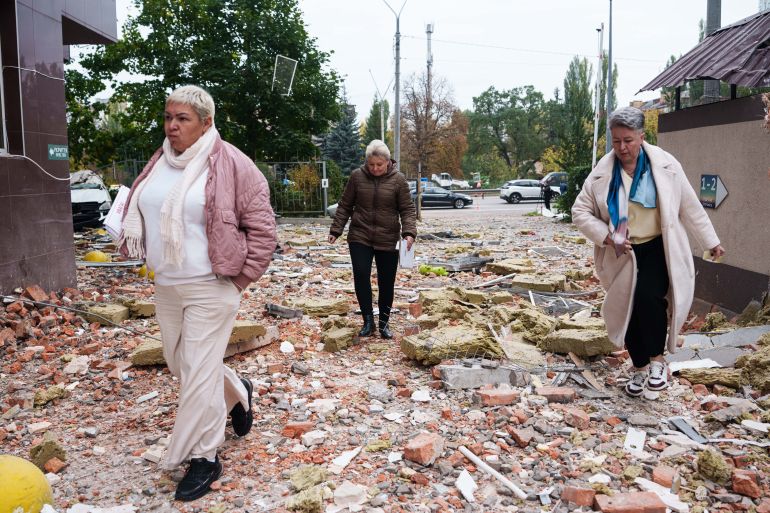
Russia responded by hitting dozens of Ukraine’s energy facilities and using cluster bombs in attacks that harmed civilians.
Recommended Stories
list of 4 itemsend of list
“Our soldiers have liberated more territory since the beginning of autumn than the Russians have managed to capture,” said Ukrainian President Volodymyr Zelenskyy in a public address.
Ukrainian General Staff spokesman Andriy Kovalev denied Russian claims to have seized 1,800 sq km (700 square miles) of Ukrainian territory during the autumn.
The Institute for the Study of War, a Washington-based think tank that uses geolocated open-source information to assess territorial movements, said Ukraine had made a net gain of 241 sq km (93 square miles) since September 1, effectively eliminating any Russian territorial gains this year.
Russia’s casualties suggest the effectiveness of its forces is in decline.
Russian losses – meaning those killed or severely wounded – hovered around 30,000 a month from January to May, but steadily increased over the summer. According to Ukrainian estimates, Russia lost 46,230 soldiers in September, its highest monthly losses of the year, and 37,000 so far in October.
October 21 marked its highest daily losses of the entire war, at 2,250, said Robert Brovdi, the commander of the Unmanned Systems Forces of Ukraine, as his unit’s kill rate had climbed to a new record.
Advertisement
Overall, Ukraine estimated there were more than 350,000 Russian dead and wounded since the beginning of the year.

Many of Ukraine’s territorial gains were made by Operation Vivaldi, a Ukrainian counteroffensive that stopped a Russian pincer movement to recapture the remaining one-fifth of Ukraine’s eastern Donetsk region – roughly 5,500 sq km (2,000 square miles).
General Andriy Biletskyi, who led Ukraine’s Third Army Corps to victory in that campaign, said he had eliminated a Russian bridgehead on the western bank of the Zherebets river, and crossed over to the east bank, shortening his own front line and concentrating artillery and unmanned aerial firepower, stabilising its defence.
The defeat of the pincer, said Biletskyi, had left Russia with the unsavoury option of a frontal assault on the “fortress belt” of heavily defended cities of Kramatorsk, Sloviansk and Druzhivka.
Russia had “temporarily abandoned this plan, although it plans to resume it,” Biletskyi told the Ukrainian news outlet Suspilne. Russian military expert Andrey Marochko told Russia’s state news agency TASS that Ukraine was reinforcing the fortress cities.
Russia has responded to its sagging military fortunes by increasing the ferocity of its attacks on civilians.
On October 22, it flew three ballistic missiles with cluster warheads into Kyiv, Zelenskyy said.
“This warhead detonates above the ground and is specifically designed to inflict maximum damage on people and equipment within an area of 400 by 400 metres,” said Ukrainian Defence Ministry senior adviser Serhiy Beskrestnov. “45 submunitions explode in the air.”

One of the warheads struck an area between the Kyiv-Pechersk Lavra cathedral and a monastery.
“There was not even theoretically any military object nearby,” said Zelenskyy. “It is a deliberate choice of weapons, a deliberate choice of the area.”
Russia’s Defence Ministry claimed it had targeted an assembly building for the FP-5 long-range drones and FP-9 missiles Ukraine has been using against it, as well as other drone manufacturing sites.
More than anything else, though, Russia has relentlessly targeted Ukraine’s energy infrastructure, despite United States President Donald Trump declaring an energy ceasefire for both sides on October 11.
Since then, there had been more than 170 strikes on Ukraine’s energy infrastructure, Zelenskyy said.
“Russia is not achieving any significant results on the front lines. Therefore, it is directing all its aggression and hatred towards terrorising civilian infrastructure: electricity, heating, and now, water. The goal is clear – to exhaust the people,” Prime Minister Serhiy Khoretskyi told the BBC.
Advertisement
Since he assumed office on July 16, he said, Russia had attacked Ukraine’s energy infrastructure 2,147 times.
Ukraine has been hampered in its defence by the US, which on October 8 was understood to have stopped providing early warning of incoming ballistic missiles for the second time this year.
Zelenskyy said that early warning had been restored on October 20, but three other US actions detrimental to Ukraine’s defence had not been reversed.
One was Trump’s waiver of oil export sanctions on Russia to lower the price of diesel, which he formalised with an executive order on October 16. Putin said on October 21 that Russia’s first shipment of 40,000 tonnes of diesel to the US would depart within two or three days.
Another issue was that the US has not released Patriot interceptors to Ukraine, which are its most effective defence against ballistic missiles, despite having previously supplied a dozen a month, and despite the fact that Europe has paid for them.
But the biggest problem was that Ukraine’s ability to fly its drones at more than 150kmh (100mph) using the Starshield satellite navigation system remained suspended.
Ukraine has said it cannot intercept fast-moving jet-powered drones at such speeds, and its attacks on Russian logistics, as well as the resupply of its own front lines by drone, are also rendered more vulnerable.
Starshield was created as a military application of Starlink, owned by Elon Musk, and he and the White House traded blame for making the decision to restrict it throughout the week. Trump said on October 22 that Starlink and Starshield services were about to be restored.
After initially observing Trump’s energy ceasefire, Ukraine resumed targeting Russian energy infrastructure, as part of an economic strategy to starve the Russian war machine of export revenue.

On October 18, it struck the St Petersburg oil terminal, Russia’s biggest offloading terminal for oil exports. It also hit a data centre serving Russian social media platform Vkontakte, disrupting services.
Other facilities were likely targeted. Russia’s Defence Ministry said it had downed 1,015 Ukrainian drones over various regions that night.
The US appeared to leverage its waiver of diesel sanctions and the suspension of Starshield services to push for a trilateral meeting among the US, Russia and Ukraine.
US envoy Steve Witkoff met with Zelenskyy in Oslo on October 20, and followed up with a meeting with Putin in St Petersburg the following day.
Putin aide Yuri Ushakov told the media that Russia had agreed “in principle” to meet on November 10. Kremlin spokesperson Dmitry Peskov said the planned meeting would be held in Abu Dhabi.
Disclaimer : This story is auto aggregated by a computer programme and has not been created or edited by DOWNTHENEWS. Publisher: aljazeera.com




