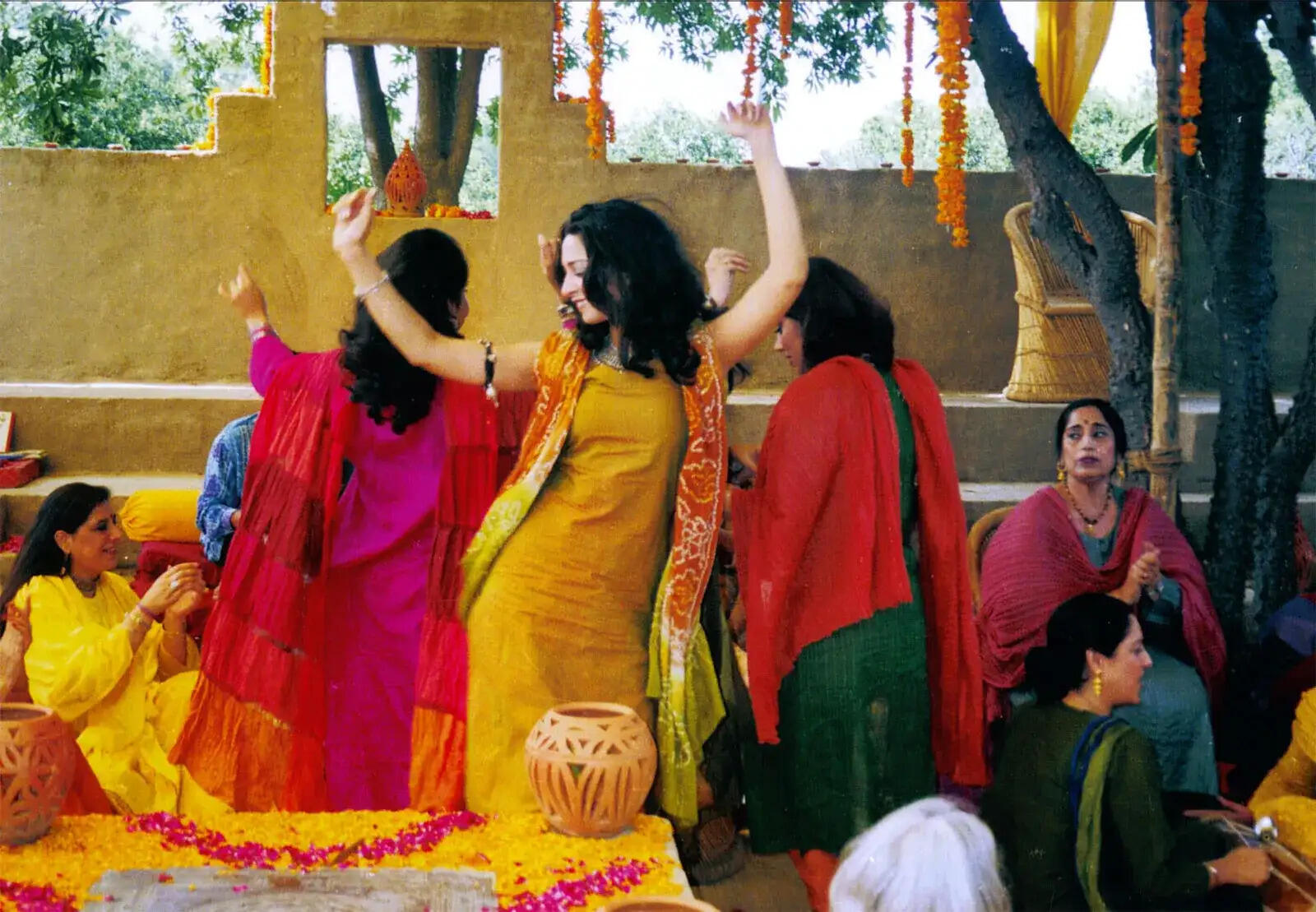
Monsoon Wedding was never simply a celebration of the Big Fat Indian Wedding. Instead, it offered a glimpse into the lives of upper-middle-class Delhiites at a time when India was embracing globalisation. Against the backdrop of a chaotic family wedding, the film explored love, identity, trauma and the complexities of family relationships, bringing together seemingly disparate worlds in a story that resonated across cultures.
As the landmark film completes 25 years, writer Sabrina Dhawan revisits its origins and reflects on conceiving the story in America, collaborating with director Mira Nair, weaving the subject of sexual abuse into the setting of a wedding, and the film’s lasting cultural impact.
A still from Monsoon Wedding
Conceiving Monsoon Wedding: Bringing Together Two Very Different Ideas
Can you recall the first time you conceived the idea of Monsoon Wedding while studying in America?
I had no film training when I was in India, and I went to America when I was about 25, after working as a journalist. When I applied to film schools, I knew one thing: I wanted to write about sexual abuse in an upper-middle-class family. That was what made me want to make movies.
I learned how to write in the programme at the university. I’d never seen a screenplay before. Then I met Mira [Nair]. She had read a script for a short film I had written and said we should work together. Once I finished the short, I told her I wanted to write about sexual abuse in an upper-middle-class Delhi family. But she wanted to make a lighter movie after Kama Sutra, perhaps something like a realistic Hum Aapke Hain Koun or a wedding film.
I told her that wasn’t what I was writing. But then I thought: what if I put those two ideas together? What if I wrote about sexual abuse in the context of a wedding? While I was still a student, I wrote a first draft in December. Mira read it, wanted to make it, and managed to secure low-budget financing by March or April. We shot in August. Because it was a low-budget film, everything happened quickly—something that rarely happens with high-budget films.
Revisiting Monsoon Wedding in a Post-MeToo World
You’ve mentioned that writing the story in America gave you a different perspective. Looking back from 2026, 25 years later, how would you approach the same themes today?
I wouldn’t write the exact same movie today, even with the same characters. For instance, in the original film, it’s implied that the bride had never been to America and was trying to escape there. In 2026, it feels unrealistic that someone from that background has never been abroad. Also, the MeToo movement and changing workplace dynamics have altered how we view things. Aditi’s affair with her married boss would be examined differently today, through the lens of power imbalances and workplace exploitation.
Similarly, when we adapted the story into a Broadway-style musical around 2017–2018, I changed the conflict between Dubey and Alice. In the film, they break up over a misunderstanding about stolen jewellery. In the musical, I shifted the conflict to religion—he is Hindu and she is Christian—because that reflects contemporary anxieties around inter-religious relationships in India.
We also shifted the groom’s background. When I wrote the film, I had lived in America for just a few years, so Hemant was modelled on an IIT graduate moving to the US. Now, having lived in America much longer, my reference point is the diaspora. In the musical, Hemant grew up in America, struggling with the tension of belonging to two cultures and seeking an arranged marriage in India to reconnect with his roots.
I feel the response to the disclosure of sexual abuse in today’s India would probably be different from what it was in 2000. I essentially wrote it in 1999–2000, and there are still people who would want to pretend that it didn’t happen and sweep it under the carpet. But not everyone in the film, not even her [Shefali Shah’s character] cousins and contemporaries, calls out the act. I don’t think that would happen today. I think there would be more allies. Even if it were a generational thing, there would be more people willing to speak up because we’ve become more comfortable addressing issues such as attacks on women and harassment in the workplace over the years.
Furthermore, a massive generational shift occurs over 25 years. If we made the film today, Naseeruddin Shah’s character would be the grandfather; Aditi and Hemant would be the parents, and their children would be the protagonists!
Assembling the Ensemble: From Naseeruddin Shah to Vijay Raaz
Despite a restricted budget and a massive ensemble cast—from Naseeruddin Shah and Kulbhushan Kharbanda to Shefali Shah, Tilottama Shome, Vijay Raaz and Randeep Hooda—how did this dream team come together?
Mira’s involvement gave the cast confidence, but it ultimately came down to the script. I always imagined Naseer playing the father while writing it, even before it was greenlit. His ability to inhabit a character is unmatched. When Mira told me he was interested, I couldn’t believe it.
For the rest, we had great casting directors like Loveleen Tandan. Because it was a low-budget indie film, the focus wasn’t on casting box-office stars but on finding the absolute right actor for each role. Shefali Shah wasn’t as well-known then, and she brilliantly shadowed me to research a young Delhi girl. Vijay Raaz auditioned for comedic parts, but Mira and Loveleen saw that he could balance comedy with real vulnerability and seriousness in the Old Delhi terrace scene. Randeep Hooda had just returned from Australia for his very first film role. We also picked up his Melbourne-based accent for his character Rahul and changed it from his American or Canadian base.
The Writer-Director Jugalbandi Behind Monsoon Wedding
Do you remember any notes that you shared with Mira Nair? And how was the writer-director jugalbandi, given the unique lens she brings to the film?
During filming, you’re just trying to get all your shots in 30 days, so the jugalbandi is really about supporting the production—whether that means trimming scenes on the fly or dropping an entire subplot about Roshan Seth and Soni Razdan’s marriage because we ran out of time and it felt extraneous to the immediate family.
The real creative back-and-forth happens in pre-production. You discuss, debate and argue—you win some, you lose some. Our collaboration worked because I brought a strong sense of narrative, while Mira has an incredible eye for visual design. For instance, when Lalit first calls Dubey, I originally wrote Dubey at home or in a car. Mira felt we needed to open up the world visually, so I rewrote it to show him working at another wedding. Similarly, we set the scene where Lalit asks his friends for money at a golf club with fellow garment exporters—a significant marker of that new, globalised India. And, of course, Ayesha dancing to Chunari Chunari in the swimming pool during the sangeet was purely Mira reacting to the location!x
We didn’t always agree on structure, though. At one point, Mira wanted the film to centre around Aditi and Hemant’s love story for more drama, whereas I felt strongly that Lalit had to be the umbrella character holding all the subplots together. I eventually rewrote it her way because, as a writer, you try things out. But in the editing room, it was changed right back to my original draft when it became clear that the story needed to start with Lalit.
How Location Recce and Shooting Shaped the Screenplay
You were deeply involved in the pre-production and production of Monsoon Wedding. Did the screenplay change during the location recce and shooting?
Being on set was a huge advantage. One day, we lost a major location and had to cut an eight-page sequence down to three or four pages on the spot. Because I was there as the writer, I understood the domino effect on plot setups and payoffs.
Mira also felt we needed a quiet, emotional moment between the parents before the climax. I wrote the late-night scene where Lalit and Pammi go into Aditi’s room—a crucial moment that establishes his deep love for his daughters and justifies why he eventually banishes his brother-in-law [Rajat Kapoor].
Our collaboration worked because I understood narrative structure while Mira possessed an extraordinary sense of design and visual rhythm. For instance, she suggested opening Dubey’s introduction in an exterior setting at another wedding rather than in a car. And the iconic golf course scene with Lalit and his fellow garment exporters captured the exact economic pulse of post-liberalisation Delhi.
Monsoon Wedding at 25: A Culturally Specific Story with Universal Resonance
As Monsoon Wedding completes 25 years, how do you view its massive cultural impact?
When you’re writing it, you don’t think about pop-culture impact; it would be arrogant to think so. It was a culturally specific film about a particular community in a large city like Delhi. But staying truthful to that specific world is precisely what made it universally resonant.
We made this film in a pre-9/11 world, and the fact that it remains so deeply cherished after 25 years is overwhelming. Making a movie work is like pulling off a wedding—so many disparate elements have to fall into place: the writing, Mira’s direction, Declan Quinn’s cinematography, Mychael Danna’s score, legendary performances, and brilliant little unscripted touches, like costume designer Arjun Bhasin giving Dubey a calculator watch.
There’s this little moment in the script where Lalit [Naseeruddin Shah] is arguing with Dubey [Vijay Raaz] about the cost of the tent, and Dubey pulls out his calculator watch and starts calculating. It always gets a laugh. I didn’t write that. That came from the costume designer, Arjun Bhasin, because he understood who Dubey was. He knew that Dubey would wear a safari suit and would be the kind of person to have a calculator on his watch.
The Verma family in Monsoon Wedding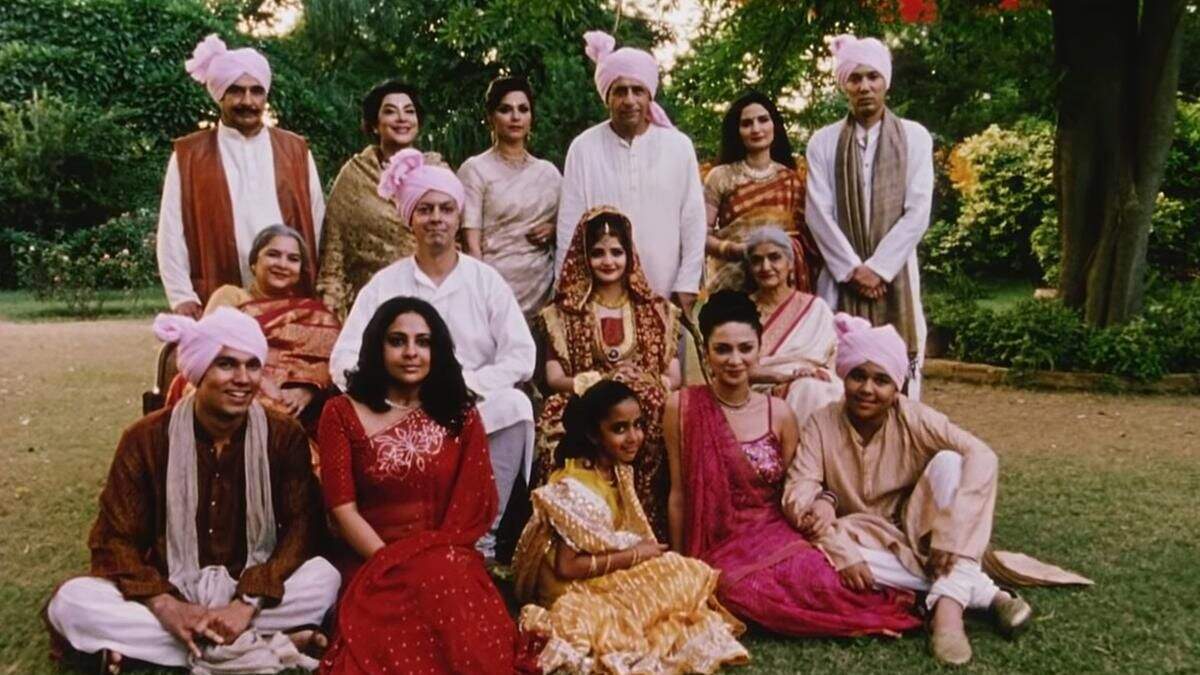
Disclaimer : This story is auto aggregated by a computer programme and has not been created or edited by DOWNTHENEWS. Publisher: filmfare.com