

There were few options for Anastasiya Byesyedina to find shelter when Russian missiles began slamming into Kyiv about midnight on Monday.
Byesyedina and her mother ran out of time to reach the safety of the Kyiv metro tunnels, so they had to wait in a corridor on the first floor of their apartment building while 60 missiles struck the city over four hours.
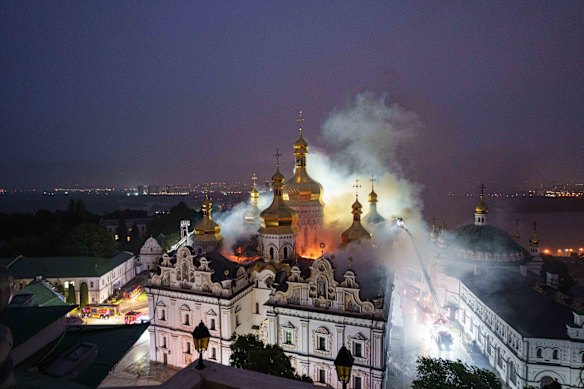
Across town, in one of the worst bombardments of recent times, the explosions set fire to the Pechersk Lavra monastery, a sacred site to Ukrainians and home of the Orthodox Church in Kyiv for a thousand years.
Byesyedina, 33, is an Australian who was born in Kyiv and chose to return there with her family – and she is angry at what she regards as Russian desecration.
“Russia was launching, consecutively, many ballistic missiles at Kyiv,” she said, speaking to this masthead on the day after the attack.
“It’s dangerous to run around in the open to get to the underground metro for shelter, so we went to the first level of our apartment building.
“For me, it feels normal now. But it is a shocking experience. It’s just shocking when you feel explosions vibrating through the entirety of your body, and you’re kind of numb and shaking. But that’s the everyday life of a Ukrainian.”
Like others, she left her home with a handful of possessions: an “emergency bag” she keeps by the door with her phone, paperwork, medicines and other essential items.
She and her mother emerged safely. Her grandmother, 84, was also safe, even though she had spent the night in a corridor on the 10th floor, near the family’s apartment. With the elevators out of service during the attack, she could not get down the stairs to a shelter.
Byesyedina has a clear view of the terror over Kyiv on some nights. From their apartment high above the streets, she and her family can see missiles flying towards their targets.
The attack on the monastery, however, was personal for Byesyedina. As a student of politics, she has explored its role in Ukrainian faith and culture as part of a dissertation for a PhD at the University of Sydney. She submitted the thesis in May, and her degree will be conferred this Monday.
World leaders have condemned the attack on the Pechersk Lavra, which was founded in 1051 and has UNESCO world heritage status. Ukrainian President Volodymyr Zelensky called it one of Russia’s most serious crimes against Christian culture to date.
“I cannot believe they’ve done it,” said Byesyedina. “From another perspective, knowing well of Russia’s historical suppression of Ukrainian religious freedoms, it’s actually entirely expected for them to strike the monastery complex that stands in continued defiance of Russian aggression.”
The monastery was the heart of the Orthodox church after the formation of the Kyivan Rus nation in the late 800s, but this makes it part of a contested history. Russian President Vladimir Putin claims to lead a single monolithic civilisation that traces its ancestry to Kyiv, and he denies Ukraine exists as a nation of its own.
That makes the monastery a symbol of an independent Ukraine. Other religious sites also demonstrate the nation’s freedom. When protesters rebelled against Russia-backed leaders during the Revolution of Dignity in 2014, they were given sanctuary in St Michael’s Golden-Domed Monastery.
For centuries, Russian priests taught in Russian at the Pechersk Lavra. This only changed in 2019, when the Ecumenical Patriarch of Constantinople, Bartholomew I, signed the “tomos” that recognised the Orthodox Church of Ukraine as a self-governing church, independent of Moscow.
Now it has independence – known as autocephaly – the church teaches in Ukrainian.
“You’re seeing a united people in Ukraine giving a signal about wanting independence,” Byesyedina said.
“The Revolution of Dignity in 2014 was a very crucial moment that showed on an international and regional level, to orthodoxy, that we are independent.”
Firefighters put out the flames at the Pechersk Lavra in the hours after the airstrikes, and the building has no structural damage, according to local news reports. But at least five people were killed, and 35 were injured in the attacks on Kyiv during the night, when authorities estimate Russian forces fired 70 missiles and 611 drones against Ukraine.
Metropolitan Epiphanius, head of the Orthodox Church of Ukraine, blamed the “Kremlin Antichrist” for the destruction.
“Another Russian crime against humanity, against history, against Christianity,” he wrote on X.
Byesyedina was born in Kyiv and moved to Australia with her family when she was seven. She returned to Ukraine in 2022 to help her mother and grandmother, but she said her reasons for staying were about more than family.
“It was one of those decisions that was really tough, but something that I had to do, not only for my family, but also for myself, for my connection to my sacred home, and for the integrity of my research on Ukraine,” she said.
“Sometimes you feel like that’s all you have in the tools or weapons that you can use against an aggressor – being home, being on sacred land.”
Get a note directly from our foreign correspondents on what’s making headlines around the world. Sign up for our weekly What in the World newsletter.
 David Crowe is Europe correspondent for The Sydney Morning Herald and The Age.Connect via X or email.
From our partners
Disclaimer : This story is auto aggregated by a computer programme and has not been created or edited by DOWNTHENEWS. Publisher: www.smh.com.au


