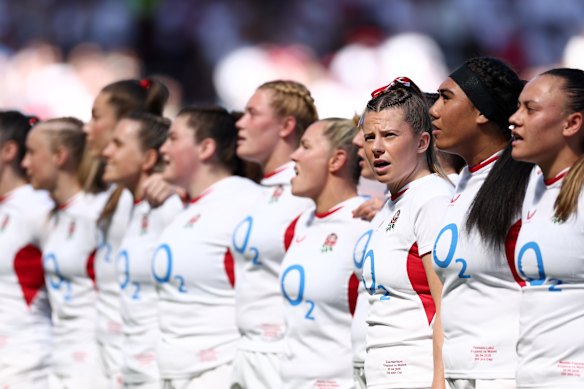

There are numerous candidates for the title of worst decision in human history. But last week, England rugby player Zoe Harrison declared that above all, World Rugby’s introduction of smaller balls for women was top of the list.
“I’ve not kicked anything less than a size five since I was the age of 14,” Harrison, a five-eighth for the Red Roses, told the BBC last week. “It’s the worst decision that someone has ever made.”
Although the idea seemed nonsensical to World Cup winner Harrison (who found out about midway through an interview with the British media outlet), smaller balls for women has already been adopted in several other sporting codes.
Women use smaller sized balls in cricket, basketball, water polo and in the AFLW. And yet, the idea that women use a smaller ball in soccer or rugby is often treated as sacrilegious – or at best, inequitable.
Jilly Collins, interim general manager of women’s high performance at Rugby Australia, said that reducing ball sizes for female players had been debated for as long as she had been involved in the administrative side of the sport.
“It was something that was discussed 20 years ago,” she said. “But what’s happened in the last few years is a consensus across unions [to] actually test this properly with really good research to see if it does make performance difference that is of benefit to the women’s game.”
With female hands smaller on average than men’s, World Rugby have been trialling the use of size 4.5 balls, which are about three per cent smaller than the size five balls used by men and women until now.
The smaller ball was first trialled at youth levels before being introduced in rugby sevens last November. Next, the smaller balls will be used in the women’s Super Rugby season starting in June, and then the international WXV Global Series – in which Harrison will play – later this year.
Australian sevens star Teagan Levi said she had initially shared some of Harrison’s concerns over the smaller ball.
“Growing up, we’ve all played with a size five ball – so to change mid-career is a bit of an inconvenience,” Levi said. “It just got brought into training and that training session was probably one of the worst training sessions we’ve ever had … They were going everywhere and anywhere because of how far we could throw it and how fast we could throw it.”
However, Levi said she has grown to see the benefits in passing with the smaller ball, and believes it has made weaker teams stronger.
Ahead of the Super Rugby season, Wallaroos and Waratahs captain Emily Chancellor has started training with the smaller ball. She admitted she, too, had reservations at first.
“It’s a game that I’ve grown up watching for a long time, and wanted to do what the boys were doing,” she said. “So to do that then with a different sized ball feels like you’re not doing the same thing – which sounds silly to be picking up over.”
Two weeks on, however, Chancellor says she’s now excited about being able to have more control over the ball.
“I don’t have to kick a ball or throw it in from a lineout, where precision becomes really important,” she said. “So for me and my skill set, I can’t imagine that I’m going to notice an obvious change, except potentially having greater control over the ball. It can only make the game more entertaining and more enjoyable for us to play because we’re not going to have as many stop-start moments from skill error.”
Collins says there is no timeline on the trial and no certainty the smaller ball will be adopted. She hopes the trial’s legacy will be in the importance of using a data-based approach to introducing adapted equipment in women’s sport.
“I really believe we’re doing it in the right way, to get to a point where we can make genuine objective decisions about it,” she said. “It gets wrapped up in this, ‘Why should we be doing anything different? We haven’t changed the ball before, we’re playing rugby, we’re not playing women’s rugby’… I want to put all of that aside and go, ‘What’s the data actually showing us?’”
Chancellor agrees.
“Particularly in the rugby union space, the women’s game hasn’t been as prominent, as prevalent, as popular by participants or by viewers. So there is a growth opportunity and when there’s growth, there is an interest in data. We have to remember that women are not the same physical shape and makeup as a man, so an opportunity to grow with science, I think, should be embraced.”
News, results and expert analysis from the weekend of sport sent every Monday. Sign up for our Sport newsletter.
From our partners
Disclaimer : This story is auto aggregated by a computer programme and has not been created or edited by DOWNTHENEWS. Publisher: www.smh.com.au