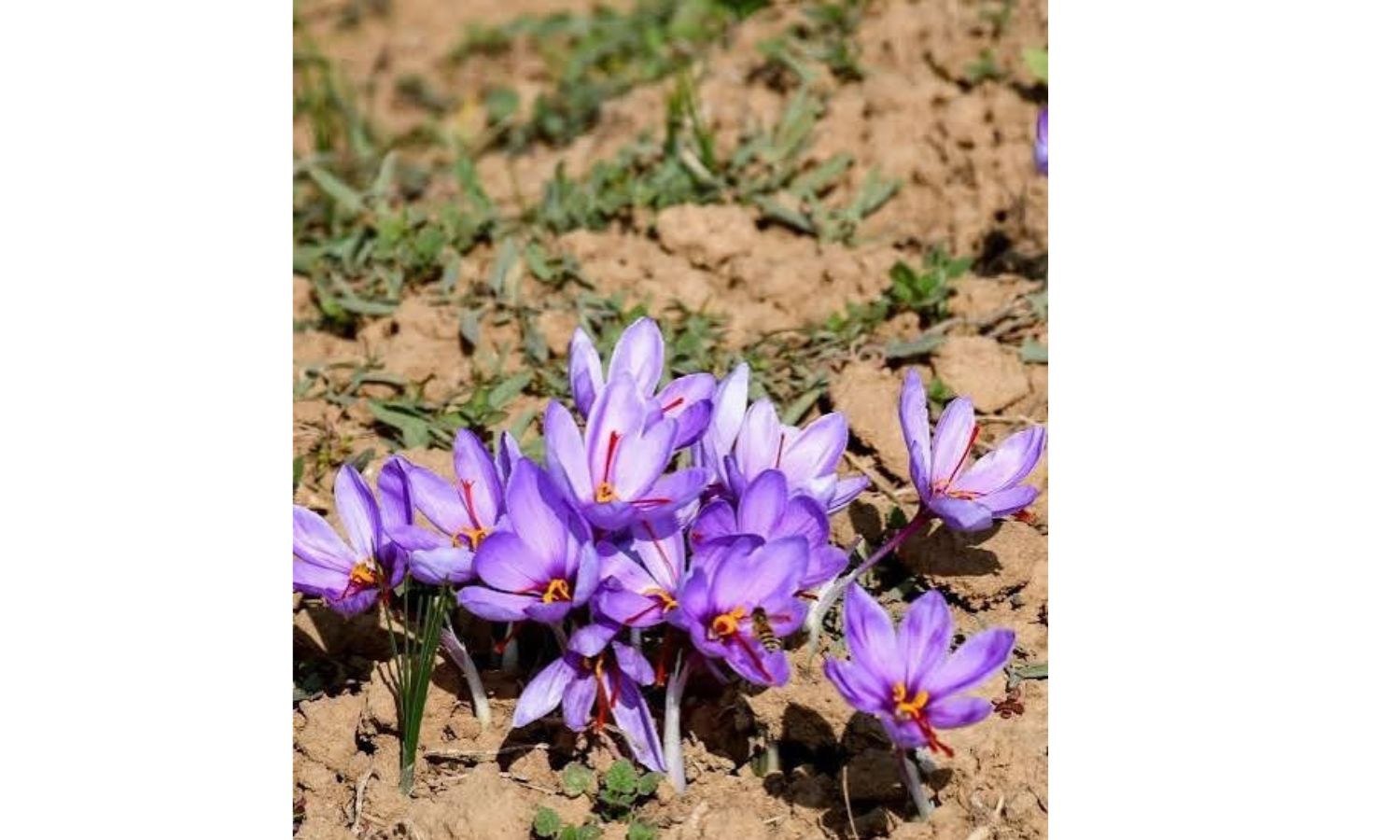
SRINAGAR: In a landmark development that could redefine the agricultural future of Ladakh, the Union Territory’s first experimental saffron cultivation project has achieved a remarkable breakthrough, with the first flowers blooming in less than 30 days on a once-barren tract of land in Leh.
The achievement, recorded nearly a month ahead of the normal flowering cycle, has strengthened hopes that the world’s most valuable spice may soon become a viable commercial crop in India’s cold desert Himalayan region, officials said on Sunday.
Lieutenant Governor Vinai Kumar Saxena visited the saffron cultivation site to witness the first bloom and review the progress of what is being hailed as one of Ladakh’s most ambitious agricultural diversification experiments. Officials informed him that the field is currently producing between 20 and 25 saffron flowers daily, while a record 72 blooms were observed in a single morning. The encouraging flowering pattern has already yielded nearly 22 grams of pure saffron within just four days of harvesting.
The success assumes even greater significance given the history of the land. Until recently, the site at Spituk Pharka was a dry, degraded expanse lying unproductive on the outskirts of Leh. Today, it has been transformed into a thriving saffron field through sustained ecological restoration efforts undertaken under Project Him Sarovar, a flagship initiative guided by the Lt. Governor. Nearly 800 kilograms of premium Iranian saffron corms, amounting to around 90,000 bulbs, were planted across 4,000 square metres of rejuvenated land on October 1. Against the conventional expectation of nearly two months for the first flowering, the crop responded in less than a month, surprising even agricultural experts overseeing the pilot.
The experiment represents the latest chapter in Ladakh’s evolving agricultural story, a official statement issued in Leh said. “Inspired by Prime Minister Narendra Modi’s vision of diversifying traditional farming practices to strengthen financial sustainability and create new opportunities for rural youth, the administration has progressively introduced high-value crops suited to the region’s unique geography, “ it said, adding that the spectacular success of large-scale Lilium and Gladiolus cultivation in recent years demonstrated that Ladakh’s harsh climatic conditions could support premium floriculture, generating employment and new sources of income for farmers, self-help groups and local entrepreneurs.
Building on that momentum, the administration turned its attention to saffron, one of the world’s most prized agricultural commodities. The crop commands premium prices in domestic and international markets and has long been associated with the fertile saffron fields of Pampore in the Kashmir Valley, often called the ‘Saffron Bowl of India.’ For generations, saffron cultivation in India has remained largely confined to the Kashmir Valley and parts of eastern Kishtwar district of the Jammu region, which together account for nearly 90 per cent of the country’s production.
Introducing saffron to Ladakh’s cold desert environment therefore marks much more than a crop trial. It challenges long-held assumptions about the climatic limits of saffron cultivation and seeks to determine whether high-altitude regions can emerge as new centres of production. Officials said that the corms selected for the pilot project were of the highest quality standards, with experts carefully choosing planting material capable of ensuring vigorous flowering and superior yields.
“The saffron field also showcases the broader success of land and water restoration efforts underway in Leh,” they said, adding that the plantation forms part of a larger programme aimed at reclaiming nearly 800 acres of degraded land. Water from the revived Igoo-Phey irrigation canal is now reaching areas that had remained moisture-starved for years, while four adjacent water reservoirs constructed under Project Him Sarovar, with a combined storage capacity of nearly 24 million litres, provide crucial support for irrigation and groundwater recharge.
Describing the initial results as highly encouraging, Lt. Governor Saxena said the project demonstrates both the resilience of Ladakh’s environment and the immense untapped potential of high-altitude agriculture.
“This remarkable achievement is a powerful testament to the resilience of the local environment and highlights the immense, untapped potential of high-altitude farming in the Ladakh region. The breakthrough of this pilot project lays a promising foundation for future commercial-scale saffron production. It will open highly lucrative new avenues for crop cultivation and agro-based entrepreneurship in Ladakh, paving the way for a stronger, thriving and self-reliant local economy,” he said.
Agricultural experts believe that if the pilot continues to perform successfully over subsequent growing cycles, saffron could emerge as a high-value addition to Ladakh’s agricultural portfolio, offering farmers a lucrative alternative crop and creating opportunities across the value chain, from cultivation and processing to marketing and agri-tourism.
The Lt. Governor also applauded officers of the Agriculture Department and field staff whose technical expertise and sustained efforts helped turn the experiment into an early success. Their work, he noted, has demonstrated how scientific intervention, ecological restoration and innovative thinking can together convert barren landscapes into productive assets.
Disclaimer : This story is auto aggregated by a computer programme and has not been created or edited by DOWNTHENEWS. Publisher: deccanchronicle.com