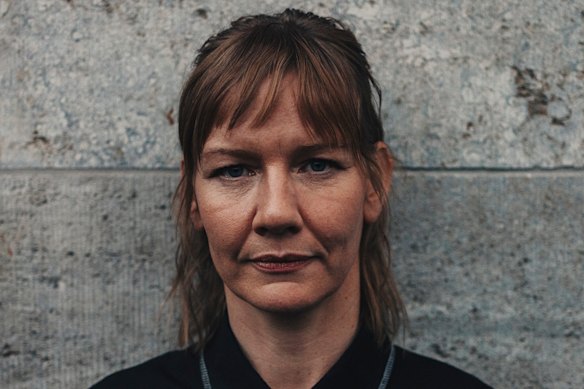
As Thomas Mann’s daughter in Fatherland, the acclaimed actress is once again generating Oscars buzz.
Just the word “Fatherland”, with its three staccato syllables, has the rattle of sabres behind it. “I don’t have a strong connection to the word fatherland. I would probably rather say ‘motherland’,” says German actor Sandra Huller. “But these words are quite stained where we live. You can’t use them. They are not innocent any more. Although I think, for the film, ‘fatherland’ has a double meaning.”
Fatherland is the name given by Polish filmmaker Pawel Pawlikowski to his concise, complex and utterly compelling film about a postwar journey taken by Thomas Mann, the great German novelist who won the Nobel Prize for literature in 1929, around a newly divided Germany. In Frankfurt, Mann will receive an award commemorating Goethe’s 200th birthday; on the other side of the line that will soon be a wall, he will visit Weimar.
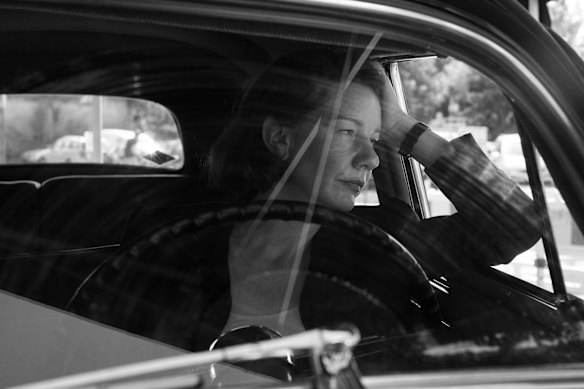
With him is his middle-aged daughter Erika (Huller) – journalist, cabaret entrepreneur, rally driver and a bold and brilliant character in her own right – who acts as her father’s assistant. This is the double meaning Huller has observed: Erika is living in her own private fatherland, the habitat of the great man of letters.
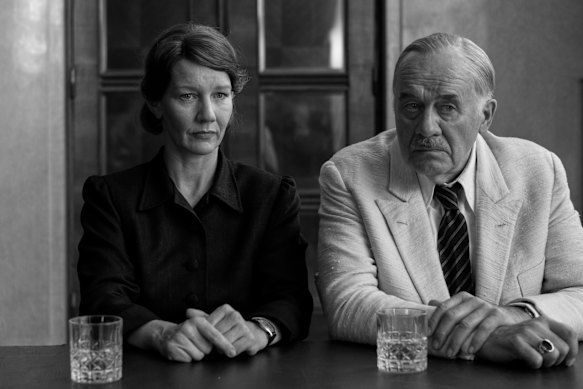
Hanns Zischler plays Thomas Mann, whom both sides of Germany want to claim as their own, with the weary dignity of a man on an obligatory civilising mission. Mann and his wife left for the United States in 1933, where Thomas was offered citizenship and the questionable comforts of exile. Erika later joined them.
When we meet them, Thomas has lived in California for 16 years. “They don’t know where their home actually is any more,” says Huller, whose performance has generated glowing reviews and Oscars buzz (her previous best actress nomination was for 2023’s Anatomy of a Fall). “And that doesn’t only mean the place where you live, but it means the language that you’re using. It has been abused by a fascist regime. It can’t be understood the way it was understood before.”
Pawlikowski is Polish; his previous film, Cold War (2018), was also set in this peculiar period of flux, but in his home country. He came across the story of the Mann tour when a publisher sent him a new biography of the author, suggesting he could turn it into a biopic.
“I didn’t want to,” says Pawlikowski emphatically. “But in that biography, I discovered this moment in 1949, where he came back to Germany. He was trying to be bigger than the situation and to fight and argue for a ‘good Germany’, which he hoped could be resurrected. Instead, he was being forced to choose between communism – which was Stalinism at that time – and American capitalism.”
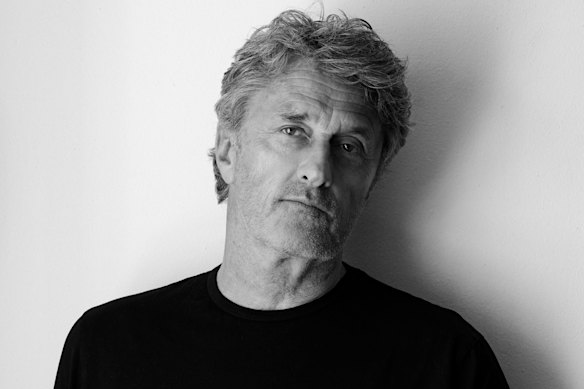
Pawlikowski didn’t want to stick with the facts. The real journey itself took months, while he compresses it into five days. Erika wasn’t really there; Mann went to Germany with his wife, Katia. “I was very imprecise, let’s say,” Pawlikowski says. “We took huge liberties with what happened when.” News reaches the Manns of family members who are ill or dying, events that really happened in other years altogether.
“I wanted to combine the kind of intimate family story – very focused, very narrow, claustrophobic in a way – with a big historical vista. That was one interesting thing. How do you bring these two things together? And that led to all sorts of formal solutions as well.”
Those solutions include Lukasz Zal’s luminous black and white photography, which evokes the period; his use of the square aspect ratio, which makes every scene feel confined, and a frequently static camera trained on those square sets, suggesting nothing so much as a series of dioramas showing how things were in postwar Germany. “It helps me to limit what we see and to force people to look very precisely in a certain place and the details that are there,” Pawlikowski says. “Not to show everything, but using out-of-frame sounds and context so people fill in the space that is not shown.”
On tour, Erika proves an ideal helpmeet. She filters the poison pen letters from the mail at the hotel, makes tea, battles border guards at each checkpoint and drives the car. She also fends off the fans. “Erika has been chosen as the favourite child, which is not always a good thing,” says Huller. “It means you don’t want to lose this position, so you have to do a little work to stay connected.” Her louche brother, Klaus (August Diehl), craves his father’s love in vain.
Erika Mann was a famous adventurer; she is still well-known in Germany. “There were some discussions around this movie where people were asking me if she was losing her freedom in deciding to follow her father, but I don’t think so,” says Huller. “I think it was a very deliberate decision. She had such a rich life, she could do whatever she wanted.”
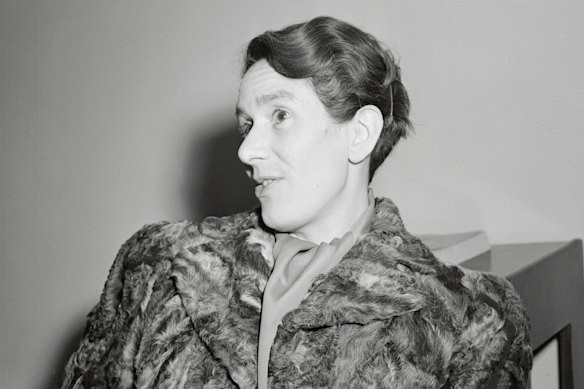
Reading the letters they sent to each other, she says, revealed to her the strength of their bond. “They had a way of talking that I admire very much, because they wouldn’t lie to each other regarding their opinions. They don’t hold back with critique, don’t shy away from conflict. And at the same time, they would forgive each other everything.”
Overall, the family was a tangled web. After his death, Mann’s diaries revealed his lifelong attraction to men. Erika was gay but married twice; her first husband, Gustaf Gründgens (Joachim Meyerhoff), was an actor who toadied to Hitler’s right-hand man, Hermann Göring, and thus thrived under the Nazis, while her second was her lifelong friend W. H. Auden, the English poet, who married her so she could stay in Britain.
Klaus and Erika, meanwhile, were so devoted they described themselves as twins. Klaus was an aspiring writer, which set him on a collision course with his father; he also had a serious drug habit. His best-known work is the novel Mephisto, which was banned in Germany because it centred on an actor – clearly based on his sister’s husband – who became the Nazis’ patsy. “It’s also about jealousy,” says Diehl.
Diehl sees Thomas Mann as representative of the end of an old German culture. “The culture that was destroyed by the war, before Germany was aware of being the most evil nation in the world. It’s hard for us to imagine.” If he really tries, he says, he feels his use of the language change gears. “There was a different way of talking. When you read letters from before the war, just from normal people, they’re close to literature. And the war destroyed that language.”
He used to love Klaus Mann’s writing as a teenager, he says, but now he sees the seeds of that destroyed language in the way he wrote, “although you feel he’s doing that on purpose, to be different from his father”. Choosing to be a writer when his father was such a giant, he says, was choosing to have a complicated life. “He was destroyed by family, but also by the war. By what happened to Germany. He’s a writer who hates his mother tongue, so he’s screwed.”
But all of culture was poisoned, it seems. There is a gimlet-sharp scene in Fatherland where Wagner’s grandsons urge Mann – who loved Wagner’s music – to lend his public support to the reconstruction of the Bayreuth opera house. “It should be razed to the ground,” he snaps back. Even outdoor pursuits like mountaineering were tarnished. “We can’t even look at the Alps any more!” says Diehl. “It is crazy what a movement like National Socialism destroys, along with its catastrophes. Many, many, many things.” Even Thomas Mann could not recover them.
Fatherland is in cinemas from November 12.
More from Spectrum
Find out the next TV, streaming series and movies to add to your must-sees. Get The Watchlist delivered every Thursday.
Disclaimer : This story is auto aggregated by a computer programme and has not been created or edited by DOWNTHENEWS. Publisher: www.smh.com.au