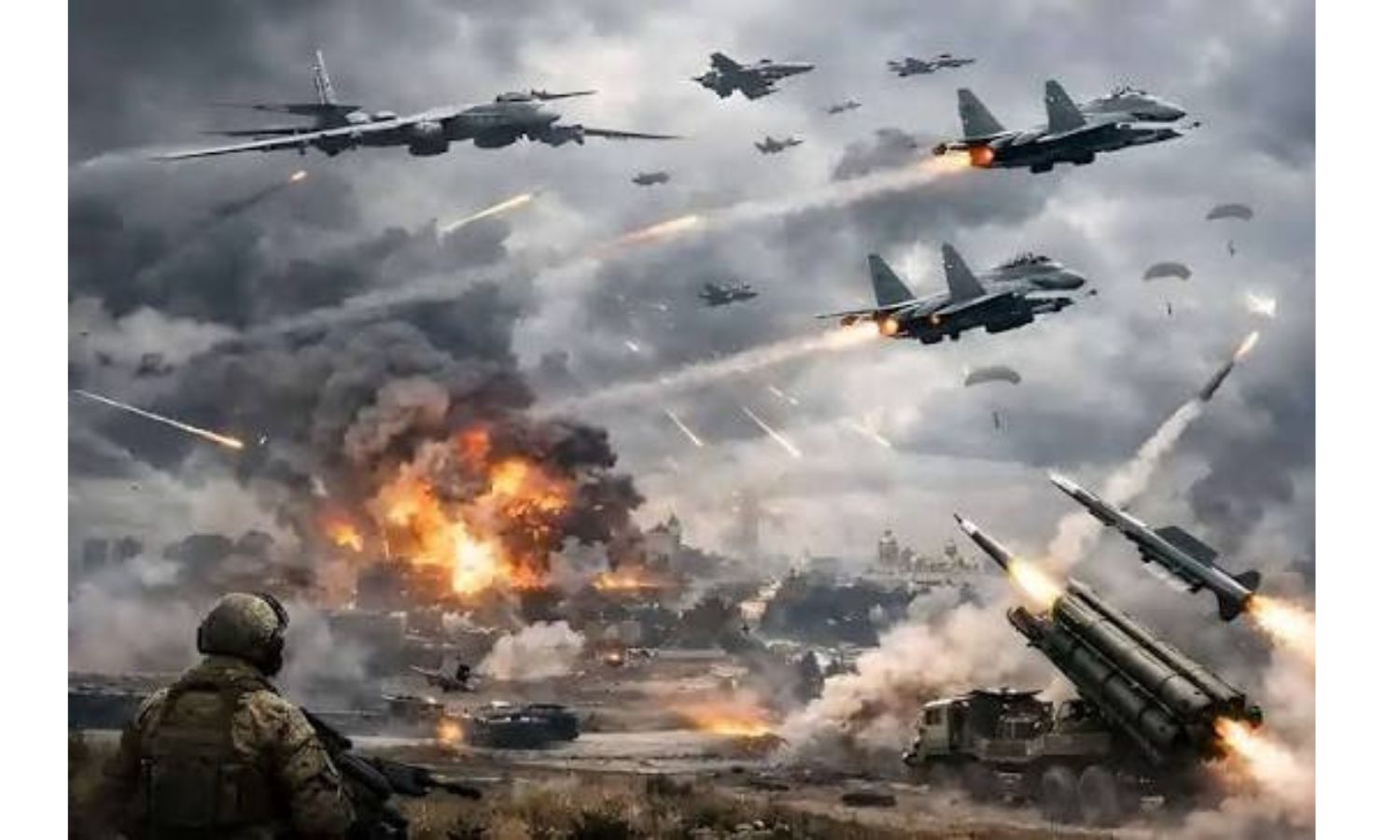
Are we in the midst of World War III? The war in Europe has become a Eurasian war with North Korean troops joining and Chinese support propping up Russia. Ukraine remains in play, at least in part due to the support from Western Europe and the United States. The war in West Asia, yoyoing up and down depending on President Donald Trump’s attention span, has drawn in many countries. The United States has made its military presence felt in Latin America, virtually “occupying” Venezuela and imposing a siege on Cuba. Africa has its own little wars from time to time. Its northern and eastern flanks have been drawn in one way or another into one conflict or another.
While there is no war going on currently in Asia to India’s east, many of the countries in the region are being drawn into the two major ongoing conflicts in Western Europe and West Asia. North Korea is a direct recruit, while Japan is a declared ally of the North Atlantic Treaty Organisation (Nato) countries. Pakistan is embedded in the West Asian conflict in more ways than one. India has suffered collateral damage, with US gunboats entering the Indian Ocean region and Indians being killed in both the major wars.
Do we, therefore, declare that we are now in the midst of World War III? The question has been raised by scholars and commentators. In answering this question, it would be wrong to look for parallels from World War I and II. Both of them were essentially military campaigns in which the armed forces of rival countries were directly engaging each other. Millions died, cities were destroyed, normal life was totally disrupted in the nations that were at war, except for the United States. The same cannot as yet be said of the ongoing conflicts in Europe and West Asia. The damage to life and property has been limited to countries directly engaged in conflict, but countries around the world are paying an economic price already.
The impact of both conflicts has been felt globally. Energy and food prices have shot up. Global trade has been disrupted. The world’s most powerful economies — the Group of Seven — have weaponised finance, energy and trade — and many citizens of countries around the world, including India, trapped in conflict zones due to their employment have been killed. The Indian people are bearing the burden of these conflicts.
There is as yet relative peace in Asia to our east and southeast, and China is holding its fire in the Taiwan Strait. Most countries in this region have increased their defence spending and war preparedness. Even as India deals with President Donald Trump’s trade offensive and a sweeping sanctions regime, it is maintaining defence relations with the US, as it indeed is with Russia. India has also increased defence spending, and is also exporting arms: selling arms to Israel, a perpetrator of war, and selling BrahMos missiles to various Asian countries.
During World Wars I and II Indian citizens were drawn into the conflict, dying on European and Asian frontlines in defence of the British Empire. Today, Indian soldiers are not yet engaged but Indian citizens are dying as a consequence of the two wars. More importantly, the Indian economy has already paid a huge price as a result of both wars. The rise in energy and food prices, the disruption in supplies and the decline in global demand for manufactures and services have all negatively impacted India. After suffering the consequences of demonetisation and the Covid-19 pandemic, India is now burdened by the consequences of both wars.
Clearly India has a huge stake in bringing both conflicts to an end. Prime Minister Narendra Modi once famously declared that “this is not an era of war”, but India’s ability to intervene and make a difference has been limited by the fact that in both conflicts India has friendly relations with both sides. India’s relations with Russia are as important for her as relations with the European Union and the United States, even if Ukraine is a lesser consideration. In West Asia, India has a stake in maintaining good relations with all sides.
India is currently seeking membership of the United Nations Security Council. It is not clear why the external affairs ministry has thrown India’s hat into the ring at this late stage. But, having done so, it could consider strengthening its case by in fact being a peace activist on the world stage. India has a direct stake in ending both conflicts. It also has a stake in ensuring that all the major powers — the US, Russia and China — respect international law and the UN Charter in their own neighbourhoods.
India is hosting the Brics summit in September this year. While Russia and Iran are directly involved in a war, most Brics countries have a stake in a return to a more peaceful and stable global environment. Can Indian leadership articulate a vision for world peace and build a coalition of nations that seek an end to both the Ukraine and Gulf conflicts? Equally, they should insist that each of the major powers desist from asserting their hegemonism in their own neighbourhood.
Of course, this requires a repositioning of India as a global citizen, not a country that harasses and terrorises its own citizens. It was India’s commitment to democratic and liberal values that enabled the Indian political leadership to acquire a global profile in the 1950s and 1960s. Even as recently as the turn of the century, Singapore’s Lee Kuan Yew posed a question as to why the world was willing to accommodate a rising India while being suspicious of a rising China. The world has since become less accommodative of India’s interests because of the new direction of our domestic politics.
If India’s appeal is not that of a democratic nation but merely a rising economy with a growing market, then its appeal even now would fade in comparison with China — still a more attractive market for many. It is India’s rise as a plural, liberal democracy that the world admired. It is through that personality that India can emerge as a voice of peace and seek an end to both wars, working with the developing economies of Asia, Africa and Latin America, all of which are threatened not just by the consequences of war but also by big power hegemonism.
Sanjaya Baru is a Distinguished Fellow, United Service Institution of India and Takshashila Institution
Disclaimer : This story is auto aggregated by a computer programme and has not been created or edited by DOWNTHENEWS. Publisher: deccanchronicle.com