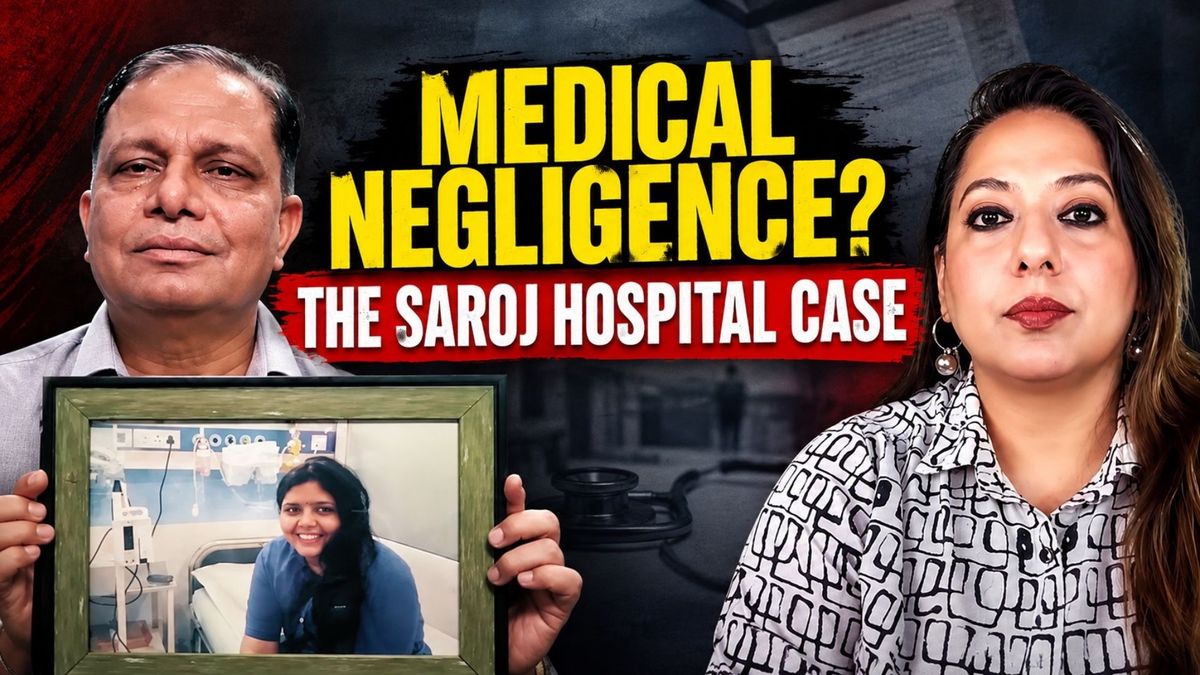
Saroj Hospital Medical Negligence Case: Key Questions Raised
On 29th March 2018, Gargi Meena walked into Saroj Super Speciality Hospital in Rohini, Delhi. Gargi had mild stomach pain, but within 48 hours she was dead.
Since Gargi’s death, for the last eight years, Uttam Chand Meena has been fighting to get justice for his wife. He went to court, he filed several RTI petitions, dug out documents related to the hospital, and eventually he found out that over 100 unregistered nurses were working in the hospital at the time of his wife’s admission. Meena has alleged that his wife died due to medical negligence.
On 15th July 2026, he got a favourable order from the Delhi Nursing Council, which has decided to initiate criminal action against the hospital’s management. Here are the transcripts of the conversation between The Probe’s Editor-in-Chief Prema Sridevi and Uttam Chand Meena.
Also Read: Medical Negligence in Delhi Hospital Claimed My Wife’s Life – Husband
How Gargi Meena Went to the Hospital
Prema Sridevi: Meena ji, thank you for joining me. The Delhi Nursing Council order is a very significant one. But before we come to that, for those who don’t know your case, tell us what happened to your wife, Gargi Meena, in 2018.
Uttam Chand Meena: Let me give you the background. On 29 March 2018 we were due to travel to Pushkar and Ajmer Sharif. That morning she woke up with her period and mild pain. I said, Saroj Hospital is close by, go and get some medicine. If she had the medicine with her, then on a long road journey she could take it whenever the pain came. You don’t find a doctor on the highway. That was the only thought behind it. She went to the hospital on her own.
She reported at casualty, at emergency. They managed her pain there. She called me again at around 9:00, 9:15. I told her, your pain has settled, but get the medicine prescribed as well, that was the whole purpose. The moment she asked the emergency doctor for a prescription, he said no, it is OPD time now, go to the OPD.
So she was sent from emergency to the OPD. The gynaecologist on duty that day was Dr Nisha Jain. She saw her at about 10:20 in the morning. My wife explained the problem and asked for medicine. Instead of prescribing anything, the doctor told her to get tests done. One of them was a trans-vaginal scan. On the basis of that she said, you have a cyst, and this bleeding will not stop, you will have to undergo surgery. But that bleeding was menstrual bleeding.
And note this. When she pushed her towards surgery, she had already written out the pre-surgical tests at the very start. It is not that she added them after seeing the TVS report. They were written earlier. After the TVS she said, now get these further tests done too. By 3 p.m. the doctor had prepared her for surgery.
Why Was Surgery Recommended?
Prema Sridevi: Meena ji, you are saying there was no need for that surgery, that for mild stomach pain she only needed medicine. When you raised this with the doctor, when you asked why surgery was necessary, what were you told?
Uttam Chand Meena: Before meeting the doctor I spoke at length with my CMO. He told me that doctors avoid surgery during menstruation, because the body is unstable anyway. So he said, ask them to plan it for after the period.
With that in mind I went to the labour management room. My wife was sitting up in bed. I told the doctor: I have no problem giving consent, but for now give her conservative treatment and manage the pain. We will go to the village and come back, and you can operate then.
The doctor flared up. She said, “You don’t understand. She will die if you don’t do the surgery.” The HOD of the hospital, saying that to an ordinary man like me. I knew nothing about any of this at the time. I gave consent under pressure.
The Surgery and What Happened Afterwards
Prema Sridevi: We have seen photographs of her from before she went to the hospital. She looked cheerful and healthy. Then suddenly, at the time of surgery, what happened?
Uttam Chand Meena: They performed a total laparoscopic hysterectomy — a TLH. And they did it because it pays more. The same hysterectomy could have been done vaginally, but that earns less. That is why they pushed for a TLH. I was told she would be discharged on the third day. A small keyhole operation, barely any stitches, the patient recovers by the third day and walks about.
All of that was in my head. But when she said “she will simply die”, I had no option left. I gave consent blindly.
She was taken to the OT at around 5:30. We waited. We had been told the surgery would take an hour and a half, two hours. It went on until 7:45. That is the time written in the records, but we were only taken in to see her at 8:45.
She was in so much pain that I could not make sense of it. When she was being wheeled in for surgery she had looked at me briefly. I said only one thing to her. I said, you have delivered three children; this is a small surgery, removing the uterus, it will be done, you will come back, why are you worrying? I did not know she would not come back.
Prema Sridevi: What happened after the surgery?
Uttam Chand Meena: She was in severe pain. Terrible pain and this is immediately after surgery, when the anaesthesia is still working on the body. Even with that dose in her, she was in agony. And in that pain she whispered to me that she could not pass urine.
I went and called Dr Nisha Jain. I said, she is having trouble passing urine. She pulled back the sheet and said, look, the catheter is in place. At that point, there were other patients in the room. The doctor just pulled off the bedsheet and exposed my wife to everyone. She was nude. It was a very embarrassing and shocking moment for us. Why would a doctor who is a caregiver be so angry and ruthless?
Prema Sridevi: So in front of the other patients beside her, and their families, she pulled off the sheet?
Uttam Chand Meena: It was the labour room, and we had been called in specially to see her. The other patients were all around. And at that moment she pulled the sheet away. I could not react at that time. I was under pressure because my wife was in so much pain.
But understand what followed. In the post-operative period we simply kept waiting. It was 11:30 at night and they still had not shifted her to a room. They kept the patient lying there in the post-operative labour room. It turned 12:00, 12:30, and I thought, forget it, they won’t move her now. In the morning our daughter, who had stayed there all night, called me: “Papa, they are shifting her to the ICU.” I asked what had happened. They said her blood sugar had gone to 358. This was the morning of the 30th, around 7:30.
Now that I am fighting the case, I have learnt that there were no nurses available that night to manage her. The nurse simply did not bother to check that her sugar had to be monitored post-operatively. All her post-operative vitals should have been charted as routine. No such record was ever given to me.
And the biggest thing. They had spoken about transfusing blood, first the blood management, they said. If a patient’s haemoglobin is 7.6 and you are operating, you must stabilise her first, bring the Hb up to at least 10. Instead, they started one unit and wheeled her into the OT. And at night, until about 11:30 or 12:30, they were still giving the three units they had decided on in the post-operative period. What is the sense in that?
On the one hand they say there was bleeding. But once you have removed the cause of the bleeding, the bleeding stops. So why keep transfusing blood afterwards? It means something inside the abdomen had been damaged, something had been cut during the surgery, and they had to get through the night on transfusions.
Also Read: Saroj Hospital Medical Negligence: NMC Takes Action – The Probe Impact
What the Operation Recording Revealed
Prema Sridevi: Over these eight years you have done a great deal of investigation yourself, and the authorities have also examined the case. Looking back now, in 2026, what are the things that happened in that hospital that make you say this is medical negligence?
Uttam Chand Meena: The All India Federation of Laparoscopic Surgery is a federation based in Bombay. On the strength of a letter from them, Saroj Hospital had been made a centre for laparoscopy training, and the person delivering that training was Nisha Jain. Yet on the day of the surgery, the operative record does not even carry Nisha Jain’s signature to show that she attended the patient. There is another assistant, Dr Priyanka Gupta. So the way I read it, Priyanka Gupta probably performed laparoscopic surgery.
Prema Sridevi: That is what you believe?
Uttam Chand Meena: Yes. If Nisha Jain’s signature is not in my documents, that is what I will believe.
Prema Sridevi: But the National Medical Commission took action against Nisha Jain. On what basis did the NMC act against her, if she had not even seen the patient?
Uttam Chand Meena: Ma’am, it is a convention of the medical fraternity that the senior doctor under whom the patient is being treated carries the blame. It does not fall on the junior. That is our misfortune.
Prema Sridevi: So the first reason you call this negligence is that you believe Dr Nisha Jain did not perform the surgery. What else do you think happened in that hospital that day?
Uttam Chand Meena: After a great deal of effort we had the CD of the operation released through the court, and we watched it very closely. It shows that a cut was made. And while the ovaries and so on were being removed, a serious injury occurred. It is all on the CD. I am not the one saying this. The CD the hospital itself handed over says it.
Prema Sridevi: Could you identify the doctors in it, or is it only the computerised imaging?
Uttam Chand Meena: It is the imaging, ma’am. In laparoscopic surgery you only see the screen.
Prema Sridevi: So what did you see on that CD?
Uttam Chand Meena: I saw that she was bleeding internally. We saw the bleeding. There was bleeding, and after that they did not control it. That is why they kept transfusing blood post-operatively.
Take it on principle. The doctors say she was bleeding because of a cyst inside the uterus. You removed the uterus. The bleeding should have stopped, and no transfusion should have been needed at all. The post-operative blood settles it: there was massive bleeding during surgery, which they kept clearing, kept suctioning out and this was caught on the CD.
Their target was to finish in about an hour and a half; that is roughly what it takes. It took far longer. So the anaesthesia dose has to be increased too. The dose given at the start covers a fixed duration, so that management also has to be extended. Finally within 48 hours of my wife stepping inside that hospital, she was declared dead.
How the RTI Investigation Found Nursing Records
Prema Sridevi: Over these eight years of fighting, how did you come to know that unregistered nurses were involved at the time of admission?
Uttam Chand Meena: In the documents Saroj Hospital gave me, a nurse’s number appeared at the bottom of the sheets. I wanted to identify the nurse by name — which nurse did what for the patient, and in which shift. I was struggling with that. So I asked Saroj Hospital for the data of every nurse connected with my patient. They gave it to me.
When I analysed it, I asked them for the DNC numbers. What they had given me as DNC numbers were actually Saroj’s own employee codes. Once I realised that, I filed an RTI with the DNC to verify it: tell me whether this nurse, by this name, is registered with you or not. For some of them the answer came back: she is not registered with us.
Once “not registered” was on record, I kept at it through RTI after RTI. Through that process I even obtained the DNC’s approval to go into Saroj and take their complete record. I took the entire Excel sheet of nurses and then showed how many were unregistered. Multiple RTIs — I cannot even tell you how many. And the result is that things were gradually filtered out, and today we are sitting here with this favourable order from the DNC.
Prema Sridevi: One major outcome of your eight-year fight is that the National Medical Commission acted against Saroj Hospital’s doctors, and the Delhi Medical Council also accepted that there was negligence by the doctors in this case. But whenever medical negligence is discussed, only the doctors’ role is scrutinised. The role of nurses is hardly ever examined. In your view, in cases like this, what is a nurse’s responsibility, and what is her role?
Uttam Chand Meena: Ma’am, think about it practically, exactly as an ordinary person would. Doctors come on their round, write a note on the chart and leave. Once that note is written, who administers the medicine according to it? The nurse.
If she gives the wrong drug, or the wrong dose — or if the doctor has written that an injection is to be given after a certain interval and she does not understand what that means, and an unqualified woman pushes that injection into your IV line — what could the consequences be?
Doctors barely give you five minutes. They come on rounds for a minute or two per patient. For the remaining 24 hours, whether the patient is in the ICU or a general ward, the person who provides the actual care — like a mother — is the nurse.
Also Read: Delhi High Court Flags Regulatory Failures at Saroj Hospital | Impact
What the Delhi Nursing Council Order Says
Prema Sridevi: Meena ji, I am looking at the Delhi Nursing Council order you received, dated 15 July 2026. It is a shocking order. The Council accepts that of 245 nursing staff, 114 nurses were registered with the Delhi Nursing Council. 120 nurses were not registered with the Council, which is against the rule of law.
More importantly, six nurses — in fact the order does not even call them nurses, it says six individuals — were completely unregistered with any state nursing council in India, posing a direct threat to patient safety in critical care. Those are the Delhi Nursing Council’s own words. These six had no registration anywhere, so we do not even know what their qualifications were or what they were doing in that hospital.
And there is the misclassification. Five more individuals had been shown as nurses, and the order says they were “mistakenly rostered as nursing staff.” What is this?
Uttam Chand Meena: There is a story behind those five that people don’t know. Every hospital, according to its bed strength, must maintain the nurse numbers laid down in the Delhi nursing rules — how many beds means how many nurses, and how much OT staff if there is an OT. It is all defined. So to make up their headcount, hospitals sometimes fold in the OT staff. That is exactly what happened here: the nurses were falling short, so they included these people too. Technicians, assistants — they show all of them as nurses.
Prema Sridevi: To make the numbers add up on paper.
Uttam Chand Meena: Exactly. And notice point 102, which you read out, on “interstate registration default”. There the DNC says the interstate registration is in default — that these people did not take an NOC from their home state and migrate properly. But alongside that it also says their documents were never verified.
Prema Sridevi: So among those 120, part of the responsibility may lie with the DNC itself.
Uttam Chand Meena: Exactly.
Prema Sridevi: At The Probe we cover a great many medical negligence cases. We are probably the only news organisation focused on covering medical negligence and public health accountability. It is a major campaign for us.
Since we began, a great many victims email us and call us, asking us to cover their stories. The first thing I tell them is: register your case, go to your state medical council, do everything that is required — and we will look at the documents and cover the story. And what most of them say is that justice in medical negligence cases is impossible. That the doctors’ mafia, the hospital mafia, are wired into the system, that they will waste their time and never get justice.
Your case is an inspiration to many families, because in eight years you have won a series of favourable orders — from the Delhi High Court, the Delhi Medical Council, the National Medical Commission, and now the Delhi Nursing Council. So to the people who say justice in medical negligence is impossible, what would you say? What is your message?
Uttam Chand Meena: What you have said is the reality. Let me explain what lies behind it. If my parents had not educated me, I would not be qualified. I am a graduate engineer, and I studied further after that. Could I otherwise have picked up a medical textbook and read it? I have brought the books with me — I even brought Harrison, and the book I found on laparoscopy, I studied it.
Now tell me, after all that: will an ordinary person concentrate on earning a living, or read medical textbooks and then consider himself fit to walk into the DMC and argue with doctors? At the DMC they do not let your lawyer in, nor any doctor. The NMC is the same: you cannot take legal support, you may bring a companion with a medical background but not a relative. In that kind of setting, how is an ordinary man to make those doctors understand what was done to him? It is very difficult, ma’am.
Prema Sridevi: So what message would you give them?
Uttam Chand Meena: My message is this. Many NGOs are working, but I would ask that some good NGO enter this field as well — one that can help an unlettered person who arrives with documents, that can support the average, middle-income person, the poor man who cannot spend money.
And I would ask the government to do everything in its power to bring such NGOs onto the ground. Because just as a government does not function well without a good opposition, in exactly the same way, if there is nobody to spot the flaws in how the medical fraternity works, then whatever the fraternity does is accepted as correct. We treat the white coat as another form of God.
Prema Sridevi: Is this issue of unregistered nurses confined to Saroj Hospital, or do you think it is a far broader problem affecting many more hospitals in this country?
Uttam Chand Meena: Pull up the records of any nursing home and you will find the nurses’ certificates and qualifications on file — and that nurse is not even working there. It is not as though I only looked at Saroj. There are plenty of other small hospitals and nursing homes where, when a minor accident happens, someone takes the injured person to the nearest roadside hospital. He has no idea whether the staff at the place he is taking an accident case to for first aid can even handle his patient.
A stranger passing through comes across an accident victim and takes him to the nearest hospital. It is neither the patient’s fault nor his. Often you are told outright, this patient is not ours — meaning we do not provide this kind of care — but they will still enter the hospital’s name on the record. And when the word “hospital” comes to mind, nobody stops to ask whether treatment for this particular condition is available there.
So I consider it a very big failure of the Delhi Nursing Home Cell that it grants hospital status to anyone at all, whether the place stands on 250 square yards or on four acres. The four-acre one does only one extra thing: it writes “Multi-Speciality Hospital” underneath. And now even the small nursing homes have picked up the habit — they write “Super Speciality Hospital” too. A great many deaths happen because of this, and nobody pays them any attention.
Gargi Meena: Her Life and Her Dreams
Prema Sridevi: Meena ji, the most important person in this entire conversation is Gargi Meena ji. We want to know about her. What kind of person was she? What were her dreams?
Uttam Chand Meena: My wife had done her JBT. She gave up her MCD teaching job for the children. And the dream we had, let me tell you, was to go back to the village and open a small school — to give tuition to children who cannot afford tuition. That was our dream: that if in that rural area, that countryside where people cannot manage a proper meal, we could move even a few children’s lives forward, then the two of us having come to this earth would have been worthwhile.
Prema Sridevi: So what happens next in this case?
Uttam Chand Meena: My next stage is to take the DHS to court over Saroj, and to take the Quality Council of India to court. Whatever the licensing authority is, whatever the accreditation body is, a strong message should go to all of them.
Prema Sridevi: Thank you, Meena ji. Wish you all the best in your fight. We truly hope that you get justice.
Uttam Chand Meena: Thank you.
Disclaimer : This story is auto aggregated by a computer programme and has not been created or edited by DOWNTHENEWS. Publisher: theprobe.in