Kim Jong Un does not travel like other heads of state. He moves through North Korea aboard a “rolling fortress” — an armored train so heavily plated it requires two diesel locomotives to pull it, so comprehensively equipped it functions as a mobile command center, and so closely guarded that entire stations were built, and in one case a private airstrip demolished, simply to ensure he never has to step outside.
Through satellite imagery analysis, I examined the full scope of that infrastructure: a network of top-secret “No. 1 rail stations” built exclusively for Kim Jong Un and his family. The major stations at Ryongsong, Wonsan, and Wihwa Island strictly prohibit ordinary trains from entering. Each is engineered around a single purpose — ensuring the supreme leader can move without ever being exposed to the outside world — and each bears the hallmarks of that obsession: underground passageways linking platforms directly to his private residences, skylight shafts venting diesel fumes from the armored locomotive, and the State Affairs Commission rail emblem marking every platform as his exclusive domain. That Kim Jong Un favors this sealed, heavily secured network over aircraft, which are vulnerable to weather and interception, reflects a governing philosophy in which his personal security comes before everything else.
Ryongsong, Wonsan, and Wihwa Island: Three stations, one purpose
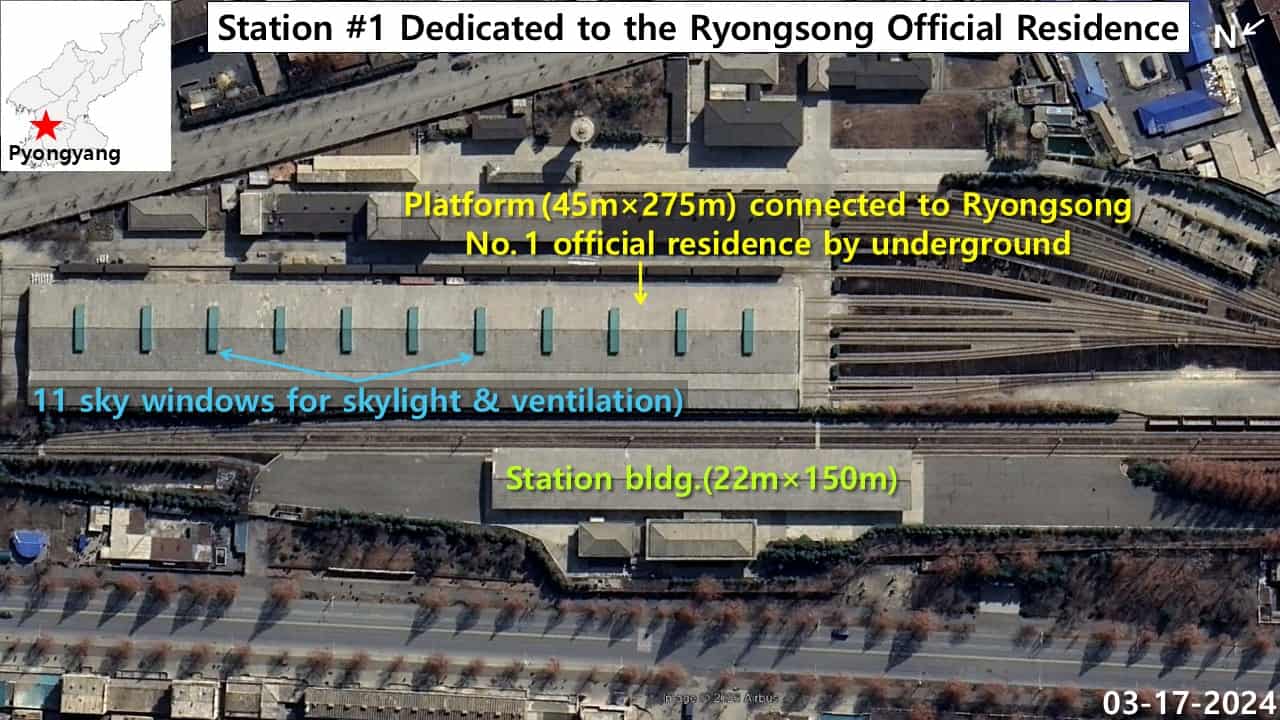
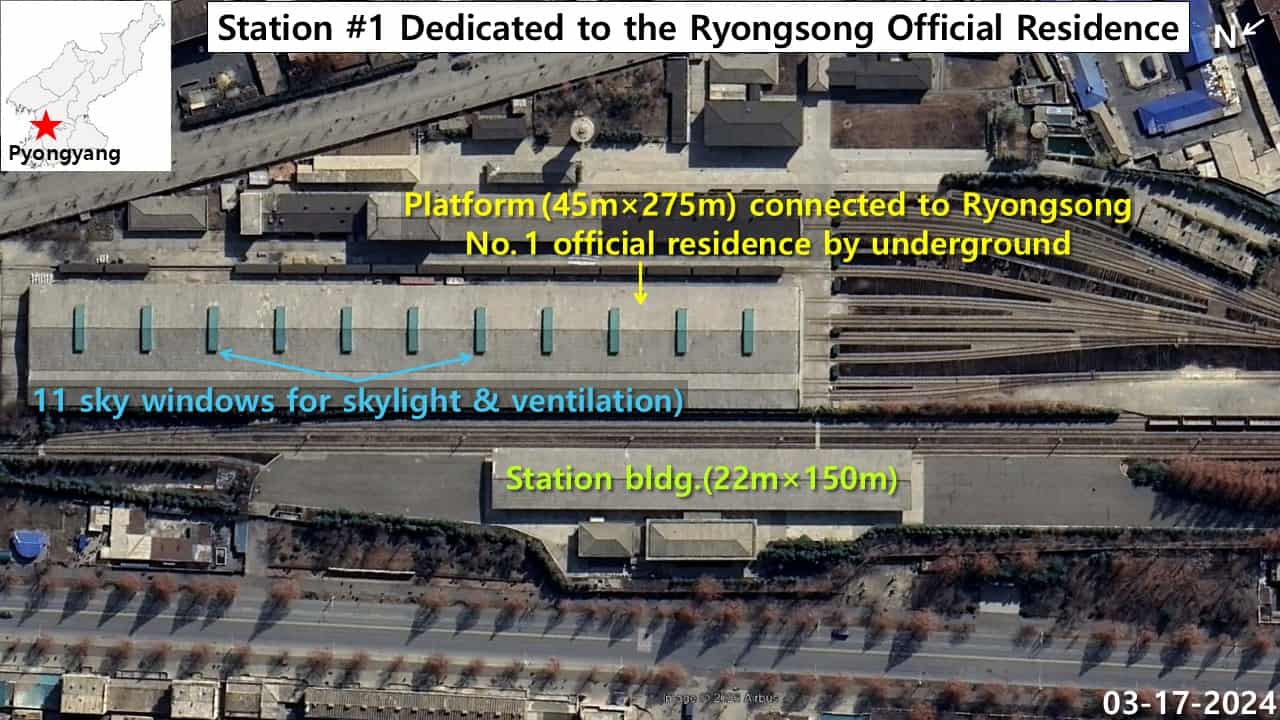
Ryongsong No. 1 Station in Pyongyang is a top-secret rail terminal reserved exclusively for Kim Jong Un and his family. Its defining feature is a massive platform connected directly to the Ryongsong residence, Kim Jong Un’s primary base in the capital, by an underground passageway. This allows him to travel from inside the compound to the train without ever stepping outdoors. Ordinary trains cannot enter the platform at all and must pass through on a separate outer track without stopping.
The platform roof, which I measured at 275 meters in length, has 11 elongated skylight shafts installed at regular intervals along the top. These perform two functions: venting the large volumes of exhaust and heat produced when the heavy armored diesel locomotive enters the enclosed space, and admitting natural light during daytime hours. The adjacent station building, roughly 150 meters long, is not a public waiting hall. It is a dedicated security facility where personnel from the Supreme Guard Command, the agency responsible for protecting the supreme leader and other senior officials, are permanently stationed for perimeter security and communications control.
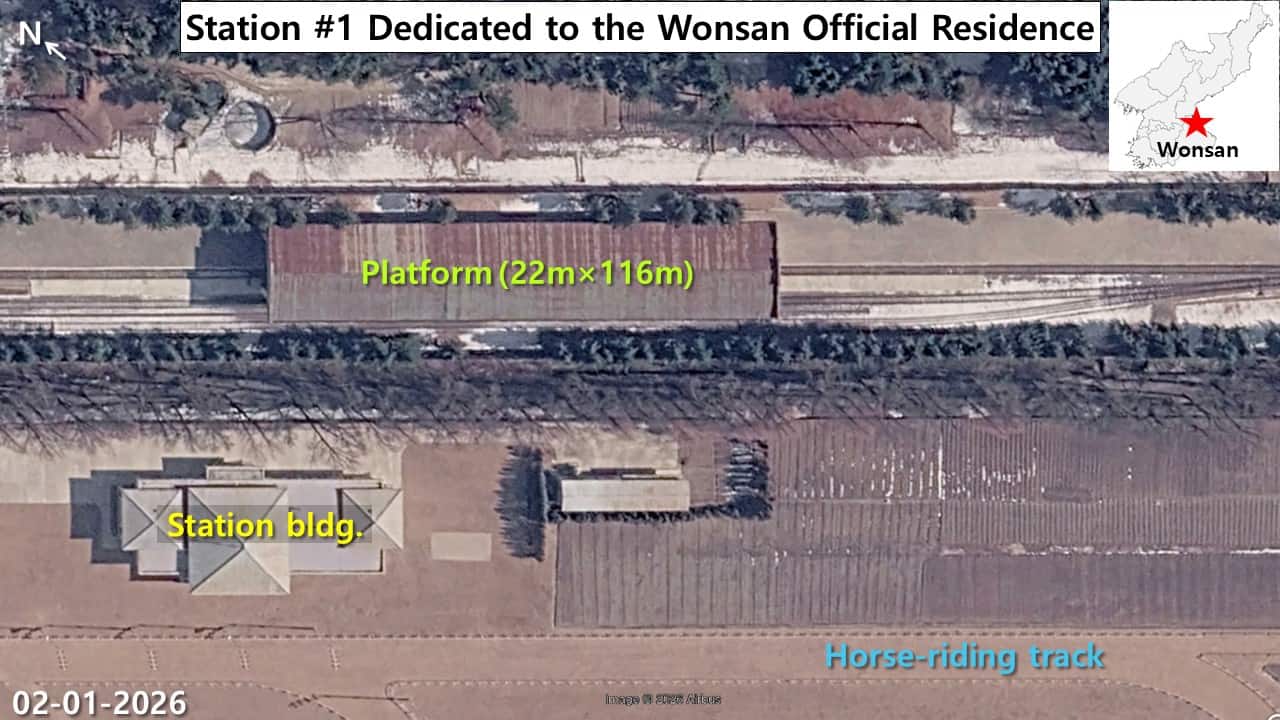
Wonsan Residence No. 1 Station, located near the Kalma Peninsula in Wonsan, Kangwon province, is the exclusive rail gateway to Kim Jong Un’s large leisure and resort complex on the east coast. It has been a focus of my satellite analysis on multiple occasions when his movements in the area have been detected. Most notably, in April 2020, when widespread speculation arose about his health, I identified his dedicated train stopped at the platform here, which became a key piece of evidence that he was still active. As at Ryongsong, ordinary passenger and freight trains are barred from the dedicated platform and must pass through on a separate outer track.
The station building below the platform serves a dual purpose: a temporary working space for Kim Jong Un before or after boarding, and a permanent control facility where Supreme Guard Command personnel manage security and communications.
The equestrian track adjacent to the station is one of the clearest examples I have seen of the supreme leader’s personal preferences reshaping North Korean infrastructure. The site was originally a private airstrip, giving Kim Jong Un direct light-aircraft access to the resort complex. The runway was demolished and replaced with a large horse-riding circuit and associated stable facilities to suit his well-known interest in equestrian sports. The result is a seamlessly integrated transit sequence: arriving by armored train, passing through the station building, and moving directly to the riding track or the coastal complex, at no point exposed to the outside.
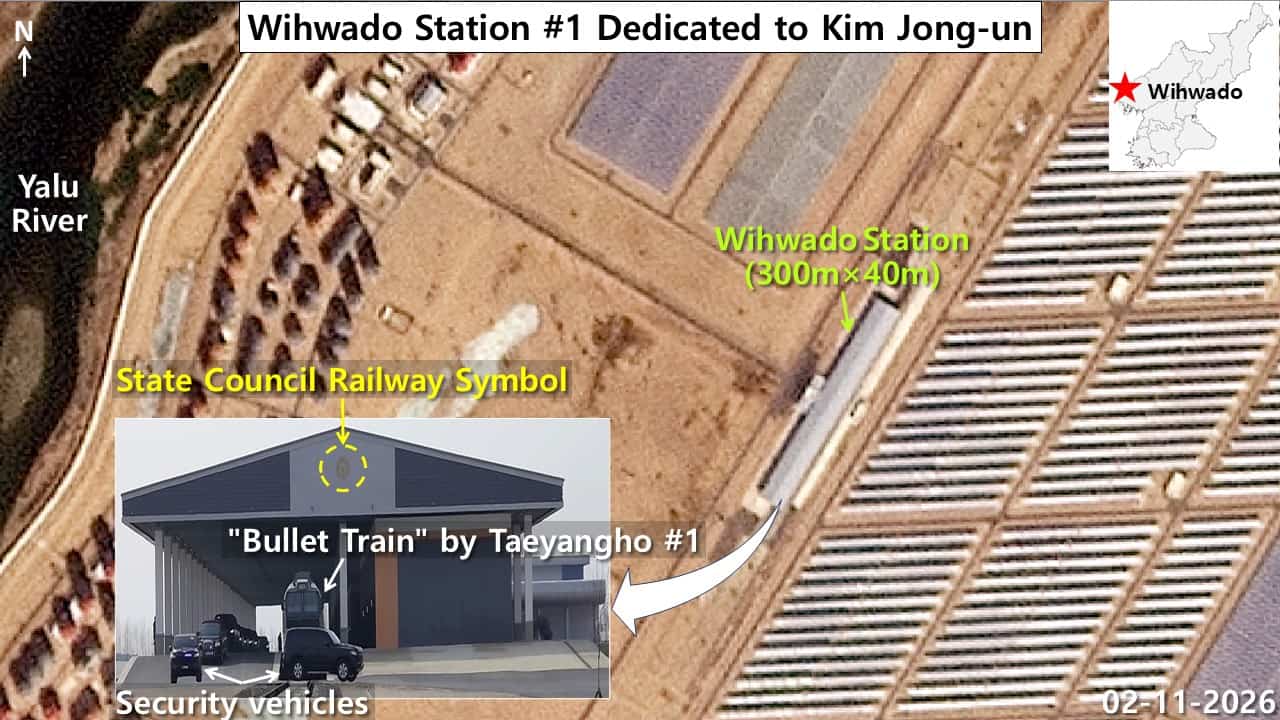
Wihwa Island No. 1 Station in Sinuiju, North Pyongan province, was built rapidly and specifically for Kim Jong Un’s attendance at the inauguration of the Sinuiju Greenhouse Farm Complex on Feb. 1, 2026. Photographs from the ceremony show the State Affairs Commission rail emblem, denoting exclusive supreme leader use, prominently displayed on the side of the station’s large covered platform. The Taeyangho No. 1 was secured inside the platform during the event. In satellite imagery, I confirmed an enclosed roof structure measuring 300 meters by 40 meters, built immediately next to the greenhouse complex.
The station is laid out so that the supreme leader can step off the train and transfer directly to a waiting vehicle without any external exposure. On inauguration day, Kim Jong Un departed in a Mercedes-Maybach S-Class armored limousine, with close-protection personnel following in a convoy of high-performance SUVs. The entire facility was clearly purpose-designed with armored vehicle logistics and strict security protocols in mind, allowing the supreme leader to reach a high-profile state event as safely and quickly as possible.

Sinuiju Station, in the city center of Sinuiju, North Pyongan province, occupies a different role in this network. It is the terminus of the Pyongui Line connecting Pyongyang and Sinuiju and the principal border rail gateway between North Korea and Dandong, China. Kim Jong Un passed through it twice, in 2018 and 2019, traveling by dedicated train to China for summits with Chinese leadership. The platform roof I measured here runs 363 meters by 45 meters, larger than those at both Ryongsong and Wonsan, which reflects its dual role as a major passenger and freight hub and a secure crossing point for the supreme leader’s cross-border movements.
Unlike the three exclusively reserved No. 1 stations, Sinuiju Station is an open, multipurpose facility used daily by North Korean people on international and domestic services, as well as by freight trains. The station building handles passenger services on the Pyongui Line, freight inspection, and international customs processing. When Kim Jong Un’s train enters or passes through, the Supreme Guard Command imposes a full lockdown of the surrounding area. Sinuiju Station is, in that sense, a place of contradictions: everyday public infrastructure for ordinary North Korean people, and simultaneously the most security-intensive point on the supreme leader’s cross-border diplomatic route.
Why Kim Jong Un prefers the ‘rolling fortress’
The main reasons Kim Jong Un travels by rail rather than air come down to security and historical precedent. Aircraft are inherently vulnerable: sudden weather deterioration, mechanical failure, and the ever-present risk that an exposed flight path can be tracked by satellite or radar and targeted for interception. Rail travel through dedicated ground and underground networks eliminates that exposure entirely, whether within North Korea or when traveling overland to China or Russia. A train can also stop immediately in an emergency, enabling rapid evacuation to a nearby underground facility or secure zone.
There is a political logic to the preference as well. Kim Il Sung and Kim Jong Il both governed extensively from moving trains, receiving field reports and issuing directives en route. By doing the same, Kim Jong Un projects continuity with his predecessors and reinforces the regime’s sense of institutional permanence.
The Taeyangho No. 1 itself is, by any measure, an extraordinary piece of engineering. Its floor and walls are lined with high-grade armor plating capable of withstanding detonations beneath the carriage or external mortar fire, and every window is fitted with thick bulletproof glass. Each carriage is dozens of tons heavier than a standard rail car, which is why two large diesel locomotives must pull from the front simultaneously, keeping top speed to around 60 kilometers per hour. Inside, the train functions as a mobile command center: private bedroom, office, high-end lounge, and banquet space, supported by satellite communications and encryption systems that allow real-time contact with Pyongyang. A dedicated cargo carriage carries Kim Jong Un’s armored limousine and escort SUVs, so that a fully secured vehicle convoy is ready the moment the train pulls in anywhere.
Disclaimer : This story is auto aggregated by a computer programme and has not been created or edited by DOWNTHENEWS. Publisher: dailynk.com