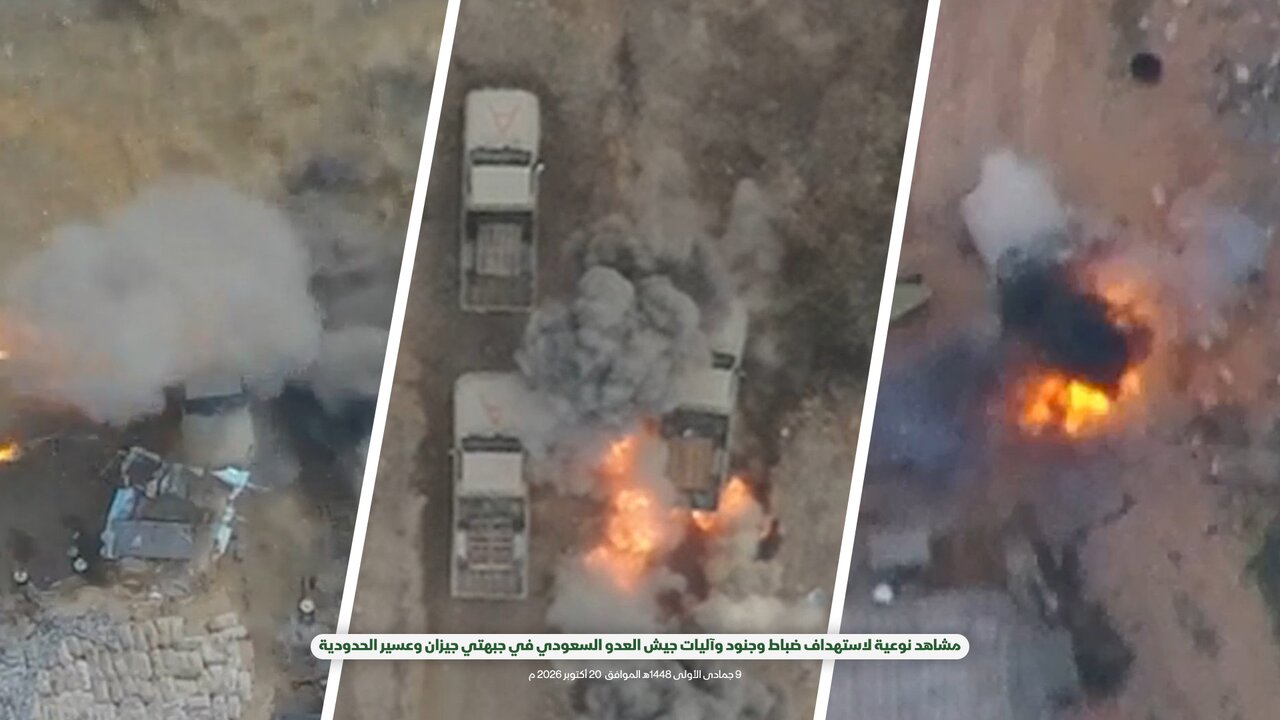
TEHRAN – Failing to protect itself and its proxies in southern Yemen, Saudi Arbia has turned to an American-AI generated system to unsuccessfully counter Yemeni Armed Forces (YAF), also known as Ansarallah.
The war between Ansarallah and Saudi Arabia was resumed after Saudi Arabia on July 13 prevented a passenger plane carrying Ansarallah officials from landing in Sanaa by bombarding the airport, forcing the plane to land at Hodeidah International Airport.
After this reckless move, Ansarallah declared an eye-for-eye reprisal and started to target Saudi facilities, including airports and oil infrastructure. It also began targeting Saudi vessels in the Red Sea in response to the blockade of Yemen which has been in force for more than a decade.
Feeling helpless, Saudi Arabia has asked numerous allies for help. That includes the United States, even though media report that Donald Trump refused when Saudi ruler Mohammed bin Salman asked him to take direct military action against Ansarallah.
Ansarallah’s latest military campaign, which primarily began in September, has taken further control of Yemen’s coast. So far, though, military campaigns against Ansarallah by Saudi Arabia, the United States and others have all failed.
Wary of Ansarallah, the U.S. is providing Saudi Arabia with intelligence, which includes a targeting tool that uses AI. A September report by U.S. broadcaster CNN, quoting several unnamed American officials, said that between 100 and 200 U.S. soldiers were in Saudi Arabia as part of new joint force command to facilitate this.
The U.S. personnel were helping the Saudis “use a targeting tool that allows military officers to see in real-time what is happening on the battlefield,” CNN reported.
Officials said the system in Saudi Arabia was similar to that known as the Maven Smart System, or MSS for short, which the U.S. military has also used as it sought targets in Iran, Iraq and Syria.
MSS came out of what’s known as Project Maven, the U.S. flagship artificial intelligence program for the military, first launched in 2017. MSS itself is an AI-enabled digital platform that “aggregates, organizes and visualizes vast streams of intelligence, surveillance and reconnaissance data,” analysts at the Center for Strategic and International Studies in Washington explained in a June text.
The software system identifies patterns in data coming from, for example, live satellite feeds or drone cameras and then labels potential targets such as possible rocket launchers, tanks or suspicious vehicle convoys.
Using the MSS dramatically speeds up what is known as “the kill chain” — that is, the time it takes to detect a target, decide if it’s dangerous and then order a strike.
Up until recently, the long-simmering war in Yemen had been comparatively calm following an informal ceasefire negotiated in 2022.
Yemen’s Ansarallah has held large parts of northern and western Yemen since 2015. The pro-Saudi government and other groups held territory across the south and east.
There are certain technical issues users have noted with the MSS in the past that could also prove problematic in Yemen.
Ansarallah tends to be highly mobile, using truck-mounted ballistic missiles and small drone swarms as they operate from hills and canyons in rugged countryside. It’s possible that fighters might be long gone before they can be attacked even with the help of AI-assisted targeting.
Though MSS is known to work best in relatively unpopulated areas, factors such as changes in desert terrain, dust storms, high wind, snowfall and dense foliage — and even deliberately planted decoys — can reduce its success rate.
There is also a worrying ethical aspect to shortening the kill chain. A human is always supposed to verify the target that the AI-assisted tool has identified and decide how to react.
But it doesn’t always work that way. For example, among the sites MSS targeted in Iran on the first day of the war was a school. An American missile killed almost 200 people at a primary school in southern Iran, most of them children aged between seven and 12.
In its military campaign in Gaza, Israel has also used AI-assisted targeting. An Israeli system known as the Gospel, or Habsora, is the closest to MSS in the way it works.
But, as has been documented elsewhere, including by Israeli and British journalists and in the recent documentary Naza, the use of such AI targeting tools have also been highly problematic because of the numbers of civilian casualties that can result.
“On the one hand [in Gaza], AI has enhanced commanders’ situational awareness, lessened the human costs of tunnel mapping, improved the speed of military strikes, and boosted the survivability of troops,” analysts Frederic Wehrey and Andrew Bonney wrote for War on the Rocks, a specialist media outlet. “Yet the benefits afforded by such functions have been overshadowed by mounting civilian deaths reportedly resulting from this technology’s safeguards being loosened or eliminated.”
All of which is why Antony Loewenstein, an independent journalist based in Australia who has researched the impact of Israel’s AI-assisted technology, doesn’t believe similar technology will lead to the defeat of Ansarallah.
“I don’t think there’s much evidence at all that using an AI tool is going to make much difference on the ground, except for causing huge amounts of civilian casualties,” Loewenstein, who authored the book, “The Palestine Laboratory: How Israel Exports The Technology of Occupation Around the World,” told DW. “And I think what the US and the Saudis will find is that the Houthis (Ansarallah) have an incredibly high tolerance level for destruction.”
Disclaimer : This story is auto aggregated by a computer programme and has not been created or edited by DOWNTHENEWS. Publisher: tehrantimes.com