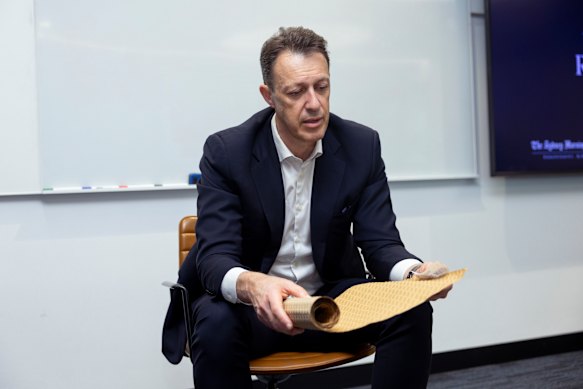

If you walk into a hardware store, you can now find rolls of “bubble wrap” made from paper. The product has the same performance as plastic for about the same price, but the rolls are a lot thinner because it has a honeycomb design rather than air bubbles.
Yet the real beauty of it, says Visy chief executive Mark De Wit, is what happens when you are finished with it.
“We’ve all had bubble wrap before … it’s a soft plastic so it ends up in landfill, and somewhere between 500 and 1000 years later, it might disintegrate into microplastics,” De Wit said. “This [paper bubble wrap] can go in your recycle bin, and we’ll turn it back into a box within a few weeks of it being collected from your house.”
This is just one of a host of innovations in consumer products and packaging that has occurred in the past five years, since this masthead and Visy started hosting an annual recycling roundtable with business leaders and the federal environment minister of the day.
Other examples from Visy alone include cardboard replacements for the plastic protective sheets used by painters and renovators, fruit and vegetable punnets made from recycled cardboard, new insulated material made from reused cardboard to replace polystyrene.
Asahi Beverages has replaced the plastic shrink wrap around Carlton Dry six-pack bottles with innovative fibre-board packaging. The company’s Australian primary packaging (excluding caps and labels) was 100 per cent recyclable, reusable or compostable for the first time last year.
Nu-Pure has decreased the volume of plastic resin in its water bottles. The company’s 600ml round PET bottle produced in NSW now weighs just 8.59 grams, plus 1.3g for the lid, making it one of the lightest still water bottles in Australia.
Several companies are now supplying disposable coffee cups to cafes where the cup and lid are made entirely out of compostable and biodegradeable fibre to Australian standards.
Another achievement is that Australian-produced glass now contains 54 per cent recycled content. For Visy, it had increased from 30 per cent to 64 per cent and was expected to reach 70 per cent by next year once the company’s new facility in Yatala, Queensland was complete. This put Australia on par with Germany and New Zealand “and a country mile ahead of everyone else”.
But the failure of the federal and state governments to agree on national packaging standards has stymied growth. Last week, Suzanne Toumbourou, chief executive of the Australian Council of Recycling, put out a statement decrying the lack of federal government action.
“Australians are doing their part,” Tomoubourou said. “Recyclers have invested. But the Australian government is betraying that effort by delaying the packaging rules it promised, while more plastic goes to waste and Australian recycling capacity shrinks.”
Australians use more than 1.3 million tonnes of plastic packaging every year, but only 19 per cent is collected for recycling, leaving more than one million tonnes to wind up as landfill or litter. Yet Toumbourou said about 320,000 tonnes of Australian plastic reprocessing capacity was standing ready, much of it sitting idle, awaiting the government reforms. This left recyclers in severe commercial peril with some plants facing closure, she said.
The industry has been saying for several years that mandatory national standards for packaging are needed so that companies can invest with confidence. The Albanese government has talking about legislation since 2022, but former environment minister Tanya Plibersek and current Environment Minister Murray Watt say the problem has been getting the states and territories to agree.
“When I discuss these things with states, some are completely on board,” Watt said at the roundtable on Friday. “Some are very concerned about what might be quite minimal cost increases for consumers.”
Watt said packaging would be on the agenda at the next meeting of the federal, state, and territory environment ministers in September. One option for Watt could be using national policy payments to states to encourage them to come on board with national standards.
De Wit said the economics of glass, cardboard and aluminium recycling made sense because they were a comparable cost to virgin material. That was not true for hard plastics – including the PET bottles such as water and soft drinks and the HDP bottles such as cloudy milk bottles – because the recycled resin had fixed costs based on collection and processing, while the virgin product was tied to the price of oil and fluctuated wildly.
“As a producer of this recycled resin, we see the sales go strong when the virgin price is up here, and then drop off when they’re down here because a lot of companies buy the cheapest, whatever that is, virgin or recycled,” De Wit said.
“What I would like to see is what they’ve done in the 27 EU countries, in the UK, in California, Washington State, New Jersey, where they’ve said because of this exact issue, there has to be 25 per cent minimum recycled content in every plastic bottle.”
De Wit said the additional cost would between half and one cent per bottle, so it would “not contribute one iota to a cost of living crisis”.
Another issue requiring government action was that imported drinks were not held to Australian standards. A plastic drink bottle produced in Australia had to have a wrapper that could be recycled with the bottle. But imported drinks such as those found in Asian supermarkets had PVC wrappers that contaminated the waste stream – one 3g wrapper would contaminate 150 kilograms of PET plastic recycling, which meant 7500 bottles could no longer be processed into food-grade packaging.
George Zoghbi, chief executive of Arnott’s Biscuits, said he had two things on his wish list.
“One is curbside collection for everything, including soft plastic because if you can do that at scale, it changes the game for everybody, and it makes the cost of recycling significantly cheaper, and the take-up rate significantly higher,” Zoghbi said.
“The second one is that it’s very hard for consumers to look at these chemical symbols and say which colour bin you should use. Instead, you could put dots on the packaging that matches the colour of the bin – if it’s a red dot, it goes in the red bin; if it’s yellow, it goes in a yellow bin.”
This would require states and territories to harmonise their bin collection systems.
Get to the heart of what’s happening with climate change and the environment. Sign up for our fortnightly Environment newsletter.
 Caitlin Fitzsimmons is the environment and climate reporter for The Sydney Morning Herald. She was previously the social affairs reporter and the Money editor.Connect via email.
From our partners
Disclaimer : This story is auto aggregated by a computer programme and has not been created or edited by DOWNTHENEWS. Publisher: www.smh.com.au