
TOKYO –
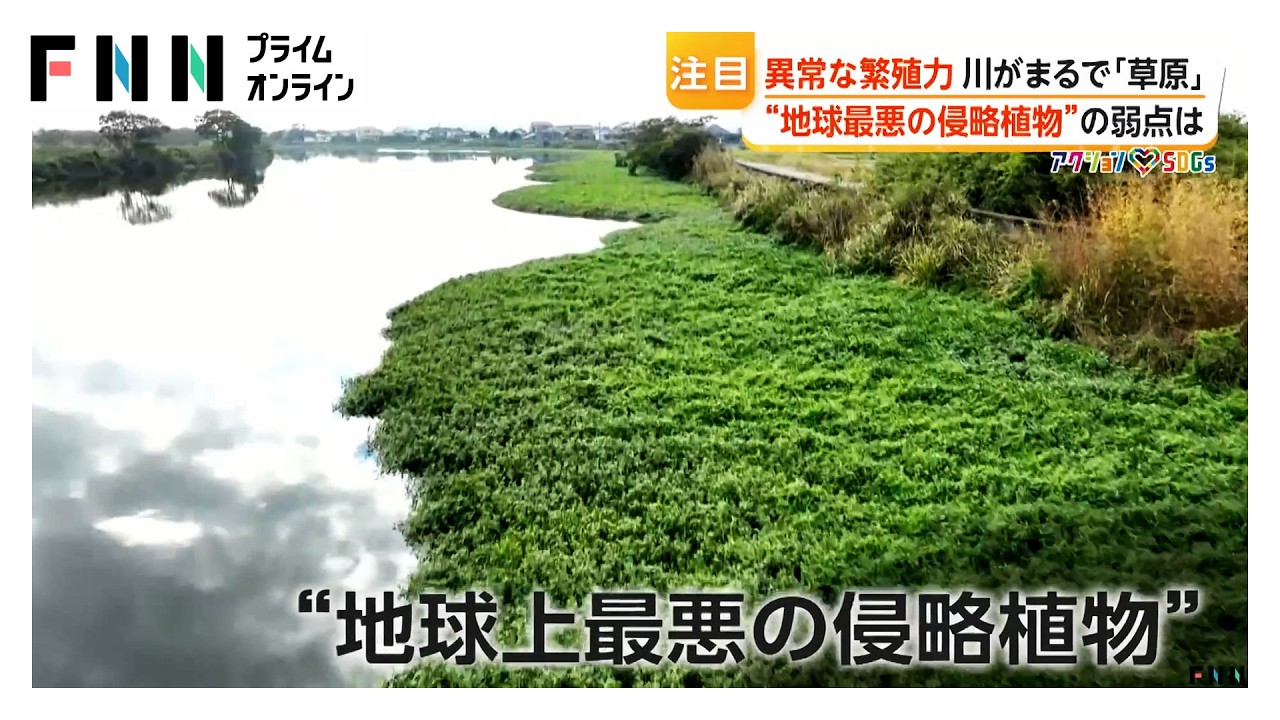
Scientists at Toyo University have identified a possible weakness in alligator weed, an invasive aquatic plant described as one of the world’s worst, raising hopes of finding a way to control its extraordinary ability to regenerate as it spreads through Japan’s waterways, threatens agricultural land, and creates growing concerns about flooding.
The plant, known scientifically as Alternanthera philoxeroides, is native to South America and has been designated a specified invasive alien species under Japanese law. Its remarkable reproductive capacity allows it to spread rapidly across rivers, lakes, irrigation channels, and farmland, making eradication extremely difficult even with heavy machinery.
In Chiba Prefecture, large sections of waterways have become covered by dense mats of vegetation, transforming what were once open stretches of water into thick green carpets. Excavators have been deployed to remove the plants, but the scale of the infestation has made complete removal almost impossible.
Residents say the situation has deteriorated rapidly, with some waterways now almost entirely concealed beneath vegetation. One local resident explained that areas extending toward a nearby floodgate had become overgrown, raising fears that the plants would eventually cover the entire waterway.
Naoki Hirotsu, a professor at Toyo University who has studied aquatic plants for more than 15 years, said alligator weed possesses an unusual ability to reproduce from fragments of its own stems.
Even a piece measuring just 1 centimeter can regenerate into a new plant, effectively producing a clone of the original. The process can occur both in water and on land, allowing the species to establish itself in a wide range of environments.
Hirotsu said the plant appears to be spreading throughout Japan primarily through regeneration from broken stems, making it particularly difficult to identify an effective weakness.
Its rapid growth also creates problems for water management infrastructure. As stems grow and intertwine, they form dense masses that can drift into drainage facilities and become entangled in pumps.
If pumping equipment stops functioning because of blockages, drainage systems may be unable to prevent flooding during periods of heavy rainfall.
The plant is also advancing into agricultural areas, including rice paddies and the irrigation channels that supply them.
At one farming location, the weed had established itself along a pathway beside a rice field. A farmer said the plants had appeared for the first time this year, despite being absent from the same location the previous year.
Once established on agricultural land, alligator weed can obstruct waterways and interfere with crop growth, creating additional difficulties for farmers already managing increasingly unpredictable weather conditions.
The threat intensified when Typhoon No. 25 brought record-breaking rainfall to Chiba Prefecture in October, causing a levee at Lake Inbanuma to collapse and sending muddy floodwaters into surrounding residential and agricultural districts.
The flooding may also have carried large quantities of alligator weed into previously unaffected areas.
Residents reported that substantial masses of vegetation had been swept away by the floodwaters, although their eventual destinations remained unknown.
The plant’s stems are hollow, making broken fragments light enough to float. Once detached, they can travel considerable distances downstream before settling and regenerating into new plants.
Researchers and local residents believe the October flooding may have transported fragments more than 1 kilometer from their original locations near Lake Inbanuma.
One resident expressed concern that nobody yet knew where the displaced vegetation had ended up, warning that its arrival in additional waterways could create serious problems.
The effects were particularly visible at a rental boat business beside the lake, where large quantities of vegetation washed onto the property following the typhoon.
The operator said the volume was unprecedented, with truckloads of material accumulating in an area that had never previously experienced such extensive deposits.
Even two weeks after the storm, large piles of the invasive plant remained in a corner of the property.
Removing the vegetation is complicated by regulations governing specified invasive alien species. Transporting the plants while they remain alive is prohibited in principle, and special precautions are required when disposing of the material.
According to the Chiba prefectural government, effective removal requires uprooting the plants, placing them in sealed containers or bags, and ensuring they are completely dried and killed before disposal in accordance with municipal regulations.
These requirements place a substantial burden on businesses and residents dealing with infestations.
The boat rental operator said tackling the problem independently was effectively impossible, describing the plant as something that keeps returning regardless of how much is removed.
“It’s like a zombie,” the operator said, expressing frustration that the same work would apparently have to be repeated indefinitely.
Chiba Prefecture has already spent more than 1.7 billion yen on efforts to remove the invasive vegetation, including large-scale operations using heavy machinery. Despite that expenditure, authorities have yet to find a lasting solution capable of preventing its spread.
The growing problem has also attracted attention from national political leaders.
Takayuki Kobayashi, chairman of the Liberal Democratic Party’s Policy Research Council, indicated that the party would consider expanding support measures to help affected communities and local governments control the plant.
Kobayashi said the issue should be recognized as a nationwide problem rather than one confined to Chiba Prefecture.
“I believe we need to recognize this as a nationwide issue, not just a problem for Chiba Prefecture,” Kobayashi said. “We will carefully consider within the party whether additional measures can be taken beyond the existing framework.”
The central government already operates a system providing financial assistance for local efforts to control invasive species, but the scale of the infestation has prompted calls for stronger intervention.
Against this background, a Toyo University research team has been investigating the environmental conditions that influence the plant’s extraordinary regenerative abilities.
The researchers are examining how changes in light, temperature, and nutrient availability affect the ability of small stem fragments to develop into new plants.
Their objective is to identify conditions under which regeneration becomes slower or more difficult, potentially providing a scientific basis for future control methods.
An experiment observed by television reporters began three weeks before the findings were presented.
Researchers first cut alligator weed stems into fragments approximately 1 centimeter long. The pieces were then placed in a liquid containing nutrients intended to simulate conditions found in Lake Inbanuma and agricultural waterways.
The samples were transferred into specialized equipment capable of maintaining controlled temperature and lighting conditions.
For this experiment, the temperature was kept constant at 25 degrees Celsius, while the fragments were exposed to continuous light throughout an 18-day observation period.
During approximately the first week, researchers observed little visible change in the stems.
However, after around 10 days, new shoots began emerging from the fragments, demonstrating the plant’s regenerative ability even under the controlled conditions.
By the end of the 18-day experiment, two new shoots had developed, reaching approximately 5 centimeters in length. Roots had also begun to form, indicating that the small fragments were successfully regenerating into independent plants.
Although the growth confirmed the weed’s resilience, Hirotsu noticed something unexpected.
The newly developed shoots were shorter than he had anticipated.
“I felt that the amount of growth in terms of length was smaller than expected,” Hirotsu said. “It may be possible that continuous exposure to light slows the speed of regeneration.”
The observation raised the possibility that uninterrupted illumination could affect the plant’s ability to regenerate, potentially revealing an environmental condition that limits its growth.
However, Hirotsu emphasized that the results of a single experiment were insufficient to establish whether continuous light genuinely suppresses regeneration.
Further experiments will be necessary to determine whether the slower-than-expected growth was caused by the lighting conditions or other factors.
The findings are particularly interesting because alligator weed is otherwise capable of vigorous growth under favorable conditions, and controlling its reproduction has proved exceptionally difficult.
If researchers can establish specific combinations of environmental conditions that slow or prevent stem regeneration, the discovery could eventually contribute to more effective methods for managing infestations.
Hirotsu said his team intends to expand its investigations to examine different temperatures, lighting patterns, and nutrient concentrations in water.
The researchers hope that identifying the conditions under which the plant struggles to regenerate will provide practical guidance for limiting its continued expansion.
“We hope that if we can find conditions that slow down or suppress regeneration, we may eventually be able to prevent further spread,” Hirotsu said.
For farmers, local businesses, and communities already struggling with the invasive species, the research offers a possible direction toward a solution, although no effective treatment has yet emerged from the experiment.
With flooding capable of transporting even tiny stem fragments into new areas, preventing further dispersal remains an urgent challenge.
The research team plans to continue investigating the plant’s biological characteristics in the hope of developing an effective method of control, potentially reducing the financial and environmental burden imposed by one of the world’s most persistent invasive aquatic plants.
Source: FNN
Disclaimer : This story is auto aggregated by a computer programme and has not been created or edited by DOWNTHENEWS. Publisher: newsonjapan.com




