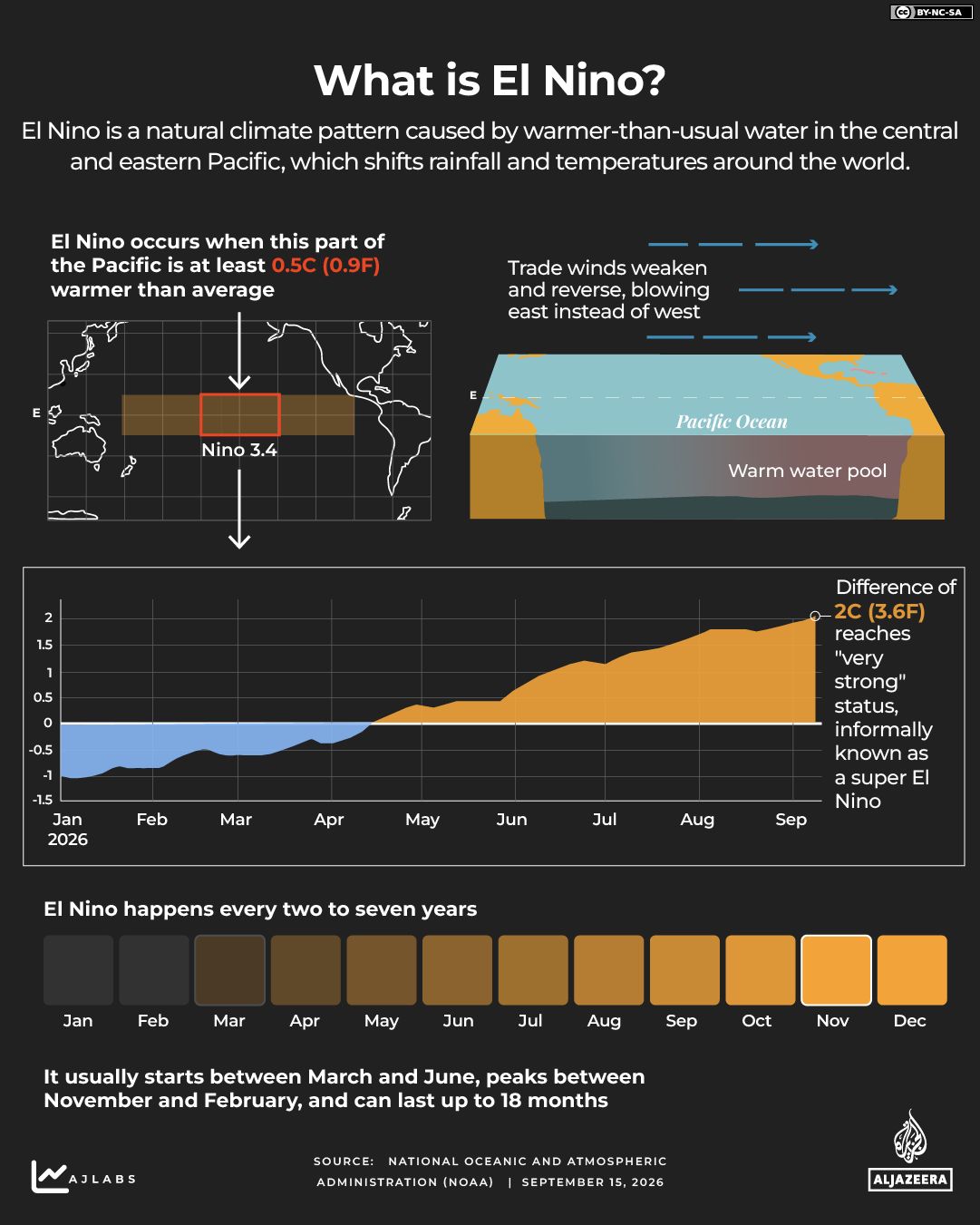
The record global heat caused by this year’s powerful “super El Nino” could cause nearly half a million excess deaths worldwide by early next year, according to a report (PDF) published by the global research collaboration, Climate Impact Lab, on Wednesday.
So what does the report reveal, how has climate change supercharged the effects of El Nino and should we all be really worried?
Recommended Stories
list of 3 itemsend of list
What does the report say?
Climate Impact Lab (CIL)’s report has found that as many as 451,000 more heat-related deaths between June this year and the end of February 2027 could be caused by the effects of El Nino, than the number expected in an average year.
The study’s authors came to their projections after researching the relationship between temperature and excess mortality in 24,378 regions, taking local climate and vulnerability into account.
They combined those findings with temperature forecasts to estimate excess deaths which could arise from heat caused by El Nino compared with the 1996-2025 average.
Their methodology will be published in a peer-reviewed journal.
The number of extremely hot days is likely to rise by 44 percent compared with normal years, according to the report, titled, “451,000 at Risk: Where Action Can Save Lives During the Super El Nino”.
The researchers described this year’s El Nino as a “postcard from the future”, ushering in temperatures that will become the new normal in just a few decades.
It recommended that emergency response efforts should be directed to high-priority regions to tackle heat-related mortality in the coming months.
Advertisement
CIL’s Adaptation Inventory recommends implementing a number of measures to help vulnerable populations cope with extreme heat, including issuing heat warnings, increasing the number of staff at medical facilities during the hottest periods, establishing cooling centres where people can shelter and implementing protections for outdoor workers.
“This report allows decision-makers to see exactly where emergency actions can be taken now to save tens of thousands of lives in the coming months,” said Michael Greenstone, economist at the University of Chicago and cofounder of CIL.
What is super El Nino?
El Nino is the period of time during which the central and eastern equatorial Pacific Ocean heats up to at least 0.5 degrees Celsius (0.9 degrees Fahrenheit) above average temperatures. It takes place every few years and is part of a natural climate cycle that alternates between a warm phase – El Nino – and a cool phase, known as La Nina.
During El Nino, the warmer ocean water can drive major changes in global weather patterns.
Scientists and meteorologists classify El Nino as “super” when ocean surface temperatures reach or exceed 2C (3.6F) for a few months. The current El Nino reached 2.7C last month, and some forecasts say it could rise to 4C when it peaks somewhere between November and December.
Why is it so bad this year?
The way El Nino develops depends a lot on “how the atmosphere and the ocean are behaving”, Akshay Deoras, senior research scientist at the University of Reading’s National Centre for Atmospheric Science & Department of Meteorology, told Al Jazeera.
Early in the year generally, “you get winds blowing towards Indonesia and these winds pile up warm water over there. But sometimes, if the winds weaken or the wind pattern is reversed, then that’s when you get strong winds from the Indonesia side, and that leads to a lot of transport of warm water”, Deoras explained.
This warm water then heads towards the eastern equatorial Pacific Ocean, resulting in El Nino.
“This year, we have really seen these strong winds from Indonesia blowing in the spring season, and they help to transport a large amount of hot water or let’s say warm water, and that’s why we have a super El Nino.”
What effects will it have?
Despite its unprecedented strength, it remains unclear what effects this year’s super El Nino will have on weather around the world.
“Scientists are still assessing whether the impacts will be in proportion to its magnitude, but we are already seeing expected effects worldwide,” said Adam Scaife, head of long-range forecasting at the United Kingdom’s Met Office.
Advertisement
“Historical evidence shows that El Nino can significantly alter global rainfall patterns,” the Met Office said in a statement.
Regions that often experience reduced rainfall during this period include parts of Central and northern South America, the western Pacific and areas affected by the Indian summer monsoon.
Other areas, including Southern Africa, may face an increased risk of drought.
El Nino also reduces tropical cyclone activity in the Atlantic, with the Met Office adding that no hurricanes have been observed yet this year.
The disruption to rainfall can have severe consequences on global food supplies as agriculture suffers and natural food-growing and harvesting seasons are altered.

Why could El Nino cause so many excess deaths?
The main thing that El Nino does “is it just dumps a lot of heat into the atmosphere and we know that this heat and high temperatures basically supercharges extreme rainfall and weather events”, said Deoras.
A super El Nino not only increases the frequency of these events, but also amplifies their intensity and severity, meaning that there is a “general expectation that we would get more of these extreme weather events across the globe over the next couple of months, and unfortunately, that could translate into a lot of deaths,” said Deoras.

How is climate change involved in this?
Friederike Otto, professor of climate science at Imperial College London, said that climate change has worsened the impact of El Nino around the world.
“El Nino is likely to bring higher global temperatures and extreme weather impacts in the months ahead, and climate change will further exacerbate these impacts, as the underlying heat driven by fossil fuel emissions continues to push global temperatures higher,” said Otto.
“However, while El Nino patterns are a natural phenomenon that come and go, climate change does not and will only continue to worsen unless we take much faster action globally to move away from fossil fuels.”
Which countries will be worst affected and why?
The Climate Impact Lab report warns that countries in the Global South will bear the heaviest burden of the excessive heat.
The country likely to suffer the most excess heat-related deaths is Nigeria with 31,400, followed by Indonesia with 19,300 and Sudan with 17,600.
Heat in Africa’s Sahel region, including Niger and Chad as well as Nigeria and Sudan, is likely to cause an additional 66,800 deaths.
The researchers also predict that the Philippines, Vietnam, Thailand and Cambodia will suffer an additional 19,400 deaths combined.
The number of excess deaths could climb higher if El Nino extends further into next year, with key areas of the Northern Hemisphere, including India and Pakistan, especially vulnerable during their summer months.
Tom Burke, cofounder and director of the climate change think tank E3G, agreed that the Global South would be disproportionately affected.
“Coping with the additional stresses caused by El Nino is harder on countries that have weaker institutions. So the poorer a country it is, the weaker institutions it has,” he told Al Jazeera.
Advertisement
Countries of the Global North, by contrast, have “a whole variety of institutions to respond to these kinds of stresses: fire departments, health systems, etc. They have a quite complex set of institutions to respond to events like this”.
Deoras said added that “it’s quite difficult to” assume that El Nino will impact the Southern Hemisphere more, as “we haven’t really seen an El Nino of this nature in the past, so there could be surprises and extreme weather events can happen even in the Northern Hemisphere”, adding that he expects “to see these impacts happening across the globe”.
Are nearly half a million people really going to die?
Burke told Al Jazeera that he believes this figure is actually a conservative estimate, since it only refers to heat-related deaths.
El Nino also has “an effect because of fires and floods, which will lead to increased deaths” and is compounded by conflicts like the US-Israel war on Iran, which will “likely lead to a big impact in food price inflation and in turn to a harder-to-record increase in deaths”, said Burke.
Deoras said the report’s figures are “subjective” and that he’s “sceptical about regional distributions”, all of which makes it difficult to calculate such an exact toll.
“For example, over 15,000 excess deaths are projected for India until February 2027, which is not so convincing, since it’s not going to be summer for India when deadly dry heatwaves strike.”
However, he does maintain that there’s a “good chance that we would expect a lot [in the coming 12 months] of these impacts in terms of deaths and also damage to property, infrastructure and the economy”.
Disclaimer : This story is auto aggregated by a computer programme and has not been created or edited by DOWNTHENEWS. Publisher: aljazeera.com