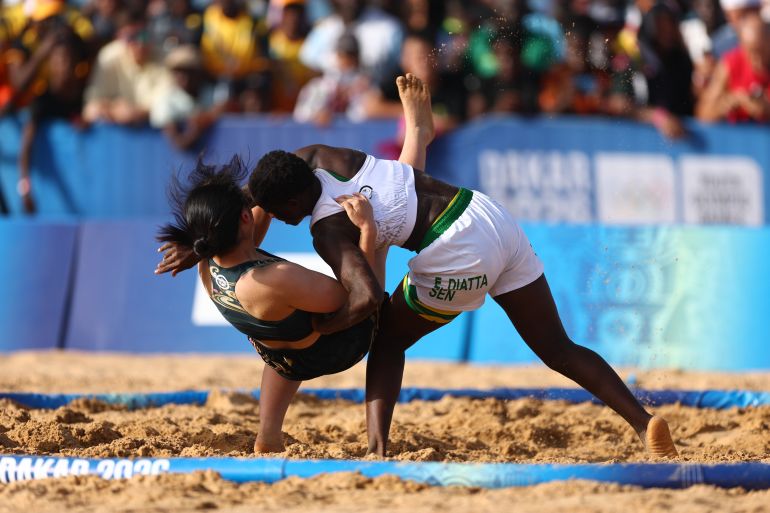
She wasn’t even supposed to be there.
Sixteen-year-old Elisabeth Diatta is from the southern Senegalese region of Casamance. Football was her sport, not wrestling.
Yet, On Saturday, there she was on the sand at Saly beach, representing Senegal in beach wrestling at Dakar’s Youth Olympics, almost instinctively seizing her opponent and throwing her down. Then came the whistle, the referee’s look, the confirmation, the disbelief. She celebrated like Cristiano Ronaldo; the leap, the turn, the “Siu!”
At 16, she had beaten Japan’s Reisa Kojima 5-1 in the 55kg final to win Senegal’s first Youth Olympic gold.
A teenage girl had delivered a medal in a sport so often described as belonging to men.
The crowd roared. Diatta danced, defiant, before wrapping herself in green, yellow and red. Beneath the Senegalese flag’s green star, a new star was born.
Her path here began when her older sister Jeannine was injured and could not enter a wrestling tournament at a sport camp. Diatta took her place. She won her first bout. The footballer kept wrestling.
“They said wrestling would make me less feminine,” explains Diatta – the “they” she is referring to are the adults around here. Out of teenage defiance, she persisted in the sport.
Watching proudly was coach Isabelle Sambou, twice an Olympian herself. She had wanted this gold for Senegal long before her young wrestlers were old enough to compete.
Advertisement
“I wanted to win gold for Senegal when I was an athlete,” she said. “Today, I have my reward.”
She would soon have another reason to celebrate as another Senegalese teenage hopeful, 16-year-old Maguette Diop, stepped into the wrestling circle later on Saturday. Diop had been preparing for this moment long before the games, being held from October 31 to November 13 in the Senegalese capital Dakar and nearby towns of Saly and Diamniadio.
Three months in an intense training camp had helped Senegal’s young wrestlers adapt to beach wrestling, where the rules differed from those of their traditional sport.
In traditional Senegalese wrestling, a wrestler wins by bringing their opponent to the ground, typically onto their back, buttocks or knees, or by forcing them onto all fours. Unlike beach wrestling, there is no points system. One decisive fall can end the contest.
In beach wrestling, forcing an opponent outside the circle earns one point, as does a takedown. A throw onto the back earns three and ends the contest. Bouts last up to three minutes; the first to at least three points wins.
Diop had spent months preparing for this moment. On August 27, he had lost to Iran’s Reza Jalilian in the semifinals of the under-17 world championships in Baku. Barely two months later, on home ground, he was not about to let that happen again.
He reached the boys’ 80kg final feeling confident despite facing Azerbaijan’s Nihad Suleymanli, a two-time under-17 world champion. Suleymani wrestled with skill, ignoring the crowd cheering for Diop.
For a moment, the gold appeared to be slipping away. The referee awarded Suleymanli three points. Diop’s coaches urged a challenge. The replay reversed the decision: Those points belonged to Diop. He had won 4-0.
More dancing. More flags. Another Senegalese teenager with gold.
Here, wrestling runs deep. Long before the Olympic flame reached this Atlantic coastline, generations had gathered around circles of sand.
Laamb, Senegal’s traditional wrestling, carries the pride of villages and neighbourhoods. It is more than a contest of strength. Wrestlers seek spiritual protection through prayers, rituals and amulets believed to ward off evil spirits. All to the rhythm of sabar drums, traditional Senegalese percussion whose beats accompany the ceremonial dances, summoning courage and stirring the crowd.
In Casamance, where Diatta comes from, women have long wrestled too, even as men dominate the professional arenas.
“I hope this experience will give girls courage and determination,” said Ndeye Khady Anna Diatta, who added a third Senegalese gold in the 45kg category the following day.
Advertisement
By Thursday, Senegal stood sixth in the medal table – three of their five golds won wrestling on the sand.
For Africa, hosting its first Olympic sporting event, these victories offered something the rankings could not measure: young people seeing themselves in the athletes wearing gold, a familiar sport carrying them onto a world stage.
And for the girls watching Senegal’s female wrestlers, perhaps something closer still. A place inside the circle.
Disclaimer : This story is auto aggregated by a computer programme and has not been created or edited by DOWNTHENEWS. Publisher: aljazeera.com