
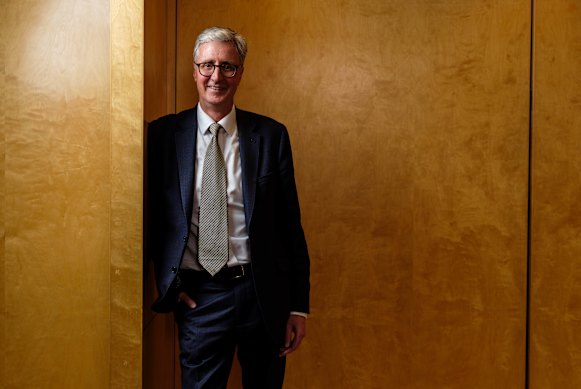
Simon Hickey has faced plenty of challenges overseeing the birth of the nation’s first major airport in half a century.
Three months after Australia was plunged into lockdown to thwart the spread of COVID-19, Simon Hickey took the reins overseeing construction of the nation’s first major airport in half a century. Navigating the unknowns of a pandemic was quickly followed by floods in western Sydney, bushfires and locust and mouse plagues.
Through sheer coincidence, the Western Sydney International Airport chief executive has often found himself at the centre of crises.
Twenty-five years ago, he was in his office in New York’s landmark MetLife Building working for Bovis Lend Lease when a colleague rushed in to tell him the World Trade Centre was on fire. “If you stepped outside my office, you could just look down and see the World Trade Centre,” he recalls.
“There was so much smoke, and then there was a flash, which was clearly the second plane going in. We turned on CNN, and it looked like a small plane. And then they slowed it down, so you could see what was going on, and it was clearly a passenger airplane. We realised at that point that there was a terrorist attack. That was the only thing that would cause that.”
The next day in a near-deserted Manhattan, Hickey – then the Australian company’s most senior executive in the Americas – visited the site of what became known as Ground Zero. “[It was] a moment in time when the world changed,” he says.
In the chaotic days that followed the September 11 terrorist attacks, Hickey played a pivotal role after Bovis Lend Lease was awarded a contract for the rescue mission. “It did change me in a way. It makes you a little introspective … about what you want to do in your life,” he says.
Those days in 2001 were the start of other consequential moments for Hickey.
A decade later, he was involved in arguably one of the most controversial decisions in Australia’s aviation history while serving as a senior Qantas executive. The grounding of Qantas’ entire aircraft fleet to break an industrial dispute in 2011 was, as he describes, a “monumental moment” and one he believes to this day was the right call. “I was on the executive committee that considered it, and I supported it,” he recalls.
After steering Qantas’ frequent flyer business, Hickey went on to become head of its international and freight operations. “It was a white-knuckle ride. We had to turn around an international business. It’s very different from growing a business from scratch,” he explains.
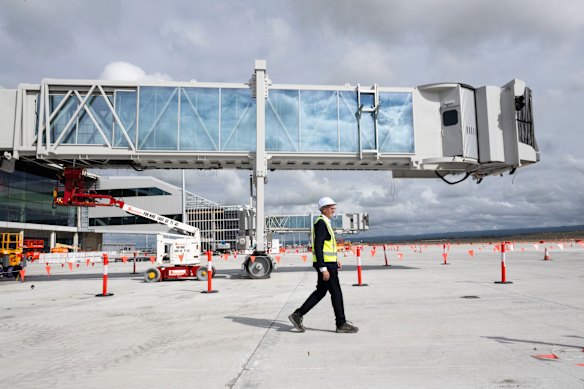
These experiences have influenced the man who has overseen the complexities of building a major new international airport and enticing airlines to fly passengers there when it opens to passengers on October 25.
Hickey, 61, concedes there was a “level of scepticism” when he was at Qantas that an international airport on Sydney’s western fringe would open a decade later. He certainly did not think he would be the person leading it. “You don’t know what’s in the future,” he laughs.
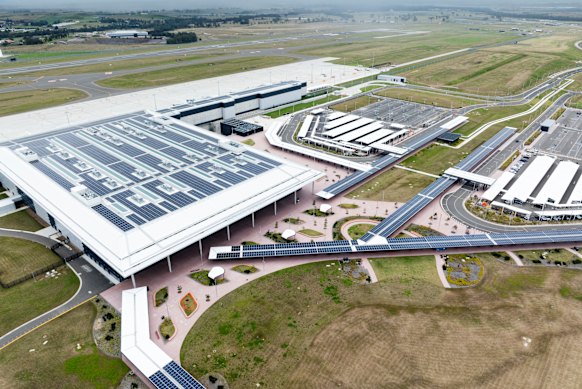
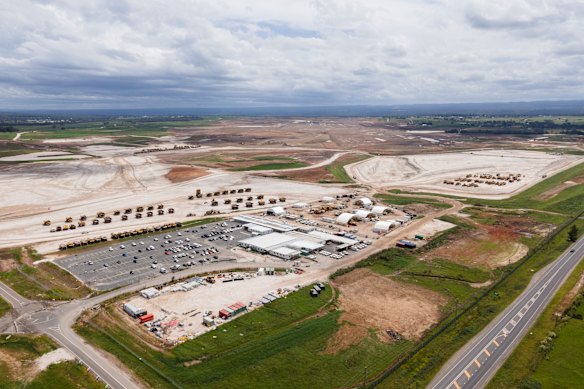
Having taken the reins at the Commonwealth-owned airport corporation during the early months of the pandemic in 2020, Hickey oversaw one of the largest earthmoving projects in Australia’s history as farmland was flattened for what was to become Western Sydney Airport. “We moved 27.5 million cubic metres of dirt. From the highest to the lowest point was the equivalent of a 12-storey building, and at one stage at the site we had the largest number of earthmoving pieces of equipment in the world,” he recalls.
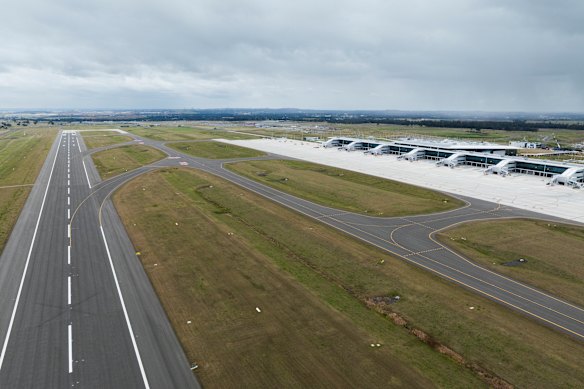
The major build was happening at the same time as work was shutting down due to the pandemic. And as the focus turned to constructing the runway and terminal, Hickey and his team faced two years when western Sydney was struck by one-in-100 year floods. “In a building project that’s exactly what you don’t want to see. We got excellent at working in those conditions, and kept on moving forward,” he says.
“We had two major plagues that came through after that. We had a mouse plague and there was a locust plague. The problem with that is they eat your cables. We’ve had bushfires up to the boundary.”
The first passenger flight from Western Sydney International (Nancy-Bird Walton) Airport on October 25 fires the starter’s gun on competition with Kingsford Smith Airport at Mascot. The fledgling rival’s trump cards are its curfew-free status and federal government ownership.
Yet, the privately owned incumbent has shown every intention of doing its utmost to retain its vice-like grip on aviation in the Sydney basin.
Hickey’s rival is Sydney Airport chief executive Scott Charlton, who earned a reputation as a dealmaker from his long tenure expanding Transurban into a toll-road powerhouse. He left Transurban in late 2023 for the role steering Australia’s largest airport.
Sydney Airport is now embarking on its largest expansion since the city hosted the 2000 Olympics by merging its two domestic terminals. Charlton says the goal is for it to become more efficient and exploit the benefits of its location about eight kilometres from the CBD.
Yet, there is little doubt that it is partly a response to the arrival of a competitor at Luddenham, more than 50 kilometres away by road.
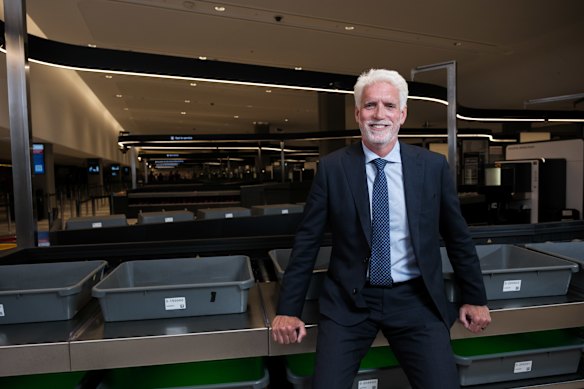
“We want to compete for every passenger,” Charlton says, adding that Kingsford Smith spars with Melbourne, Brisbane and Auckland airports for air traffic.
The silver-haired Texan, who counts one of his first jobs as designing laser-guidance systems for smart bombs, says he was impressed by the new airport when he visited for a sneak peek several years ago, and concedes that the new rival’s advantage is its curfew-free status.
“All great cities have two or three big airports, and we think that keeps the centre of aviation clearly in Sydney and NSW. It makes us sharper and more focused,” he says. “We’d rather share a bigger pie than have a smaller pie. Long term, it’s good for both of us.”
As a new chapter starts, one of the flow-on effects will be a cut to the number of aircraft granted exemptions to land at Sydney Airport during an overnight curfew. From November 1, up to 74 freight flights a week that have been permitted to fly over Botany Bay to land at Sydney Airport during the 11pm to 6am curfew will be forced to use the new airport.
Flight Centre founder and managing director Graham Turner says the two airports are likely to have different priorities in the short term: Sydney Airport in managing high demand at peak times and its rival in convincing airlines to fly there.
“It’s got a big catchment area, and it’s a growth area, western Sydney,” he says. “It’s a very positive sign that we have a major secondary airport in a place like Sydney. I’ll be surprised if it’s not a reasonable success.”
For Hickey, overseeing the construction and opening of the new airport is a career pinnacle. “To my mind, this is the most impactful piece of infrastructure that Sydney has seen since we built the Harbour Bridge. This is a lasting legacy for generations,” he says.
The next test has only begun for Hickey and his across-town airport rival.
Start the day with a summary of the day’s most important and interesting stories, analysis and insights. Sign up for our Morning Edition newsletter.
Disclaimer : This story is auto aggregated by a computer programme and has not been created or edited by DOWNTHENEWS. Publisher: www.smh.com.au





