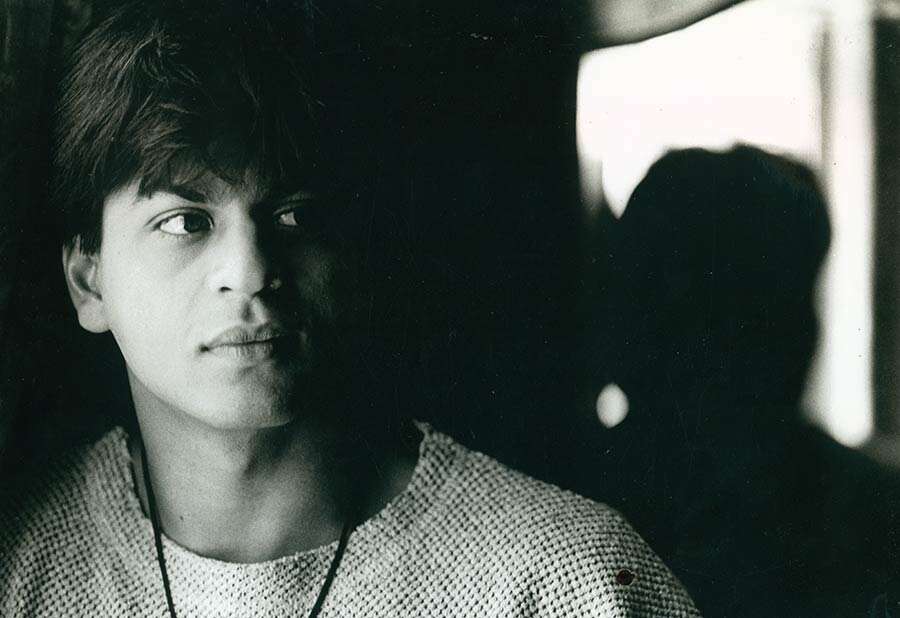
Ever since we began following Bollywood, particularly through the defining years of the 1990s and early 2000s, one name has remained synonymous with the magic of Hindi cinema: Shah Rukh Khan. A boy from Delhi with a suitcase full of dreams arrived in Bombay and went on to rule the city of dreams. With his signature dimpled smile, distinctive hairstyle and unmistakable charm, he challenged the idea of what a conventional Bollywood hero should look like. Through him, countless dreamers found themselves a little closer to the possibility of becoming stars themselves. He made the seemingly impossible business of being a movie star look effortless.
From Raj and Rahul to Aman Mathur, Om Kapoor and Rizwan Khan, the man behind these unforgettable characters has lit up our screens for over three decades. On his 61st birthday, we look back at what makes Shah Rukh Khan such an enduring part of our growing-up years: the superstar who shaped our ideas of pyaar, masculinity, dosti and dard (with a little disco thrown in).
Growing Up With Shah Rukh Khan
In many middle-class households, growing up with Shah Rukh Khan meant watching his films on television with the family, borrowing DVDs or catching a screening at a neighbour’s house during Eid. These shared viewing experiences created a community of fans. The youngest sibling and the oldest aunt in the family could be equally invested in his films. Among friends and cousins, we exchanged picture cut-outs, collected posters and painstakingly wrote down song lyrics. Shah Rukh Khan was almost a school subject in himself — one we could debate endlessly and, if required, top an examination in.
As teenagers, we understood what having butterflies felt like when Kajol’s bracelet got caught in Shah Rukh’s sleeve during the song ‘Yeh Ladka Hai Allah’ in Kabhi Khushi Kabhie Gham (2001). Playing Rahul Raichand, Khan embodied the sensitive, devoted son and the doting lover. His portrayal offered a version of masculinity that was gentle and emotionally expressive rather than intimidating. While Darr (1993) and Baazigar (1993) had introduced audiences to his darker, more unsettling side, Khan was already establishing himself as an actor capable of inhabiting vastly different personalities.
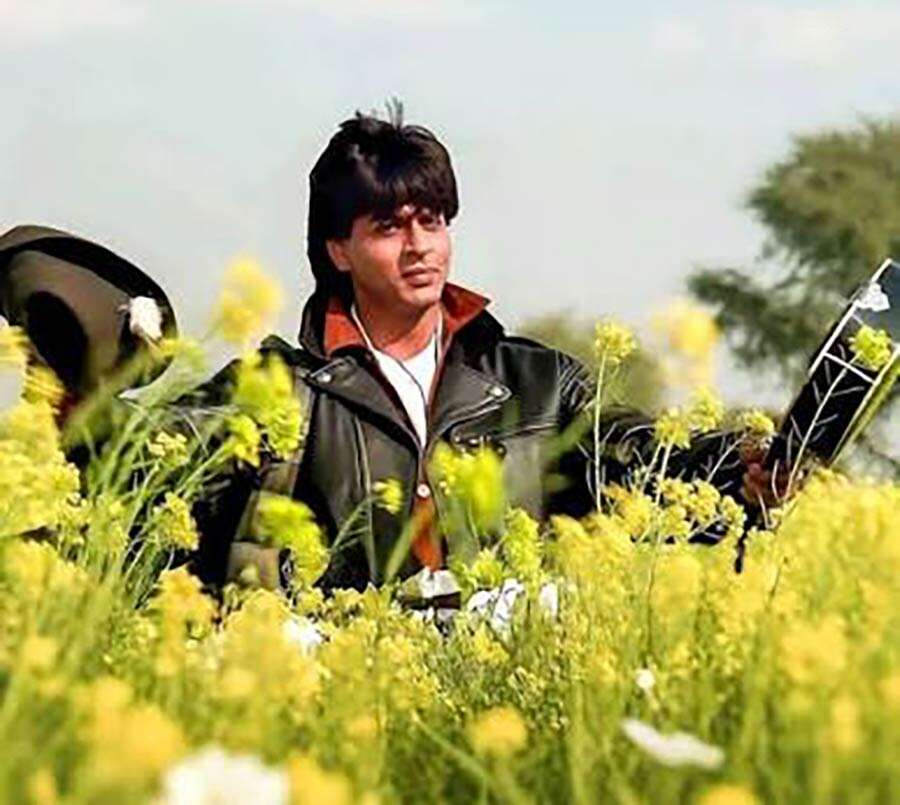
As someone born in 1997 and an old-school romantic, I gravitated more towards his lover-boy era. The first time I watched him spread his arms against a field of yellow mustard flowers in Dilwale Dulhania Le Jayenge, I wasn’t simply dreaming of running towards him. I wanted to imitate him — in a similar black leather jacket, with a mandolin in my hand. The connection was instinctive because his masculinity never felt threatening. At a time when mainstream Bollywood offered little distinct queer representation, I found in SRK someone I could aspire to be: as a lover, a friend and a child devoted to their family.
The Soundtrack to Our Growing-Up Years
For me, Shah Rukh Khan also represents a time when music and films could be preserved in physical forms — cassettes, DVDs and CDs. Every summer vacation at my grandparents’ home meant that a new Shah Rukh Khan film’s music cassette would eventually find its way to me. From Chalte Chalte, Main Hoon Na and Veer-Zaara to Om Shanti Om and Rab Ne Bana Di Jodi, the characters, songs and images became permanently etched in my memory.
In a way, SRK also became a shared love language. Later, when songs had to be painstakingly downloaded from websites, with the time taken depending on the internet connection, we would dedicate them to our crushes — or even to that friend who had quietly become something more. It makes perfect sense, then, that Rahul Khanna in Kuch Kuch Hota Hai (1998) famously said, “Pyaar dosti hai. Agar woh meri sabse acchi dost nahi ban sakti, toh main usse kabhi pyaar kar hi nahi sakta…”
The Man Who Made Us Dream Bigger
Shah Rukh Khan also taught dreamers like us to aim for the stars. When I first arrived in Mumbai, the city felt daunting. Over time, I began finding my footing here. Yet, every time I have stood outside Shah Rukh Khan’s home, Mannat, in Bandra, I have experienced a familiar sense of possibility. Looking at the imposing building overlooking Bandstand, I find myself thinking about the hope of one day building something of my own in a city I am still learning to belong to.
It is impossible not to recall the words from Om Shanti Om, a dialogue that feels almost tailor-made for Shah Rukh Khan: “Kehte hain agar kisi cheez ko dil se chaho toh puri kainaat usse tumse milane ki koshish mein lag jaati hai…” Through Om Prakash Makhija, SRK makes you believe that a setback need not be the end of the story. And so, through every high and low, I have found myself returning to another of his unforgettable lines: “Picture abhi baaki hai mere dost.”
A Little Dream, A Black Lady and a Lifetime of Possibilities
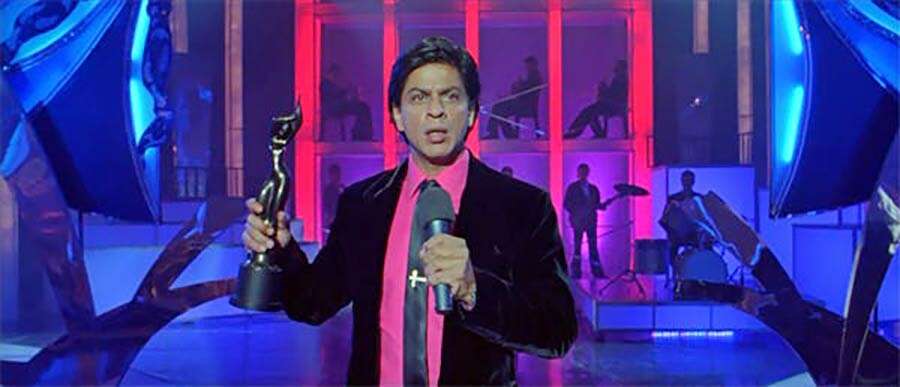
As I sit and write this from the Filmfare office, the Black Lady stands a little distance away. I have held the trophy, but I haven’t yet called it mine. And every time I think of Om Kapoor accepting his award and delivering his speech in Om Shanti Om, I remember how that moment, the look in his eyes and the conviction in his heart, made a little Zoya believe that she could have this too — and still dream of more.
Shah Rukh Khan, I have known you long enough to feel that you have been a part of my life, and yet I do not know you at all. Thank you for the memories, the smiles, the friendships I have because of you, and the dreams I still want to conquer because of you.
Happy birthday, King Khan.
ALso Read: Photos: Shah Rukh Khan Strikes His Signature Pose As He Greets Fans Outside Mannat on His Birthday
Disclaimer : This story is auto aggregated by a computer programme and has not been created or edited by DOWNTHENEWS. Publisher: filmfare.com