
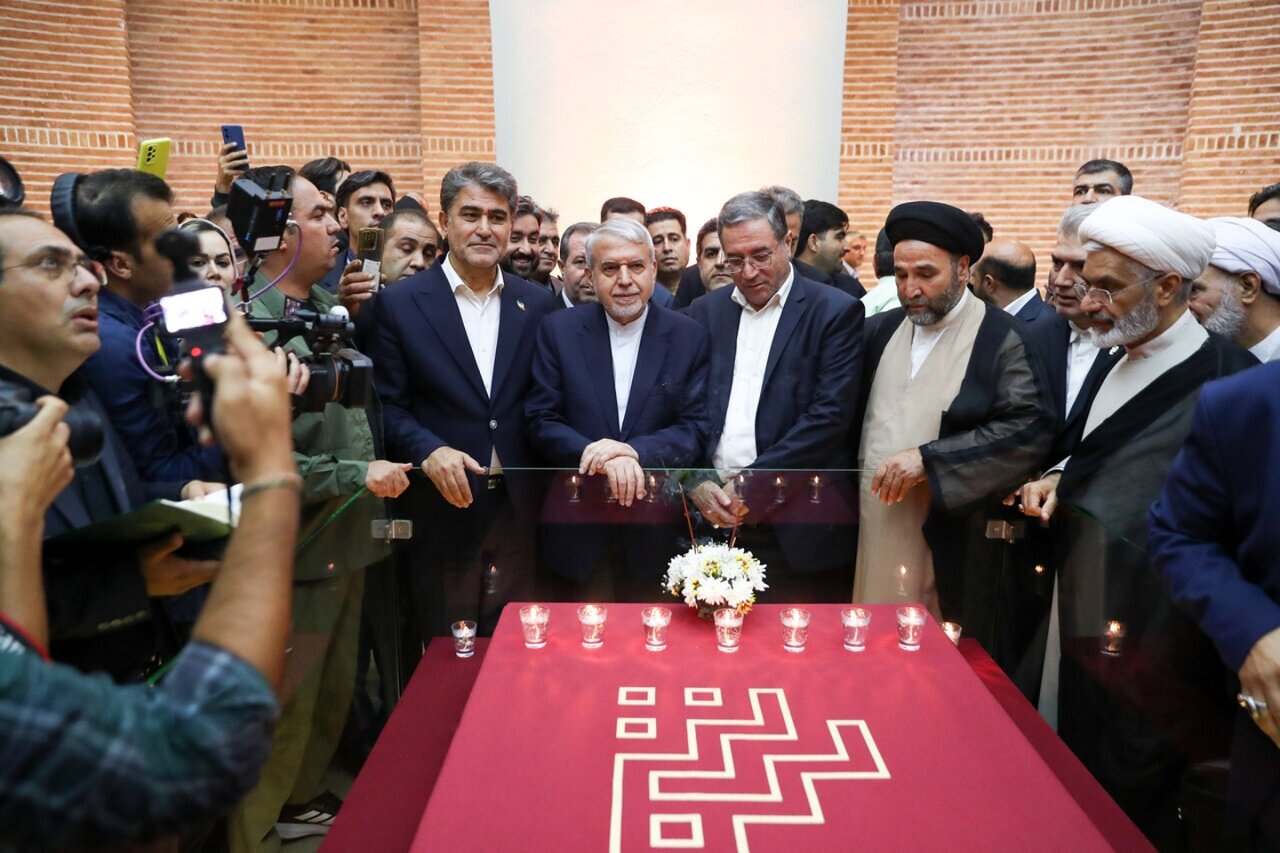
TEHRAN- The mausoleum of Shams Tabrizi in Khoy, West Azarbaijan province, has officially opened after two decades of anticipation, marking a new step in efforts to promote Iran’s Sufi heritage and cultural tourism.
The inauguration ceremony was attended by Minister of Cultural Heritage, Tourism and Handicrafts Seyyed Reza Salehi-Amiri, West Azarbaijan Governor Reza Rahmani, and a number of national, provincial and foreign dignitaries on Wednesday, October 7, ISNA reported.
A statue of Shams Tabrizi was also unveiled at one of Khoy’s main squares during the ceremony. The square was named after the celebrated mystic, further highlighting his longstanding connection with the city’s cultural identity.
The shrine complex, covering an area of 7,000 square meters, includes a domed chamber, an 8,000-volume library and research facilities. The site was inscribed on Iran’s National Heritage List on October 3, 2026.
The opening is expected to strengthen Khoy’s position as a destination for cultural and spiritual tourism, building on the city’s historical association with Shams Tabrizi, the 13th-century Persian mystic and spiritual mentor of the renowned poet Jalal al-Din Rumi.
Speaking to reporters on the sidelines of the inauguration, Salehi-Amiri announced plans to develop a nationwide Sufi tourism route connecting sites associated with prominent Iranian mystics.
The proposed route would extend from Shahroud, home to the mausoleums of figures such as Sheikh Kharaqani and Bayazid Bastami, to Khoy and the shrine of Shams Tabrizi. Other sites associated with mystics and philosophers, including Suhrawardi and Sohrevard, would also be incorporated into the broader itinerary.
The minister also announced plans for a cultural and spiritual corridor linking Khoy with Konya in Türkiye, where Rumi’s mausoleum is located. He said discussions and follow-up work on the cross-border initiative would resume when conditions in the country had stabilized.
Salehi-Amiri described the shrine’s inauguration as a starting point for further cultural projects centered on mysticism, acknowledging the efforts of officials involved in bringing the project to completion, particularly the provincial governor.
He also said the government intended to inaugurate one heritage structure each month, emphasizing Iran’s wealth of historical and civilizational landmarks.
The shrine’s opening and the unveiling of the statue represent efforts to integrate the legacy of Shams Tabrizi more visibly into Khoy’s urban landscape while developing the infrastructure needed to introduce his spiritual and literary heritage to a wider audience.
The proposed route to Konya could also provide a framework for closer cultural cooperation between Iran and Türkiye, connecting places associated with the enduring spiritual relationship between Shams and Rumi.
Shams Tabrizi (c. 1185–1248) was a Persian mystic and spiritual teacher whose encounter with Jalal al-Din Rumi profoundly transformed the renowned poet’s life and literary outlook. Their relationship is regarded as one of the most influential spiritual partnerships in Persian literature and Sufi tradition.
Shams’s teachings emphasized spiritual love, self-knowledge and a direct, personal experience of the divine, inspiring Rumi to develop the mystical poetry for which he became internationally celebrated. Rumi’s Divan-e Shams-e Tabrizi, one of the major works of Persian mystical literature, bears Shams’s name and reflects the depth of their spiritual connection.
Although historical accounts of Shams’s life and final years vary, his legacy remains closely intertwined with Rumi’s poetry and the broader development of Sufism.
Khoy, in Iran’s northwestern West Azarbaijan province, is traditionally associated with Shams and has long occupied a strategic position along routes connecting Iran with Anatolia and the Caucasus. Its historical role as a crossroads of culture, commerce and intellectual exchange makes the city a significant setting for efforts to preserve and promote the heritage of the celebrated mystic. The development of Shams’s shrine and related cultural facilities is expected to further strengthen Khoy’s profile as a destination for spiritual and cultural tourism, while drawing greater attention to the historical connections between Iranian mysticism and the wider Persianate world.
SAB/
Disclaimer : This story is auto aggregated by a computer programme and has not been created or edited by DOWNTHENEWS. Publisher: tehrantimes.com




