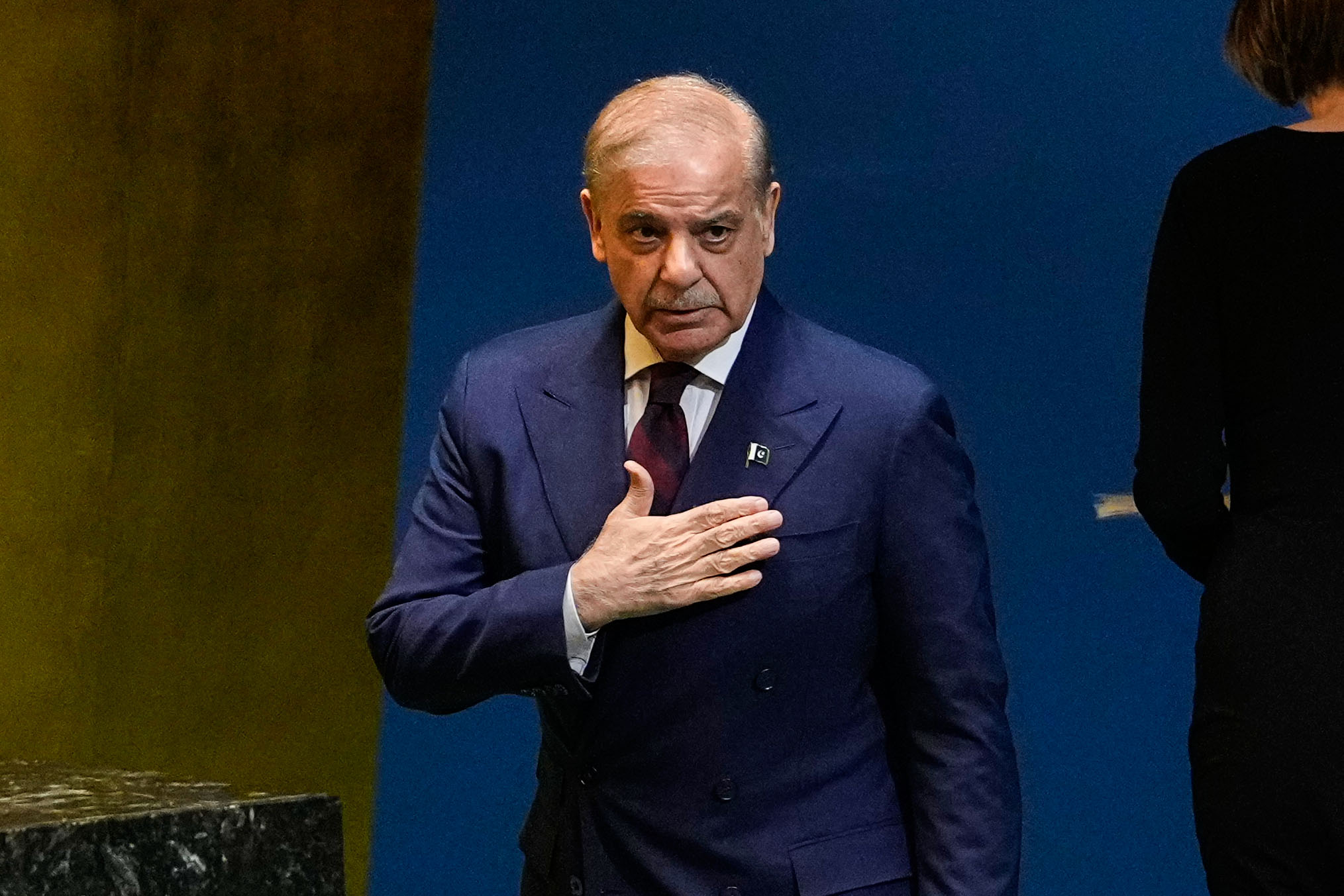
New York: Pakistan Prime Minister Shehbaz Sharif is facing domestic pressure amid economic difficulties, opposition protests and conflicts in the provinces. During his address at the United Nations General Assembly (UNGA), Sharif raised the Indus Waters Treaty and Kashmir issues while claiming that Pakistan had gained the upper hand in the May 2025 conflict with India.
Sharif spoke about Pakistan’s version of the May 2025 conflict, presenting Islamabad’s response during the confrontation as a success. During his remarks, Indian diplomat R Srinivas was seen laughing while Sharif referred to Pakistan’s claimed “victory” in the conflict.
“His timely intervention came at a decisive juncture when two nuclear-armed neighbours stood at the brink of an all-out war. And, who knows, Mr President, the extent of devastation that could have taken place had President Trump not stepped in at this critical moment with clarity of thought and action,” Sharif said.
Despite the fact that Pakistan Army’s Director General of Military Operations (DGMO) called his Indian counterpart seeking a cessation of Operation Sindoor, Sharif credited US President Donald Trump for what he described as his “timely intervention” in preventing further escalation between the two nuclear-armed neighbours.
He added, “Mr President, we must therefore ensure that South Asia never reaches that precipice ever again.”
India launched Operation Sindoor on May 7, 2025, targeting terror infrastructure in Pakistan and Pakistan-occupied Kashmir following the April 22 Pahalgam terror attack, which killed 26 civilians.
Operation Sindoor was described by India as a demonstration of its military and strategic capabilities, carried out through a combination of military and non-military measures. India said the operation targeted terrorist threats and reaffirmed its policy of zero tolerance towards terrorism while maintaining strategic restraint.
Trump has repeatedly claimed, including during his address to the UN General Assembly this week, that he played a role in stopping the India-Pakistan conflict. However, New Delhi has consistently maintained that the ceasefire was achieved through direct communication between India and Pakistan, with no third-party intervention.
On the Indus Waters Treaty, India has placed the agreement in abeyance following the Pahalgam terror attack, stating that the decision would remain in effect until Pakistan takes credible and irreversible action against cross-border terrorism.
Sharif criticised the decision, claiming it had no legal basis and emphasising the importance of the Indus River system to Pakistan.
“The shared waters of the Indus River system are the lifeblood not only for the people of Pakistan, but for the entire region. India’s unilateral decision to hold the existing treaty in abeyance has no legal basis whatsoever,” Sharif said.
He further stated, “Water must never be weaponised. Rivers should nourish nations, not divide them. Therefore, any attempt to stop, impede or divert Pakistan’s share of the waters will be treated as an act of war. India must make no mistake about it.”
The Indus Waters Treaty, signed between India and Pakistan in 1960, governs the sharing of waters of the Indus River system between the two countries.
Amid anticipated protests over the continued detention of former Pakistan Prime Minister Imran Khan and the country’s economic difficulties, Sharif also raised the Kashmir issue at the UNGA.
“But this requires a just and fair solution to the Kashmir dispute. For eight decades, the Kashmiri people have waited for the United Nations to fulfil its solemn commitment to a free and impartial plebiscite under its auspices. Generations have endured illegal occupation, arbitrary detention, extrajudicial killings, enforced disappearance, sexual violence, and collective punishment,” Sharif claimed.
India has repeatedly rejected Pakistan’s references to Jammu and Kashmir at the UN General Assembly and other United Nations platforms. New Delhi maintains that the Union Territory of Jammu and Kashmir has been, is, and will always remain an integral and inalienable part of India.
Disclaimer : This story is auto aggregated by a computer programme and has not been created or edited by DOWNTHENEWS. Publisher: deccanchronicle.com