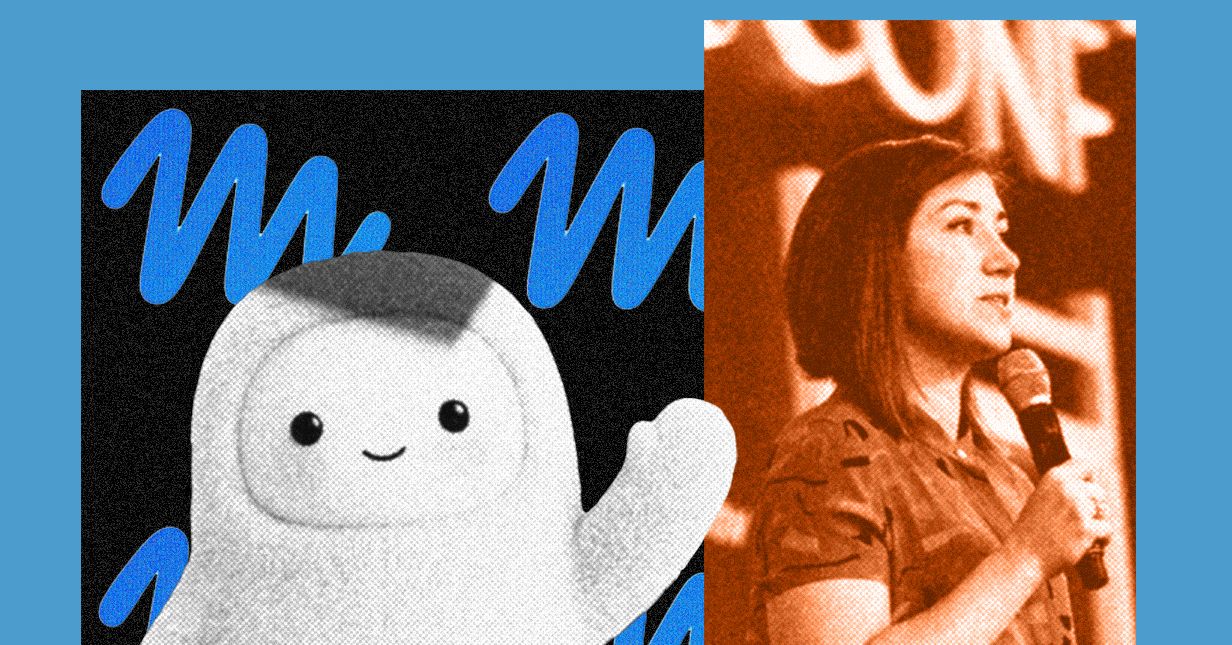
Bay Area lettering artist Jesscia Hische knew that when she took a freelance gig to design the M logo for Meta’s new AI assistant Muse, it was bound to make some people angry. “AI is such a third rail, and Meta is such a third rail,” she tells me.
Still, as a small business owner who relies on client work to keep her two brick-and-mortar art and stationary shops in Oakland afloat, she says she needed the money. “New Work! (Don’t be mad at me),” Hische wrote in her newsletter last month. “I worked with Meta on an icon and logotype for their latest release: Muse, which just launched! It’s Meta’s foray into the AI agent / personal assistant world. I know folks have big feelings about both AI and Meta, but this has been a really fun project for so many reasons.”
The news quickly went viral on Threads, where dozens of fellow designers criticized Hische for selling out. She responded to the haters by trying to explain the decision:
“For the past year, I pretty much have 2-4 payrolls in my account at any given time, which if you own a small business, you know is pretty precarious,” she wrote. She added that she had also invested $100,000 in Studioworks, an admin platform she runs for creatives, and $30,000 in Drawling, her art shop for kids in Oakland, where she hosts classes and workshops. “I have 4 people on payroll including myself, my mom, and two shop employees,” she added. Nothing she said seemed to help.
“Disgusted,” wrote one user. “It’s not about money, it’s about ethics.”
Another person responded saying, “Doing this job is like doing a hit for the mob, and being surprised later when the mob takes you out too.” Other users posted photos of Hische’s house and speculated about her wealth and finances.
Hische had expected some pushback from the artist community, but the level of vitriol caught her off guard. Even if people didn’t like Meta, she felt the company should be commended for hiring an independent artist rather than using generative AI. But the backlash made it clear just how unpopular generative AI has become in some circles, to the point that working for one in any capacity is seen as a betrayal.
We spoke on the phone last week about the backlash, her design process, and whether she was instructed to not make the Muse logo look like a butthole.
This interview has been edited for clarity and length.
Zoë Schiffer: In your newsletter, you acknowledge that people have complicated feelings about Meta and about AI. Did that make it hard for you to take this job?
Jesscia Hische: The last year or two, my client work has been really slow, and my client work is what supports the other things I do, because the brick-and-mortar businesses are not hugely profitable. My margins are razor thin. I think between the two shops, I had like $10,000 in profit last year. I can’t sustain myself on $10,000 a year.
So when the Meta project came around, it was like, alright! Let’s get some money in the account so I can pay my staff and I don’t have to feel so stressed out every time I have to run a pay cycle.
What were you hired to do, specifically?
I specialize in logo refreshes. I did the redesign of Squier from Fender, I redesigned Jeni’s Ice Cream a few years ago and did Southern Living magazine. When I work on logos, I want them to look like they went to the spa for a weekend—not that they went and got a ton of plastic surgery, you know? Just fresh and new, where you’re like, “Oh, something’s different. I can’t tell what, but I like it.”
The [Meta] team had done an exploration of the M internally. They knew it wasn’t quite right. It’s just a bunch of product designers and engineers designing type. Some of them are very skilled at typography, but it’s just such a super unique thing to be able to draw letterforms. They wanted to refine what they had already done in terms of the M.
It was a huge sprint for that M. I did the work in two days. There were 32 different versions. The logotype took another two weeks.
What did the team tell you they wanted to change?
They had drawn the M as a single stroke, a vector stroke. It was the same width all the way around. When something is just a mono-weight stroke with no adjustments, there’s not a lot of subtlety around the shape. This is where the fun happens with type design. As strokes touch each other and join, it creates this heavier pocket, visually. You get these little inky moments. And what type designers often do is sort of play with subtracting and adding bits of weight.
Their big ask was, “We want this thing to feel inspiring and creative and to get people thinking that Muse is a fun thing you can play with, not that it’s like this very rigid, engineered, cold thing.”
How much do you get paid for a project like this?
I charged what I thought was an amazing fee for a two-day sprint for a big company, which was like $12,500. That’s an amazing amount of money to make in two days, but it’s not life-changing.
Meta chief AI officer Alexandr Wang has been talking about the logo recently, noting he’s happy it doesn’t look like a butthole, unlike some of Meta’s competitors.
I do think the “don’t make it a butthole logo” thing was probably something they had top of mind internally. But for me, the discussions were more about looking at the Meta infinity loop logo and wanting the Muse logo to look like it was part of the same universe.
How did you decide to start talking about the work publicly?
I wanted to share it because I like sharing about my work. Within my newsletter group, everybody knows that my husband worked for Meta for ages, so they know that I have an association with the company.
I also wanted to acknowledge that AI is a very sensitive topic for people, but acknowledge it to an audience that understands my relationship to both Meta and AI.
I noticed that you responded to a bunch of the people criticizing you. Why?
Generally, if something happens online where there’s a misunderstanding, I’ve been able to just come at [whoever is posting about me] and say “Hey, I hear you,” in an open and conversational way. I’m not trying to persuade them, I’m trying to say, “I agree with this part, but have you considered this?” That’s always kind of worked for me in the past to help de-escalate stuff.
But with this, I made a comment about how hopefully, because of this job, I won’t have to carry $50,000 in credit card debt through the holidays for my shop, because I have to do a bunch of inventory purchasing. Then that got taken out of context by someone being like, “This rich girl spends $50,000 on Christmas.” And I was just like, OK, wait, someone will see that and not the original post, and then all of a sudden it spins into this story about me being like a kajillionaire sitting on like a pile of emeralds, yelling at poor suffering artists, which is the opposite of my whole vibe.
How did it feel to you, when all this was happening?
The first day when I was like replying to people, I was not torn up about it at all, because I was like, “Oh, these people just don’t understand that I’m a small-business owner, that I want to pay my employees. This helps me offer a health plan to like one of my employees. This is good!” And also, this company isn’t hiring me to use AI, I didn’t use AI at all in the process. Isn’t this ultimately the future that we want? Large companies hiring independent artists to do things?
But then, as it started to escalate, it just blew up way bigger than I could have ever anticipated. It wasn’t just a handful of people talking about it online. It felt like the entirety of Threads, you know? One of the things I have the hardest time with is feeling really misunderstood. I love teaching, but I’m not a guru that’s making a predatory $1,500 course or whatever. I tend to charge $35 for a five-hour workshop.
I’m very intentional about things, and I don’t just flippantly say yes to things that I obviously feel conflicted about, but I’m also like, this didn’t feel like one of those conflicts just because they were paying me as an artist, and I wasn’t using AI at all, you know?
So I felt deeply sad. I felt like I had been hit by a truck. For the two days following it, I sat in my bed and sobbed. It just made me feel so awful, like everything I have done up to this point, all the good decisions I tried to make, the free resources I’ve put out, have been for nothing.
Did it make you regret taking the job?
Not exactly. There was one camp of people who were like, “Of course, do the work if you need to, but just don’t talk about it.” But I felt like I was doing a good thing for artists by commending a company that is hiring artists instead of making generative work.
Where do you think the reaction comes from, for designers in particular? Is it fear?
I mean, the fear is real. There’s real fears about AI’s impact on commercial art. My husband and I really got into it at one point, because he was working on AI and really excited about it, and I was vehemently anti-AI. Eventually I started seeing the infrastructure, low-level data-processing side of it and how useful it is for things outside of creativity. Then I was like, OK, well, there are silver linings to using this thing. I think that softened the edges for me. My husband also came around to AI’s impact on commercial art, which helped.
Most of the folks in AI are like, “AI helps creativity because it makes human-made things more valuable!” Maybe in fine art, but that’s not how commercial art works. Of course, there’s anti-AI purists, and their whole thing is that AI is built on theft, which is true. I think I’m going to benefit from the Anthropic settlement, because they’ve definitely scraped my books.
I don’t use AI for generative art or anything like that. I just use it for admin and for help with coding and web building. But anytime that AI takes the place of a person or does the heavy lifting on stuff that requires human creativity, that’s when it becomes problematic.
Disclaimer : This story is auto aggregated by a computer programme and has not been created or edited by DOWNTHENEWS. Publisher: wired.com