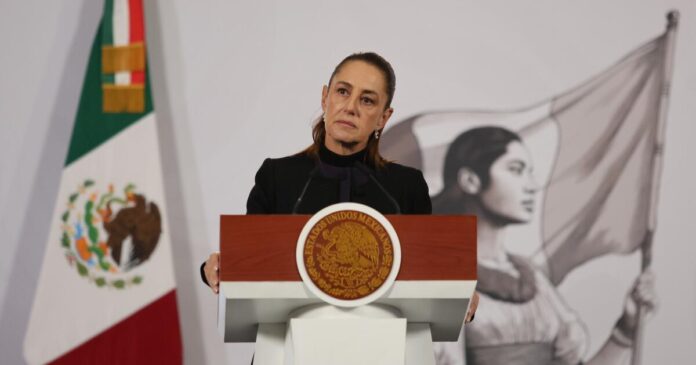
MEXICO CITY — Mexican President Claudia Sheinbaum on Wednesday again accused the U.S. of meddling in Mexico’s internal affairs after The Times published a report about two Mexican governors from her party who have had their U.S. visas revoked amid criminal probes into their possible links to organized crime.
Sheinbaum, speaking at her daily news conference, said it was up to the governors, Alfonso Durazo of Sonora and Américo Villarreal Anaya of Tamaulipas, to respond to the allegations against them.
But she questioned the rationale of the U.S. investigations, part of a sweeping Trump administration campaign against high-level Mexican officials suspected of aiding cartels.
“What is the intent behind revoking the visas, and, furthermore, making that information public?” she asked. “What is the underlying motive?”
In April, the Justice Department revealed sweeping criminal charges against prominent members of Sheinbaum’s Morena party, including Gov. Rubén Rocha Moya of Sinaloa. He and nine other current and former officials were accused of helping the Sinaloa cartel smuggle drugs into the U.S. in exchange for millions of dollars in bribes.
Sheinbaum rejected a U.S. request that her government extradite Rocha Moya to the U.S. to face charges, saying Mexican prosecutors will review the case against him, and slammed the Trump administration for meddling in Mexican politics.
“When those abroad dictate who is guilty and who is not, when there are attempts to pressure our institutions … we are no longer talking about cooperation, we are talking about interference,” she said. “We do not accept interference.”
The Times investigation cited sources who said that Durazo, 71, and Villareal, 68, had their U.S. visas cancelled amid criminal investigations. The sources spoke on condition of anonymity to discuss internal matters.
Since the cancellation of the visas, both have been the recipients of Significant Public Benefit parole, which can be used to allow individuals to enter the U.S. to cooperate with law enforcement, the sources said. The program allows non-citizens to testify before a grand jury to mitigate consequences of actual or pending charges against them or others.
In a statement to The Times, Villarreal denied any connection to organized crime, saying that as a public servant, he has always been transparent, responsible and followed the law.
Durazo, speaking to journalists on Wednesday, said his visa has not been revoked, that he is not aware of an investigation into his actions, and that he has committed no wrongdoing. He said he is so honest, “I practically sweat holy water.”
Durazo blamed The Times report on “a deliberate effort to politically undermine a progressive project,” echoing comments made by Sheinbaum over the weekend that the Trump administration is seeking to influence politics in Mexico.
At her news conference Wednesday, Sheinbaum said she was “skeptical” of the case against the governors.
Investigating active government officials in Mexico is a new strategy for the United States, which in the past refrained from targeting sitting leaders in allied countries with criminal investigations because of the clear political ramifications.
The Trump administration, which last year declared several Mexican cartels terrorist groups, has embraced the approach, putting new pressure on Morena party — which came to power on a promise to combat corruption — and further straining the relationship between the two countries ahead of next month’s review of a free trade pact with Canada.
This article was co-published by the Los Angeles Times and Puente News Collaborative, a bilingual nonprofit newsroom that covers stories from Mexico and the U.S.-Mexico border.
More to Read
Disclaimer : This story is auto aggregated by a computer programme and has not been created or edited by DOWNTHENEWS. Publisher: latimes.com