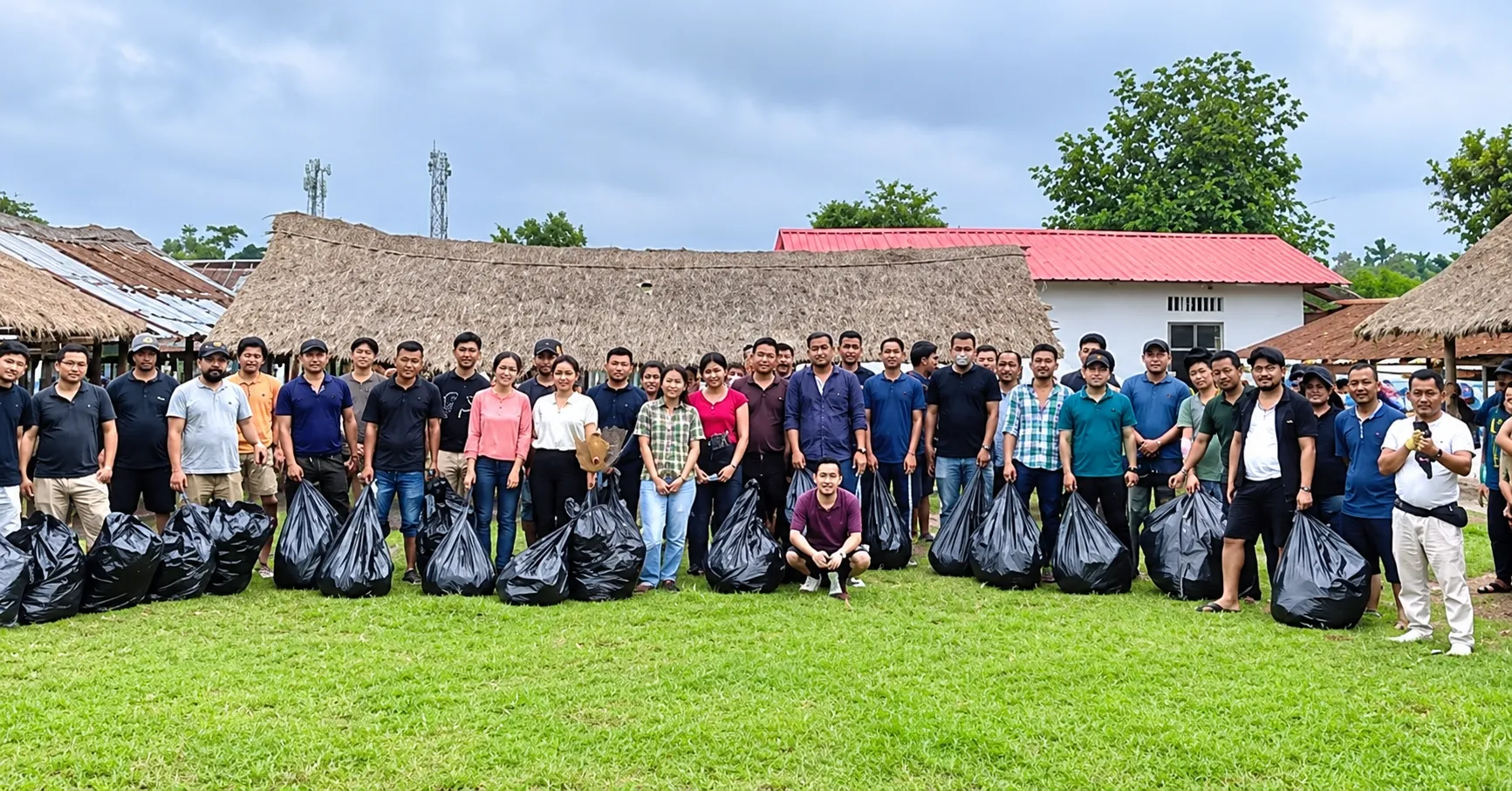
Imagine if, for one morning, shops in your neighbourhood remained closed, government employees stepped out of their offices, and residents came together to clean the roads, drains and public spaces they use every day.
On 13 November 2026, Nagaland organised exactly such an exercise across the state. Starting at 6 am, government employees, village councils, businesses, civil society groups and residents came together to clean their surroundings.
Shops and business establishments were directed to remain closed until noon to allow people to participate.
The occasion? Preparations for the 27th Hornbill Festival, which begins on 1 December and brings visitors from across India and beyond to Nagaland.
Interestingly, the state government calls this exercise ‘mass social work’. So, how did Nagaland bring together people across its towns and villages for a common cause?
A morning dedicated to public spaces
On 2 November, Nagaland’s Home Department issued a notification outlining how the statewide clean-up would be organised.
Deputy Commissioners were tasked with identifying areas that needed cleaning and dividing responsibilities among government departments, municipal bodies, village councils and other organisations.
Municipal and town councils were responsible for coordinating the work in urban areas, while village councils worked with local officials in rural areas.
The government also planned for what would happen to the waste once it was collected. Departments were asked to arrange workers and trucks to transport waste and debris, working alongside district administrations and local bodies.
Each area could plan its clean-up according to its own needs.
In Pughoboto, for instance, government offices, institutions, wards and villages were asked to clean their respective areas. Village councils and Village Development Boards helped organise participation, while heads of government offices were asked to submit reports with photographs of the work completed.
From shopkeepers to students, everyone pitched in
Across Nagaland, different groups of people took responsibility for the public spaces they shared.
In the state capital, Kohima, government employees, municipal workers, ward authorities, civil society organisations and residents cleaned roadsides, drains and other public spaces. Chief Minister Neiphiu Rio also visited the Kohima Peace Memorial and Eco-Park to inspect the work.
In Dimapur, government officials, local organisations and citizens participated in cleaning several locations. In Mon town, residents from all wards joined the exercise, coordinated by the municipal council and district administration.

In Peren district, the clean-up brought together government employees, village councils, churches, student groups, businesses and residents across the district headquarters, Jalukie town and Ahthibung subdivision.
The district administration also reported that the collected waste and debris were transported to designated disposal sites.
This last step is particularly important. For any community clean-up to be effective, people need access to a system that ensures the waste they collect is properly disposed of.
Across India, communities are finding their own ways to make this possible. From villagers establishing their own cleanliness rules in Odisha to women running a waste management cooperative in Tripura, these efforts show what people can achieve when they take collective responsibility for their surroundings.
Beyond the 10 days of festivities
Held at the Naga Heritage Village in Kisama, around 12 km from Kohima, the Hornbill Festival celebrates Nagaland’s cultural heritage through music, food, traditional crafts and performances.
This year, the festival will run from 1 to 10 December.


While preparations for performances, food stalls and cultural events are underway, the state is also paying attention to the roads, public spaces and sanitation facilities that visitors and residents will use.
In October, Chief Minister Rio urged villages to take responsibility for keeping roads clean, particularly highways passing through or near their areas. The government has also emphasised waste management and hygiene at the festival venue, including educating food-stall operators about these practices.
Nagaland’s statewide clean-up offers a practical example of how residents and local authorities can work together: identify spaces that need attention, divide responsibilities, involve local communities and arrange for waste disposal.
As Nagaland prepares to welcome visitors this December, the roads, neighbourhoods and public spaces that people have worked together to clean will be part of that welcome.
The next opportunity lies in carrying this collective effort beyond the ten days of the festival, keeping these spaces clean for the people who call Nagaland home throughout the year.
Sources
‘Home Department Notifies State-Wide Mass Social Work‘: by Kazuhito for DIPR Nagaland, Published on 2 November, 2026
‘Statewide Mass Social Work Held Across Nagaland: Kohima‘: by DPRO Kohima for DIPR Nagaland, Published on 13 November, 2026
‘Statewide Mass Social Work Held Across Nagaland: Dimapur‘: by Tovikali, IA Dimapur, for DIPR Nagaland, Published on 13 November, 2026.
‘Statewide Mass Social Work Held Across Nagaland: Peren‘: by DPRO and Mamang, IA Peren, for DIPR Nagaland, Published on 13 November, 2026.
‘Nagaland Gears Up for 27th Edition of Iconic Hornbill Festival‘: by DD News, Published on 14 October, 2026
Disclaimer : This story is auto aggregated by a computer programme and has not been created or edited by DOWNTHENEWS. Publisher: thebetterindia.com