
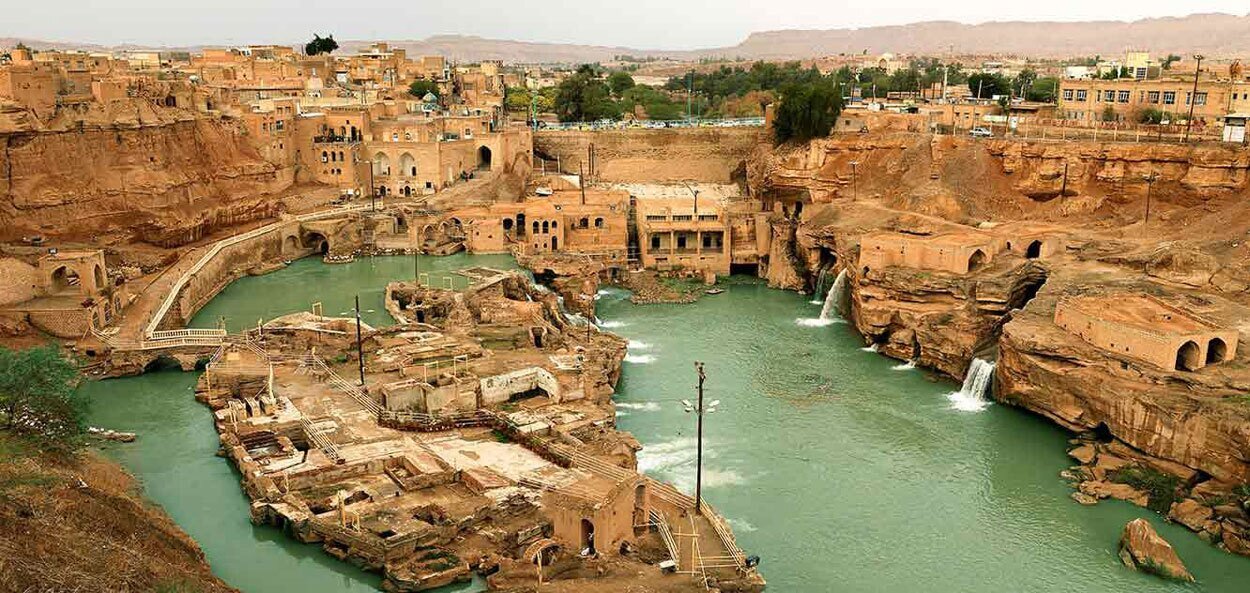
TEHRAN – The outstanding universal value of Iran’s UNESCO-listed Shushtar Historical Hydraulic System lies in the engineering knowledge and integrated water management system behind its construction rather than its individual bridges, dams or mills, the head of the World Heritage site said as the country marked the 17th anniversary of its inscription.
Atefeh Rashnoei, director of the Shushtar Historical Hydraulic System World Heritage Base, said the site should be understood as a unified hydraulic network designed to organize water, agriculture, urban life and industry, rather than as a collection of historic monuments, IRIB news agency reported on Monday.
“Many people know Shushtar for its stone dams, bridges, watermills, hand-dug tunnels and waterfalls,” Rashnoei said. “While this image is accurate, it reveals only one layer of the site’s significance.”
She said the distinction between an individual structure and an integrated system is fundamental in cultural heritage studies, adding that Shushtar was inscribed on UNESCO’s World Heritage List as the “Shushtar Historical Hydraulic System” because its value lies in the functional relationship among its components.
The hydraulic system includes Band-i Mizan )a weir situated at the head of the Ab-i Girgir canal in the massive water system), which regulates the distribution of water, the man-made Gargar Canal, underground tunnels, mills, water transfer networks and waterfalls that together form a single engineering system, Rashnoei said. She added that none of the elements can be fully understood in isolation.
According to her, the system reflects the ability of ancient Iranian engineers to use natural topography, river characteristics and engineering knowledge to create a sustainable network that supported urban development, agriculture, industrial production and food security for centuries.
She said preserving the site’s World Heritage value requires more than restoring its physical structures. Conservation efforts must also protect the hydraulic network’s functional logic, water flow routes and the interdependence of its components, she said, warning that interventions ignoring those relationships could weaken the site’s outstanding universal value.
Rashnoei described the 17th anniversary of Shushtar’s World Heritage inscription as an opportunity to reconsider the meaning of the designation, saying inscription marked the beginning of a long-term responsibility rather than the end of a conservation process.
“If Shushtar remains on the World Heritage List today, it is because the international community recognized not simply a group of historic monuments, but one of the finest examples of engineering knowledge, water management and harmony between humans and nature,” she said.
She added that safeguarding the site should extend beyond the conservation of its physical fabric to preserving the ideas and engineering principles that gave rise to the hydraulic system.
“Shushtar will remain worthy of its World Heritage status only if we continue to regard it as a living school of knowledge, creativity and Iranian civilization,” Rashnoei said.
The Shushtar Historical Hydraulic System, located in Iran’s Khuzestan province, was inscribed on UNESCO’s World Heritage List in 2009. UNESCO says the large-scale hydraulic complex, dating in its present form to the 3rd century CE and incorporating earlier foundations, demonstrates outstanding universal value through its integrated design for urban water supply, irrigation, milling, river transport and defense.
According to UNESCO, the system reflects a synthesis of earlier Elamite and Mesopotamian hydraulic knowledge while incorporating influences from Roman civil engineering. Its Gargar Canal enabled the development of a new town and irrigation of surrounding plains, while the Shadorvan Grand Weir has long been regarded as one of the engineering wonders of the ancient world.
The ancient city of Shushtar lies in the northwestern Khuzestan Plain at an elevation of about 65 meters above sea level, bordered by the foothills of the Zagros Mountains and the Dez River. The city has a hot climate with scorching summers and mild, Mediterranean-like winters. Administratively, it is divided into three districts and includes four cities and several rural districts.
The Karun and Dez rivers flow through Shushtar, shaping its urban landscape, economy and way of life. The city is renowned for its compact traditional architecture, historic handicrafts and centuries-old weaving traditions. Local residents believe that international recognition of Shushtar’s historic urban fabric would strengthen efforts to safeguard the city’s rich cultural heritage while supporting the continued coexistence of its historic character and vibrant contemporary life.
AM
Disclaimer : This story is auto aggregated by a computer programme and has not been created or edited by DOWNTHENEWS. Publisher: tehrantimes.com








