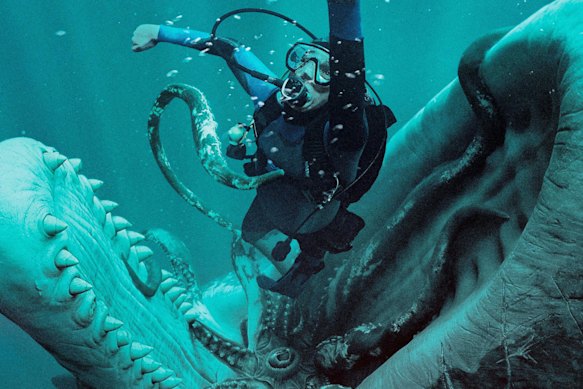

For many, Whalefall will unlock a new nightmare. The film follows scuba diver Jay (Austin Abrams) as he attempts to retrieve his estranged father’s remains, which have fallen to the depths of the Pacific Ocean. But unluckily for him, he gets caught in a struggle between a giant squid and a sperm whale. Despite his best efforts to escape, Jay is sucked into the whale’s mouth, swallowed, and sent on a journey through its innards.
Based on Daniel Kraus’ 2023 novel of the same name, the film is ultimately a story of survival. Director Brian Duffield insists they made it as scientifically accurate as possible, even consulting whale experts throughout production. It isn’t untouched territory either – a Venezuelan kayaker survived being swept into the mouth of a humpback whale last year.
But what are the actual odds of escaping the belly of the Earth’s largest toothed predator? And could you even get gulped by one in the first place?
Macquarie University whale scientist Dr Vanessa Pirotta and professor of veterinary anatomy and marine science at The University of Queensland Michael Noad offer some answers.
Are sperm whales capable of swallowing a fully grown human?
Michael Noad: [Sperm whales’] oesophagi aren’t very big – maybe 20cm in diameter in a big male. But the oesophagus can stretch when you swallow something, and if they swallow giant squid whole, they might just be able to swallow a person.
A big squid is quite a streamlined sort of thing to swallow, though. A person, especially with a scuba tank on their back, is not. It seems highly unlikely.
Dr Vanessa Pirotta: Sperm whales don’t munch down on food like we do. There’s no chewing involved. But if this guy’s got a scuba tank on, the sperm whale isn’t dumb. They’re used to eating things that are squishy … the tank would be enough for the whale to be like: “Something’s not quite right here”.
If swallowed, where exactly would you go once past the mouth?
VP: You’d go through the oesophagus. There’s no option, like for us, where you can go to the oesophagus or lungs … because the lungs aren’t connected [to its digestive tract]. It’s one way down and usually, one way out. You’d go down to the forestomach – they’ve got a multi-chambered stomach system. That has no gastric acid secretion, it just grinds and crushes the food.
Could you breathe inside the whale without a diving tank?
MN: It’s very unlikely there would be any gas of any kind in there … It [also] looks like the whale might do a deep dive. This would simply kill the diver. The pressure inside the stomach would be the same as the water pressure outside … the scuba gear would keep supplying you with air at ever-increasing pressure so you could still breathe, at least up to a point, but the air would be used up faster and faster. You might only have minutes. The effects of the pressure itself wouldn’t be good for you, and then shooting up again in the other direction would probably cause massive barotrauma and the bends, all of which would almost certainly be fatal, even if you weren’t inside a whale.
What would it be like inside the stomach?
MN: The stomach would likely contract tightly around the diver, making it impossible to move. If you were then pushed into the next stomach, there would be acid, but perhaps not enough to burn your skin immediately. It would certainly badly sting and damage your eyes.
The smell probably wouldn’t be too bad. Things don’t rot in the stomach, especially the forestomach, which is about powerful muscular contraction and grinding things up, not chemical digestion. Even if in the middle stomach, things are digested over hours by the acidic environment. Semi-digested food then passes into the intestines where more digestion takes place.
If you get bad-smelling gas, it’s probably further down the intestines rather than in the stomach. Put crudely, farts smell worse than burps.
Could you escape through the blowhole?
VP: There’s no option to go from the throat to the nose. It’s anatomically impossible.
What’s the most realistic avenue through which to escape a whale?
VP: There’s no way you could get out. You’d be dead by the time you go out through the poo chute. There’s no way unless the animal regurgitates you.
Overall, how accurate does Whalefall look regarding whale behaviour and anatomy?
VP: There’s definitely been scientific consultation, which is cool. There needs to be high praise for bringing to life what a sperm whale is. But how you watch this movie and how I watch this movie will be very different.
What strikes me as cinematic gold is the fact that you have an incredibly deep-diving whale and a deep-diving squid, and somehow the sperm whale has failed to catch that squid at depths and is remaining on the chase up to the surface. Sperm whales use echolocation, biological sonar, and all of that happens in the dark ocean depths. But feeding activity is happening at the surface in this movie. How fabulously convenient.
MN: I don’t think it looks very accurate. But the idea of someone being swallowed by a whale is ancient … it’s part of the history of myths and legends that, in a way, underlie our society [think Book of Jonah, Pinocchio]. So, I’m not going to completely pan this as a movie. Some sort of modern version of this fable isn’t completely off the mark, and the director has “altered” facts to make the impossible possible. Is it scientifically accurate? No. Is it a good story? Sure, and one that’s part of the rich tapestry of our society and relationship with nature.
Finally, how likely is it that someone could survive being swallowed by a sperm whale (on a scale of 1-10, with 1 being absolutely impossible)?
MN: One.
VP: I would say two because I’m going to give it some cinematic leeway. We need this – anything to get people to connect [with whales]. Thank God we’re getting Hollywood to engage with marine biology. I’m “whale-coming” of this movie.
Whalefall is in cinemas now.
Must-see movies, interviews and all the latest from the world of film delivered to your inbox. Sign up for our Screening Room newsletter.
 Nell Geraets is a Culture reporter at The Age and The Sydney Morning Herald.Connect via X or email.
From our partners
Disclaimer : This story is auto aggregated by a computer programme and has not been created or edited by DOWNTHENEWS. Publisher: www.smh.com.au