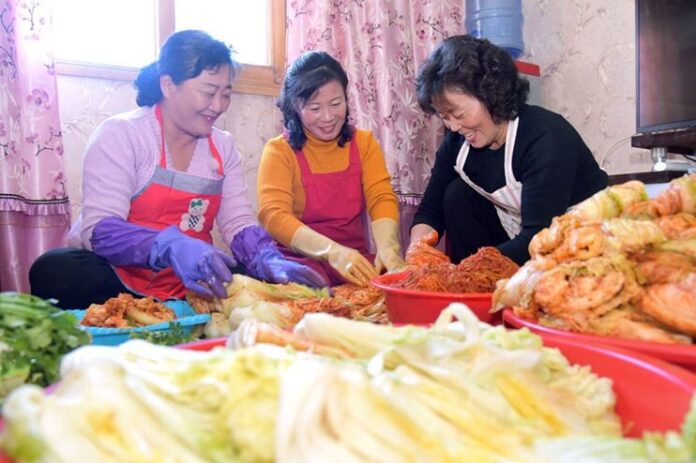
Soaring food prices are pushing a growing number of North Korean households to skip kimjang, the annual autumn ritual of making enough kimchi to last a family through the winter. This year, however, many families in Ryanggang province can no longer afford cabbage, radish and seasonings..
Kimjang began this month in Hyesan, a city on the Chinese border, according to a Daily NK source in Ryanggang province. Yet the familiar sight of families piling up cabbages and radishes to trim and salt has grown rare. “It hardly feels like kimchi season at all,” the source said. Winter arrives earlier in North Korea’s northern border regions, so kimchi-making usually starts there first. The northern provinces began in early November, and inland areas farther south should follow by the middle of the month.
The number of households unable to make kimchi has grown every year since the COVID-19 pandemic, the source said. Outlying neighborhoods far from the center of Hyesan have fared the worst. “Making money keeps getting harder while prices keep going up, so day laborers can’t even think about it,” the source said. In one neighborhood watch unit on the outskirts of Hyesan, one or two households made kimchi last year. This year, not a single household in that unit has managed to do so.
The same squeeze hit northern North Korea last year, when many families in Ryanggang and North Hamgyong provinces gave up on kimjang. By March 2026, kimchi had grown so scarce that neighbors beat a Hyesan man they caught stealing it. This year, sharply higher ingredient prices are the main reason so many families are sitting out the season.
Daily NK reported on Oct. 30 that cabbage and radish prices in South Pyongan province had roughly doubled since January. Cabbage there sold for more than 7,000 won per kilogram, while radish topped 6,000 won. In Hyesan, cabbage now sells for 12,000 North Korean won per kilogram at the local market. Radish, meanwhile, goes for 10,500 won per kilogram in the same market. Hyesan is not a major farming area, the source explained, so vegetables there cost more than in South Pyongan province.
Kimchi becomes a luxury for wealthy North Koreans
Cabbage prices in Hyesan are now roughly seven to 10 times higher than three or four years ago. Back in 2022, Hyesan families considered cabbage expensive at just 1,000 won per kilogram. At current prices, 50 kilograms of cabbage costs about 600,000 won. That sum could buy roughly 43 kilograms of corn at the going rate of 14,000 won per kilogram. Once families add radish, red pepper powder, garlic and salt, the total cost climbs even faster.
The surge in vegetable prices comes as North Korea’s broader food crisis deepens. In late October, rice prices topped 50,000 won per kilogram for the first time in North Korean markets. Poorer families struggle even to obtain cabbage and radish, let alone the seasonings that go with them. Some receive small amounts of vegetables through the workplace of the head of the household. Factories and state enterprises once handed out kimjang vegetables to workers for free or at subsidized prices. However, those provisions largely dried up after the pandemic began in 2020. Salt is also in short supply in Hyesan this winter. Some families collect leftover brine from neighbors who have already finished salting their cabbage.
Wealthier households, by contrast, are making kimchi with an abundance of ingredients. They include donju, along with party officials and trading company employees. Donju are the newly rich entrepreneurs and money lenders who have prospered through North Korea’s markets. Some of these families even add pollack and flatfish to their kimchi seasoning. Even within the same town, kimjang looks completely different depending on a household’s income, the source said.
“Prices go up every year, but people still haven’t adjusted, and they sigh just hearing what things cost,” the source said. “For decades, everyone made kimchi whether they were rich or poor, and only the ingredients were different. Now only households with money can afford to make kimchi for the winter.”
Hyesan locals now say that kimjang is no longer something just anyone can do, according to the source. Many households in the city lack even enough corn to cook in their cauldrons. For those families, the source added, preparing kimchi for the winter has become a daunting task.
About This Translation
This article was originally written in Korean and translated with the help of generative AI tools. It was then edited by a native English-speaking editor. All AI-assisted translations are reviewed and refined by our newsroom.
Reporting from Inside North Korea
Daily NK operates networks of sources inside North Korea who document events in real-time and transmit information through secure channels. Unlike reporting based on state media, satellite imagery, or defector accounts from years past, our journalism comes directly from people currently living under the regime. We verify reports through multiple independent sources and cross-reference details before publication.
Our sources remain anonymous because contact with foreign media is treated as a capital offense in North Korea — discovery means imprisonment or execution. This network-based approach allows Daily NK to report on developments other outlets cannot access: market trends, policy implementation, public sentiment, and daily realities that never appear in official narratives.
Maintaining these secure communication channels and protecting source identities requires specialized protocols and constant vigilance. Daily NK serves as a bridge between North Koreans and the outside world, documenting what’s happening inside one of the world’s most closed societies.
Disclaimer : This story is auto aggregated by a computer programme and has not been created or edited by DOWNTHENEWS. Publisher: dailynk.com