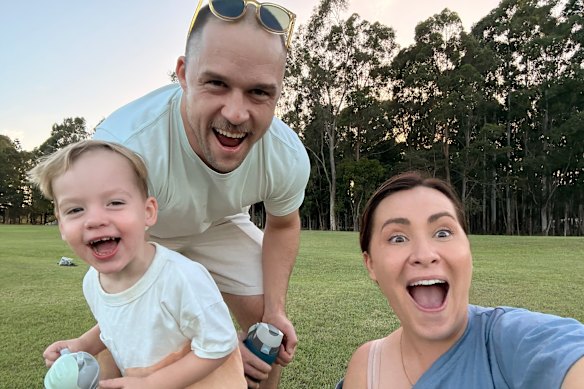

During an appointment with paediatricians at the Prince Charles Hospital, Sonny stumbled.
“It was the first time that doctors had actually seen it happen, rather than us just trying to film it,” recalls Sonny’s father, Jason Strozkiy.
“I said, ‘That’s it, that’s what we’re talking about, that stumble.’
“You could almost see [the doctor’s] concern come on her face. She was like, ‘OK, we should probably talk to a neurologist.’ ”
After an emergency trip to the Queensland Children’s Hospital, genetic testing using blood taken from Jason, his wife Sarah, and Sonny later confirmed the worst: Sonny has an ultra-rare progressive neurodegenerative brain disorder called Batten disease. There is no cure.
The disease – one of many under the devastating umbrella of childhood dementia – has already robbed three-year-old Sonny of his speech. It will take his ability to walk, to sit up by himself and, eventually, it will take his vision, and finally his life.
Sarah and Jason feel fortunate – in the only way parents with terminally ill children can find ways to feel fortunate – because Sonny’s type of late infantile Batten disease, called CLN2, is the only one with available treatment.
A drug called Brineura, a synthetic enzyme that flushes cellular waste from the little boy’s brain, is administered through a port inserted directly into Sonny’s head to slow the progression of symptoms and his deterioration.
But the drug cannot reach the nerves in his eyes, due to the blood-retina barrier. There is a way to prolong Sonny’s vision for as long as possible, with an off-label use of Brineura, so he can see his parents’ faces and the world around him, including the moon, which he is fascinated by.
The off-label treatment, which involves injecting the drug directly into the back of Sonny’s eyes, is not offered at Queensland Children’s Hospital. But Jason and Sarah are in contact with a family whose son with Batten disease is receiving eye infusion treatment at Monash Children’s Hospital in Melbourne. They understand a second boy has recently started undergoing the treatment at another Melbourne hospital.
In a statement, Children’s Health Queensland said intravitreal (injection into the eye) administration of Brineura was not currently permitted under the federal government’s Life Saving Drugs Program and outside Therapeutic Goods Administration approvals.
“Children’s Health Queensland is assessing the safety and efficacy of this new treatment, and if clinically appropriate, will explore options to establish a program to provide it in Queensland,” the statement says.
That stance is infuriating and devastating for Sarah and Jason, when they know children in Melbourne are already receiving the eye infusions, and time is crucial for their son.
“With a child that’s losing so many of their senses of the world, his vision is so important,” Sarah told radio station 4BC.
“It’s just frustrating, the whole thing is frustrating. We try to be polite, we try to be kind, we try to do the right thing, but we’re limited, we’re blocked, and there’s only so much that we can do.
“He’s a child, he is a three-year-old little boy, who is going to die.”
Sarah and Jason have contemplated moving to Melbourne, but that requires leaving their family, their friends and their support network. They cannot travel to Melbourne for Sonny to have the eye infusions each month because Brineura is allocated to a certain hospital when prescribed under the Life Saving Drugs Program.
The couple is desperately hoping their advocacy will make the treatment available in Queensland, and soon.
“We know the family at Monash [Children’s Hospital] had to continually push their neurologist to adopt it,” Jason said. “It sort of came down to the neurology team going, ‘OK, we can do this.’ ”
Dr Ineka Whiteman, neuroscientist and head of research at the Batten Disease Support and Research Association, said the eye injections were safe and effective.
“But the situation with off-label treatment is, it really does come down to the individual discretion and resources, staffing etcetera for each individual hospital,” she told 4BC.
“We want to be able to provide for all of our patients around Australia the same access and equitable access to care.
“This raises the question, how equitable is it when a child, or more than one child, can be accessing it in a Melbourne setting but not elsewhere around Australia?”
Whiteman said extra funding was not needed to acquire more of the expensive drug.
“You only need to skim a very small amount off the top of the vial … it’s also known as the overfill within the vial [for the eye infusion],” she said.
“The resources that are required are simply for the practical side … the staffing, the theatre time. It falls into this really grey area.
“I certainly don’t want to be criticising or placing blame on hospitals or clinical teams because I feel like their hands are equally tied in this situation.
“It’s not about data, it’s not about the science, it’s not about the clinical equipoise here, it’s about funding and resources.”
There are four children with Batten disease in Queensland, including Sonny. When untreated, life expectancy is between six and 12 years.
The symptoms for Sonny escalated in January when he suffered a seizure. A couple of weeks later, he had another, then another.
At first, Sonny was diagnosed with epilepsy, put on medication and the seizures stopped. For a moment, Sarah and Jason were able to breathe.
Then Sonny began to struggle with movement, and began to stumble, trip and fall. And then, at nearly three years old, he started losing words he had already learnt to say.
“Sometimes we live in our little bubble and he’s happy and running around and you wouldn’t really notice, and suddenly he falls over and bangs his head on something,” Jason said.
“Those days really hit you.”
It requires extreme and exhausting vigilance from Sarah and Jason to ensure Sonny doesn’t hit his head and cause inflammation or bruising.
The ground-breaking Brineura treatment for children with CLN2 was approved in Australia in 2018. Its development gives Sarah and Jason hope that a cure may be found one day.
Their goal is to preserve as many of Sonny’s abilities and maintain his quality of life until that cure is discovered.
“He might not talk to us, but he smiles, and he feels love and gives love,” Sarah said.
“That is the best part.
“He keeps trying. Even when he tries to pick up a blueberry and he shakes because he’s got that childhood dementia … he’ll drop it like 10 times, and then he’ll finally get it and go, ‘Yay!’ and clap.”
Start the day with a summary of the day’s most important and interesting stories, analysis and insights. Sign up for our Morning Edition newsletter.
From our partners
Disclaimer : This story is auto aggregated by a computer programme and has not been created or edited by DOWNTHENEWS. Publisher: www.smh.com.au