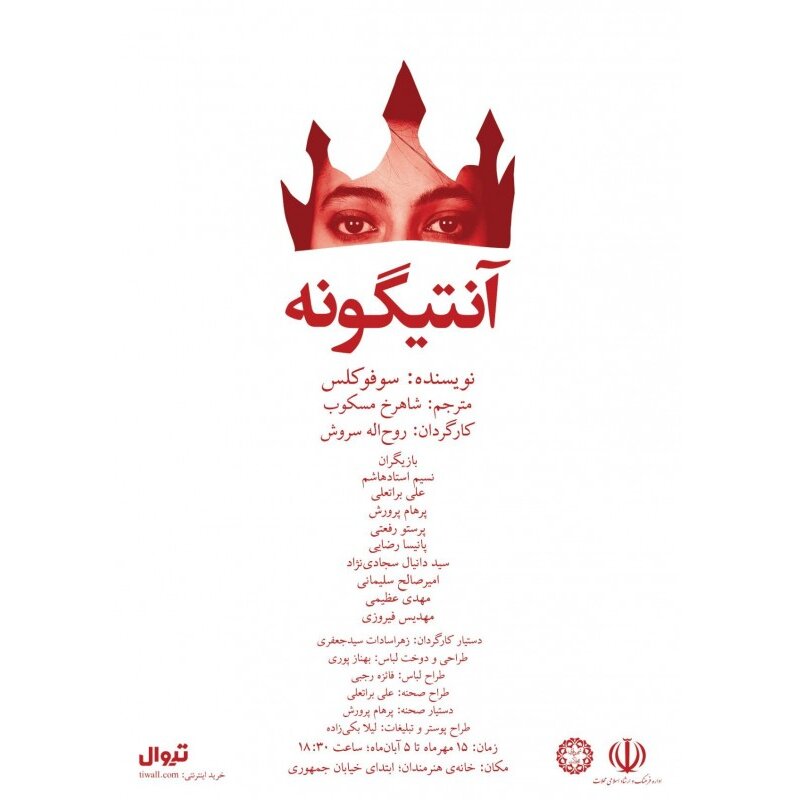
TEHRAN – The play “Antigone” by Sophocles is being performed at the Artists Forum in Mahallat, Markazi Province.
Directed by Rouhollah Soroush, the play will remain on stage through October 27. The cast includes Nasim Ostadhashem, Ali Baratali, Parham Parvaresh, Parastoo Rafati, Panisa Rezaei, Danial Sajadinejad, Amirsaleh Soleymani, Mehdi Azimi, and Mahdis Firouzi.
In Greek mythology, Antigone was a Theban princess and a character in several ancient Greek tragedies. She was the daughter of Oedipus, king of Thebes.
Antigone appears in three 5th-century BC tragic plays written by Sophocles, known collectively as the three Theban plays, with her being the protagonist of the eponymous tragedy “Antigone”.
In her eponymous play, Antigone attempts to secure a respectable burial for her brother Polynices. Oedipus’s sons, Eteocles and Polynices, had shared rule jointly until they quarreled, and Eteocles expelled his brother. In Sophocles’ account, the two brothers agreed to alternate rule each year, but Eteocles decided not to share power with his brother after his tenure expired. Polynices left the kingdom, gathered an army, and attacked the city of Thebes in the war of the Seven Against Thebes. Both brothers were killed in the battle.
King Creon, who has ascended to the throne of Thebes after the death of the brothers, decrees that Polynices is not to be buried or even mourned, on pain of death by stoning. Antigone, Polynices’ sister, defies the king’s order and is caught.
Antigone is brought before Creon, confessing her crime and foreknowledge of the king’s edict that Polynices neither be buried nor mourned, claiming the superiority of divine law to human law.
Antigone’s self-defense in defiance of Creon is passionate, courageous, and determined. Creon orders Antigone buried alive in a tomb. Although Creon finally has a change of heart—due to a visit from the soothsayer Tiresias—and tries to release Antigone, he finds she has hanged herself. Creon’s son Haemon, who was engaged to Antigone, kills himself with a sword (after an unsuccessful attempt to kill Creon), and his mother, Queen Eurydice, also kills herself in despair over her sons’ deaths (Haemon and Megareus), which she attributes to Creon’s misrule and misjudgment. By her death, Antigone ends up destroying the household of her adversary, Creon.
SS/SAB
Disclaimer : This story is auto aggregated by a computer programme and has not been created or edited by DOWNTHENEWS. Publisher: tehrantimes.com