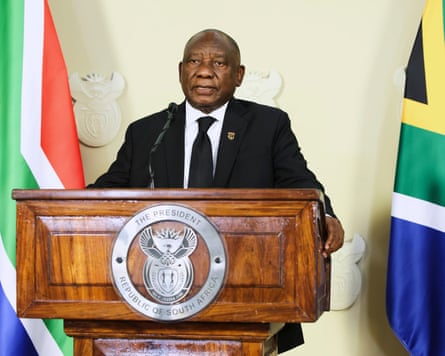
South Africa’s president has called on men to take more responsibility for violence against women as he announced measures to tackle the problem, amid anger at authorities over a recent wave of murders.
Cyril Ramaphosa acknowledged that not enough had been done to protect women. He said police would be reviewing unsolved murders, attempted murders and serious sexual offences against women and children, as well as producing a funded plan to reduce the forensic backlog for such cases, both within 60 days.
In a televised speech on Tuesday night, the president said local governments would have five months to address issues that compromised women’s safety, from broken streetlights to overgrown public spaces and abandoned buildings. He added that he had tasked five ministers to come up with a plan within 60 days to reduce alcohol-fuelled violence.
“Alcohol does not cause gender-based violence and it can never excuse it. Responsibility always lies with the perpetrator,” Ramaphosa said. “But harmful alcohol use is a significant aggravating factor in interpersonal violence and it must be addressed as part of our wider prevention effort.
“Women should not have to live in fear because government has failed to repair a light, clear a public space, process evidence or enforce a law.”
South Africa has been gripped by grief and fury after the discovery of 11 women’s bodies dumped across Ekurhuleni, the municipality adjoining Johannesburg to the east, since 15 July. Eight of the women were found in the last three weeks, including Elizabeth “Tsontso” Moselakgomo, who was discovered on 12 September after she went missing when she went for a run after work.
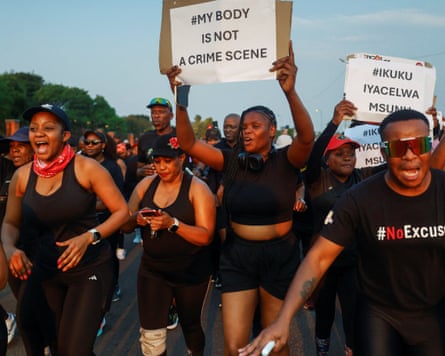
Ramaphosa said suspects had been arrested in connection with three of the killings and that the other cases would not be left to go cold. He added that police had not found evidence that a serial killer was responsible for all 11 killings, but that all possibilities were still being investigated.
He directly addressed South African men, urging them to challenge relatives, friends and colleagues who harassed, humiliated or abused women. “It is time for good men to stop being silent men,” he said.
“For too long, gender-based violence has been treated as a woman’s problem to solve. Women march, the women of our country organise, they speak out, they protest, they confront and they comfort survivors,” Ramaphosa said.
“Women change their routes home. Avoid going out at night and warn one another about dangerous places and dangerous men. We have placed the burden of male violence on women. That must change.”
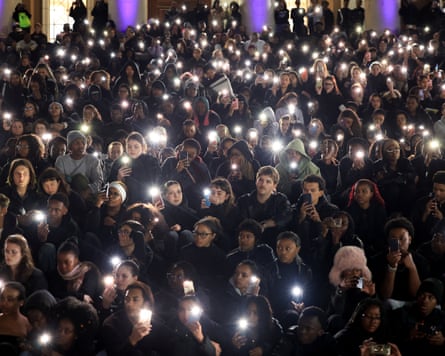
Activists expressed their frustration that solid policy actions had not been taken years ago and scepticism that the measures Ramaphosa had announced would work.
Shenilla Mohamed, the executive director of Amnesty International South Africa, said: “These are not new issues and as a country we have been talking about ways to tackle the high numbers of [gender-based violence and femicide], especially since 2019 when women took to the streets to protest, and yet here we are again in the face of continued attacks against women.
“Amnesty International South Africa also notes the timelines put in place by the president, but this will only mean something if it results in action, and if there are consequences for inaction.”
Mpiwa Mangwiro-Tsanga and Bafana Khumalo, of Sonke Gender Justice, an NGO, said: “Our concern … is that the response remains heavily weighted towards what happens after violence has already occurred.”
They added: “Investigating unresolved cases, processing forensic evidence and repairing unsafe public spaces are necessary, but they do not constitute a comprehensive prevention strategy. It is concerning that the president is asking municipalities to do what is actually their mandate and yet they do not deliver on these.”
Disclaimer : This story is auto aggregated by a computer programme and has not been created or edited by DOWNTHENEWS. Publisher: theguardian.com