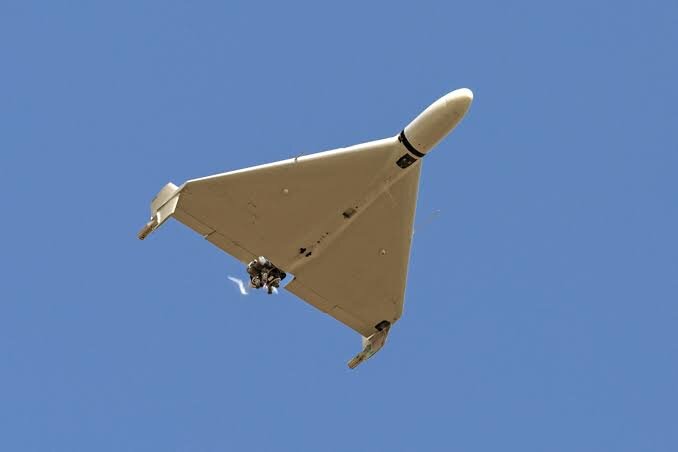
TEHRAN — South Korea has announced plans to develop and deploy domestically produced loitering munitions based on Iran’s Shahed-136 unmanned aerial vehicle, according to the country’s Ministry of Defense.
The ministry confirmed that the indigenous drones are being developed through reverse-engineering of the Iranian platform and are expected to enter operational service under a broader initiative to expand South Korea’s unmanned aerial capabilities. The program is part of a larger procurement plan that includes the acquisition of more than 20,000 low-cost drones, encompassing short-range reconnaissance UAVs and loitering munitions.
The Shahed-136, developed by Iran several years ago, is a delta-wing loitering munition with an operational range of approximately 1,800 to 2,500 kilometers. It carries a warhead of 30 to 50 kilograms and is powered by a four-cylinder piston engine driving a pusher propeller. Guidance is provided by an inertial navigation system supplemented by GPS, and the drone is typically launched from rail-equipped vehicles. Its relatively low production cost—estimated between $20,000 and $50,000 per unit—has made it a key asset in Iran’s asymmetric warfare strategy. The drone has been used extensively during Iran’s military operations against the U.S. and Israel in the past two years.
The United States has also pursued development of similar low-cost loitering munitions following analysis of Shahed-136. In 2023, the U.S. Army awarded contracts for long-range loitering munition projects, and the U.S. Air Force Research Laboratory initiated a program codenamed “Cheap Jack,” which features a delta-wing design, a piston engine, and GPS/INS guidance, with a target unit cost of approximately $30,000. The U.S. version reportedly uses a similar engine type and launch rail system. Test flights have been conducted at White Sands Missile Range in New Mexico, though production volumes remain significantly below Iran’s estimated output. Some reports suggest the U.S. may have used its version of Shahed-136 for false flag attacks against certain regional countries during its recent aggression against Iran.
South Korea’s decision to reverse-engineer the Shahed-136 follows a pattern of global interest in the platform’s cost-to-performance ratio, as several nations seek to acquire affordable long-range strike capabilities without relying on more expensive missile systems.
Disclaimer : This story is auto aggregated by a computer programme and has not been created or edited by DOWNTHENEWS. Publisher: tehrantimes.com