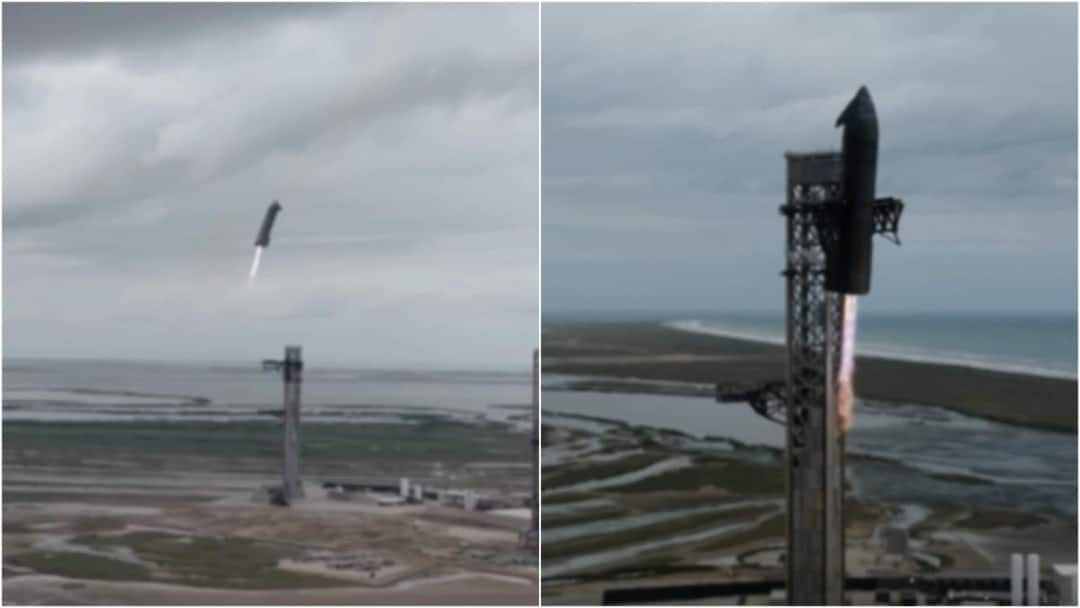
- SpaceX successfully caught Starship upper stage after orbital flight.
- Ship 42 spent 22 hours in orbit, deployed satellites.
- Booster recovery failed, but upper stage catch advances reusability.
SpaceX has successfully caught the upper stage of its Starship rocket at its launch site in Texas after the spacecraft travelled to orbit and returned to Earth, achieving a milestone the company had been working towards for years.
The historic recovery took place at around 2:52 am IST on Sunday, November 15, when the spacecraft, Ship 42, was caught by the giant mechanical arms attached to the launch tower, Mechazilla, at Starbase in South Texas. It marked the first time a Starship upper stage had been recovered at the launch site after completing an orbital journey.
The achievement was a major step towards SpaceX’s ambition of making Starship a fully reusable rocket, although the mission fell short of its original objective of recovering both stages.
22 Hours In Space, 14 Revolutions Around Earth
Ship 42 lifted off from Starbase on November 14 during Flight 15, the vehicle’s 15th integrated flight test. It reached low Earth orbit at an altitude of around 275 km and spent more than 22 hours in space.
During the mission, the spacecraft completed approximately 14 revolutions around Earth and deployed 26 next-generation Starlink V3 satellites. Three satellites carried cameras to inspect the spacecraft’s heat shield and other hardware, providing engineers with data to assess its condition ahead of the return journey.
After completing its orbital operations and final checks, Ship 42 performed a de-orbit burn and began its descent through Earth’s atmosphere. It then carried out a controlled landing manoeuvre before aligning itself with the Starbase launch tower.
The tower’s two giant mechanical arms, popularly known as ‘Chopsticks’, closed around the descending spacecraft and brought it to a stop above the launch pad.
SpaceX CEO Elon Musk shared a video on X showing him inspecting the upper stage after the successful capture.
Mechazilla catches Starship! Congratulations to the entire SpaceX team on this incredible achievement! https://t.co/YJzmGUZb2B
— SpaceX (@SpaceX) November 14, 2026
Booster Recovery Attempt Aborted
Flight 15 was the first mission in which SpaceX attempted to catch both the Super Heavy booster and the Starship upper stage at the launch tower.
However, the planned recovery of the booster was called off. Instead of returning for a tower catch, it was diverted towards an offshore landing in the Gulf of Mexico, where it exploded before hitting the water.
While SpaceX has previously recovered and reused Super Heavy boosters, it had never managed to catch a Starship upper stage after an orbital flight.
The successful recovery of Ship 42 therefore marked a significant development, even though the company did not achieve its original dual-recovery objective.
The mission also prompted temporary flight restrictions. The Hawaii Department of Transportation issued a pause on some West Coast flights over debris concerns. Separately, the Federal Aviation Administration (FAA) ordered a nationwide ground stop due to telecommunications system failures. Both orders have since been lifted.
Why The Starship Catch Matters
Making Starship fully and rapidly reusable is central to SpaceX’s long-term plans. The company aims to bring both the Super Heavy booster and the spacecraft back for inspection and reuse, potentially reducing the cost of launching payloads into space.
In the near term, Starship is expected to help expand SpaceX’s Starlink satellite internet network. The company has said that a single Starship can carry up to 60 Starlink V3 satellites.
SpaceX also plans to use the spacecraft to transport astronauts and cargo between lunar orbit and the Moon’s surface for NASA. Musk has additionally spoken about using Starship to support missions to Mars and his ambition to make humanity a multi-planetary species.
The successful catch of Ship 42 represents an important step towards those goals, demonstrating that the spacecraft’s upper stage can return from orbit and be recovered at its launch site.
Disclaimer : This story is auto aggregated by a computer programme and has not been created or edited by DOWNTHENEWS. Publisher: abplive.com