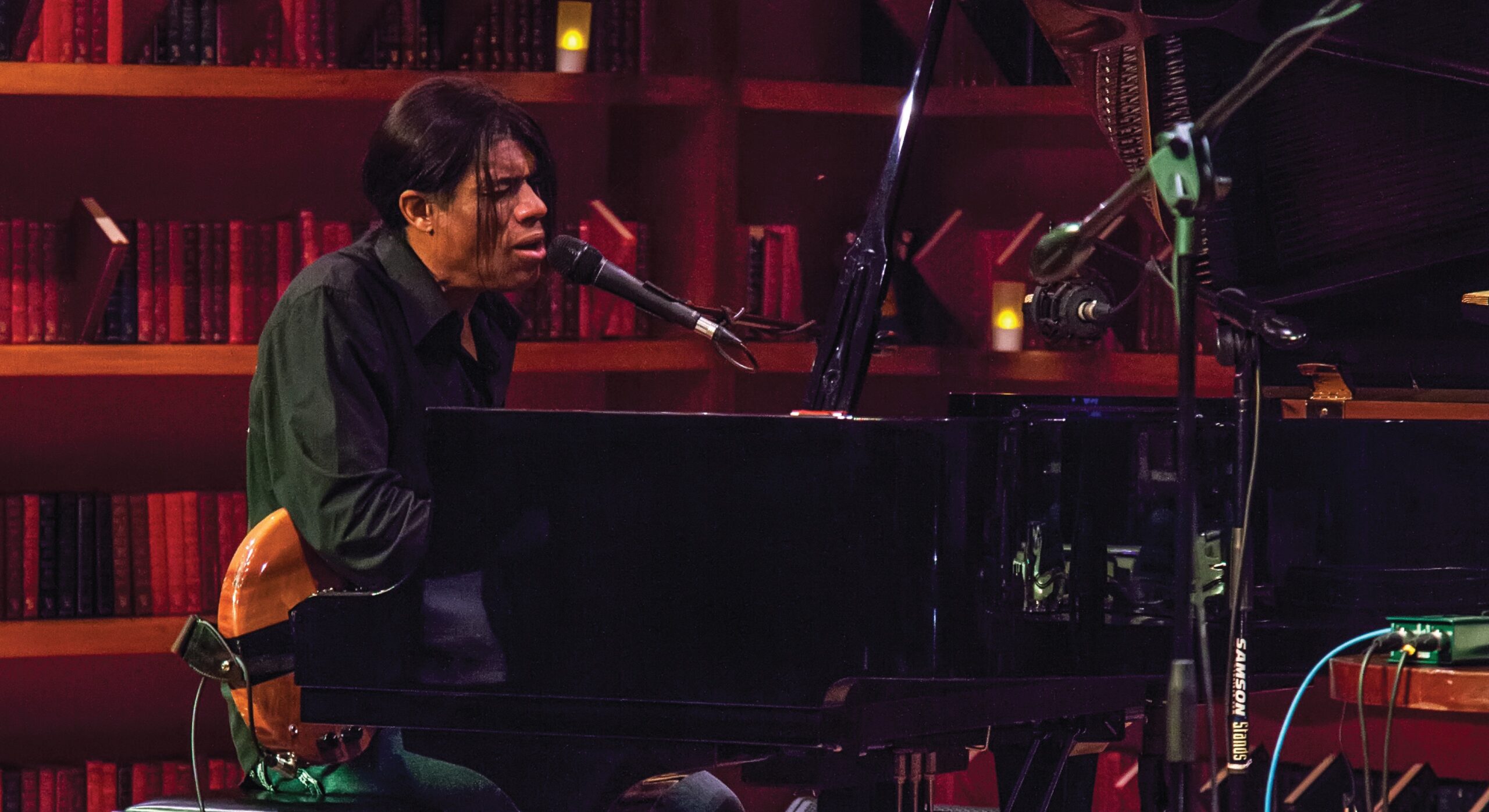
For Stanley Jordan, music was never simply about mastering an instrument. Long before the world recognised him as the pioneer of the two-handed touch technique on guitar, he was already hearing sounds in his head that conventional guitar playing could not produce. What followed was not a calculated reinvention of the instrument, but a deeply personal search for a language that could translate what he was hearing internally.
“I actually did realize that even before I did it,” Jordan says, reflecting on the evolution of the technique that would redefine modern guitar playing. “Because I had musical ideas that I couldn’t play on a guitar. I started to experiment with different techniques until I worked out this technique that I’m using now.”
That search led him toward the piano as much as the guitar. “There are textures that a piano can create that normally you can’t do on a guitar,” he explains. “But there’s another part of it too. Everybody has different music inside. I think I had music in my head, in my heart, that was different from the music I was hearing out there.”
The result was not just technical innovation but a more intimate access to his own voice. “The technique allowed me to access more of my original sound,” he says.
Ahead of his performances at Windmills Craftworks in Hyderabad and Bengaluru alongside longtime collaborator Kenwood Dennard, Jordan speaks with the calm intensity of someone still deeply curious about music despite decades on stage. For him, improvisation is not about showing off virtuosity. It is about discovery.
“It’s surprising every time,” he says about performing live. “I am a lifelong student of music. Even though I have developed a big musical vocabulary, it’s like somebody gives you a map of a huge territory. You know the terrain from the map, but it’s not the same as actually going to those places.”
That sense of exploration becomes even more profound in collaboration. Jordan has worked with musicians across genres and generations, yet what matters most to him goes far beyond technical brilliance.
“It’s definitely important for me to work with people who I can get along with personally,” he says. “The energy of the human being is a really important factor because that’s going to come through whether you plan it or not.”
For Jordan, music is visual and physical as much as it is sonic. “I watch how musicians move through space,” he says. “I think of it as choreography. If I am dancing with the other musicians, then whatever I play is probably going to fit.”
He points to his musical partnership with drummer Kenwood Dennard as an example of that almost intuitive connection. Despite significant hearing loss, Dennard continues to astonish Jordan with his responsiveness and sensitivity on stage.
“He hears everything,” Jordan says with admiration. “Even the smallest detail that I might play, he’ll catch that and respond to it. So it definitely goes beyond the sound.”
That deeper connection is something Jordan believes jazz uniquely enables. At a time when algorithms, shortened attention spans and simplified music dominate mainstream listening, he sees jazz as a necessary counterbalance.
“There’s a natural tendency for musical genres to evolve and develop,” he says. “We have had a long history of music being corporatised where big corporations decide what people hear. That can lead to a kind of dumbing down.”
Yet he finds hope in younger musicians who are embracing complexity again. He mentions modern jazz guitarists inspired by Allan Holdsworth and artists like Jacob Collier, who blur the lines between jazz and popular music.
“Music is a pattern language, but it’s also an emotional language,” he says. “When patterns become artificially simplified, it limits the emotional experience listeners get.”
Jordan compares jazz to nourishment. “It’s like when somebody’s been eating junk food their whole life and then you give them healthy food. Their body says thank you. Jazz gives you richness, spontaneity and all those organic nutrients, but it’s also fun and compelling.”
That richness is something he feels especially grateful to explore in intimate spaces like Windmills Craftworks, where audiences gather with a genuine listening focus.
“The sound is just so good there,” he says enthusiastically. “My music has a lot of detail and sometimes I go deeper and deeper into subtle details. It’s wonderful to have a place where people can hear that.”
For Jordan, environment shapes performance. “When you are surrounded by beauty, it does something to you on the inside. An environment like Windmills Craftworks not only enhances the listener’s experience, but it also brings out more things in me and helps me play my best.”
Ask him a philosophical question: Is jazz ultimately about freedom or discipline?
Jordan smiles at the impossibility of choosing one over the other.
“What’s remarkable about jazz is the way it combines both. Coming from classical music, discipline was very important. But jazz still has discipline while also creating so much more freedom.”
He compares it to evolution in nature. “A cat is more evolved than a frog because it has more complexity, but if you watch the movements of a cat, they are also smoother and more integrated. It’s both,” he says.
That balance of structure and unpredictability is also what allows jazz to endlessly reinvent itself across generations.
“There’s this factor of chaos,” he says. “The world is very sensitive. The smallest change can lead to a big effect. Jazz is set up to maximise that.”
For Jordan, the appeal of jazz ultimately lies in presence itself. “When you engage in an art form that’s always changing, it brings you into the moment,” he says. “It brings you into a state of mindfulness. That goes far beyond entertainment.”
As the conversation winds down, Jordan speaks with visible excitement about performing in Hyderabad for the very first time. Having landed only hours earlier, he is already taking in the city around him, curious and observant, much like his approach to music itself.
“I am already so excited,” he says warmly. “I have a lot to explore and experience.”
Disclaimer : This story is auto aggregated by a computer programme and has not been created or edited by DOWNTHENEWS. Publisher: deccanchronicle.com