Luke Harding is a senior Guardian international correspondent.
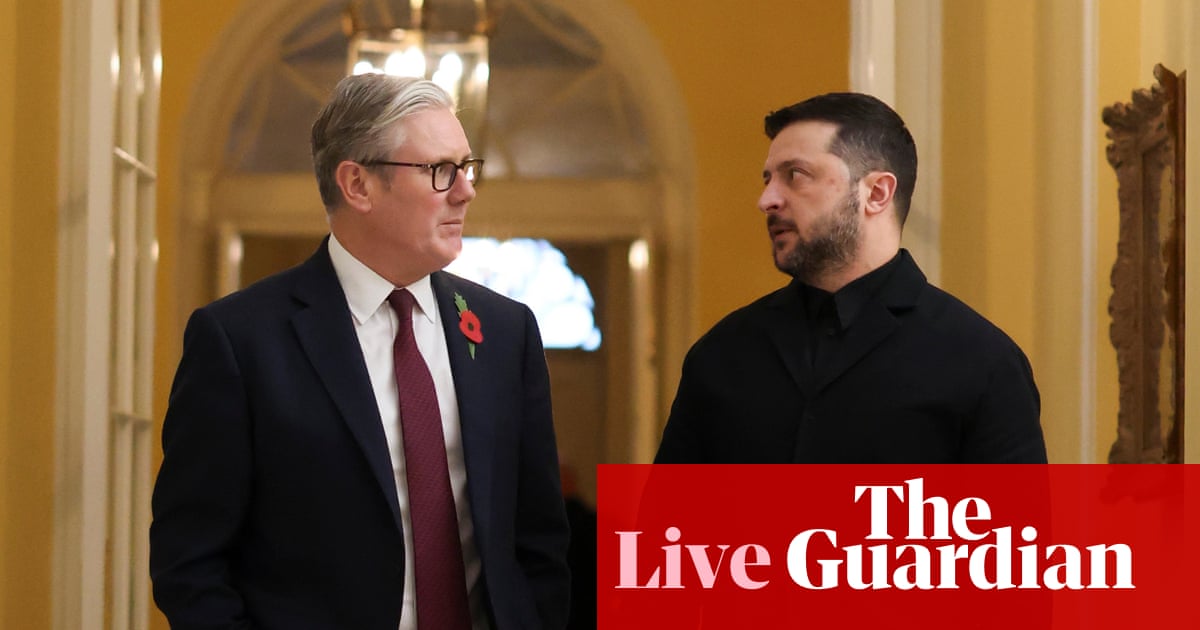
Volodymyr Zelenskyy’s office says it is seeking clarification from Downing Street on the UK’s decision to lift sanctions on some Russian oil, amid accusations from the Conservatives that Keir Starmer is helping the Kremlin make money.
Ukraine’s president has not yet commented on the decision to issue a new licence for imports of diesel and jet fuel made from sanctioned Russian oil. The UK has also permitted the maritime transport of Russian liquefied natural gas.
Zelenskyy has previously urged Western partners to maintain a tough sanctions regime against Russian oil exports, pointing out that Moscow uses cash from hydrocarbon sales to fund its war against Ukraine.
In recent months Kyiv has intensified long-range strikes against Russia’s oil infrastructure, hitting ports on the Baltic and Black Sea, as well as targets in the Urals, more than 1500kms from the frontline. Zelenskyy has dubbed these remote attacks “long-range sanctions”.
“There is currently very active communication between our diplomats and the Office [of the President] and the British side to clarify the details,” an aide to Zelenskyy said today.
We are expecting Wes Streeting, the former health secretary, to deliver his post-resignation “personal statement” in the Commons shortly.
At the post-PMQs lobby briefing, the PM’s spokesperson said that the extension of the fuel duty freeze announced by Keir Starmer at PMQs (see 12.03pm) would just last until the end of 2026.
That would mean that, since 2024, the ongoing freeze would have saved the average driver £120, he said.
The spokesperson said further decisions about the future of fuel duty would be taken in the budget. He said it remained the government’s intention to return fuel duty rates to the equivalent of what they were, in real terms, in early 2022.
During PMQs Kemi Badenoch, referring to the UK’s new sanctions policy towards Russia, said:
This morning Ukraine’s sanction chief disagrees with what the prime minister’s approach is. That’s what Ukraine is saying.
She was referring to a post on X from Vladyslav Vlasiuk, the Ukrainian president’s commissioner for sanctions policy. Vlasiuk initially posted a message saying “we understand the rationale” behind the UK’s decision but “disagree with the approach.”
But Vlasiuk later deleted this post, the Press Association reports. He then posted another message saying:
To be clear, the UK has not lifted sanctions on Russian energy. The new measures overall significantly tighten restrictions, including on Russian LNG, refined oil products and uranium. Our concern relates specifically to temporary exemptions that may still generate additional revenues for Russia’s war machine.
During his responses to questions during the UQ on Russian sanctions, Chris Bryant, the trade minister, apologised for the way the government originally presented its new Russian sanctions policy. He said that he accepted the blame.
He told MPs:
We’ve handled this clumsily and that’s entirely my fault and I apologise to all honourable members. I think we’ve ended up giving the wrong impression of what we’re trying to do, we’re trying to strengthen the regime [of sanctions], not weaken it.
Bryant said that there had been a miscommunication between the Department of Business and Trade, which he represents, and the Foreign Office. He said:
That is entirely my fault and nobody else’s, so if anybody wants to have a go at anybody, they can just have a go at me.
He later told MPs:
The problems about the headlines this morning, where I think some journalists saw one half of the story and not the whole of the story, that’s entirely down to me and my fault.
Normally in circumstances like this, when a government policy gets misrepresented, ministers just blame the media. Whether Bryant was really entirely to blame, or whether he had chosen to be gracious and ‘take one for the team’, wasn’t entirely clear.
Chris Bryant, the trade minister, responded to the Conservative party’s urgent question about the new sanctions package for Russia. (See 11.39am.)
This is what he said in his opening statement.
Putin must never be allowed victory in Ukraine and we will do everything we can as a government and as a country to debilitate and degrade the Russian war machine. That is precisely what our sanctions regime is designed to do.
We sanctioned more than 3,300 individuals and organisations and hundreds of shadow fleet tankers. It’s as tough a sanctions regime as any in the world, and we are proud of it.
I want to make it absolutely clear that our sanctions regime today is tougher than it was yesterday or last week.
In fact, thanks to the Russia (sanctions) (EU exit) (amendment) regulations 2026 statutory instrument we will for the first time from today, for the first time, ban the import not only of uranium but also the import of Russian oil products processed in a third country.
We are not lifting any existing sanctions at all.
We are, like other countries, phasing in these sanctions, which is why, in the light of the situation in the Middle East, we have issued a targeted temporary licence to allow the continued import of diesel and jet fuel. These licences are temporary and targeted.
We will review them regularly and repeatedly and will suspend them as soon as we possibly can.
As a result of all of the measures that we have taken, and there will be less Russian oil on the market, not more. Russia will be poorer.
Luke Harding is a senior Guardian international correspondent.
Volodymyr Zelenskyy’s office says it is seeking clarification from Downing Street on the UK’s decision to lift sanctions on some Russian oil, amid accusations from the Conservatives that Keir Starmer is helping the Kremlin make money.
Ukraine’s president has not yet commented on the decision to issue a new licence for imports of diesel and jet fuel made from sanctioned Russian oil. The UK has also permitted the maritime transport of Russian liquefied natural gas.
Zelenskyy has previously urged Western partners to maintain a tough sanctions regime against Russian oil exports, pointing out that Moscow uses cash from hydrocarbon sales to fund its war against Ukraine.
In recent months Kyiv has intensified long-range strikes against Russia’s oil infrastructure, hitting ports on the Baltic and Black Sea, as well as targets in the Urals, more than 1500kms from the frontline. Zelenskyy has dubbed these remote attacks “long-range sanctions”.
“There is currently very active communication between our diplomats and the Office [of the President] and the British side to clarify the details,” an aide to Zelenskyy said today.
Kemi Badenoch is now by far the most popular shadow cabinet minister with Conservative party members. That is not because her party is making great gains in elections, or in the polls. It is because she is confident, pugnacious and assertive in the Commons, especially at PMQs
Today was a good example. Badenoch always goes for the maximalist position when attacking Labour, and today she focused on the announcement about the new sanctions package for Russia. She claimed that Ukraine was being betrayed, that Starmer was approving sales that would help to fund the Russian war effort and – in her final question – she ended with a flourish (referencing the supermarket policy) that “it’s like the Soviets won”. Tory members will love it.
Confident, pugnacious and assertive? Sure. But persuasive and effective? Not so much. On the substance, on the narrow point about the rights and wrongs of the sanctions package, Keir Starmer was far more convincing. He made a strong argument about why it was wrong to present this as the watering down of sanctions that are already in place. (See 12.08am.) Assuming that he is right, many of the objections to the policy should fall away.
But Starmer should never have been on the defensive on this story in the first place. If it is the case that claims that sanctions were being relaxed were not accurate, the government should have been forcefully making that case (as Chris Bryant, the trade minister, is doing in response to an urgent question now) as soon as this story first emerged overnight. Dan Tomlinson, a Treasury minister, was doing a broadcast round this morning and he did not challenge the framing of the story in the way that Starmer did at PMQs, and Bryant is doing now. A government running an effective news operation should not need 12 hours to kill a negative story.
Karl Turner, the former Labour MP who is currently suspended, tells Starmer that people in No 10 questioned his mental health when he started opposing the government’s plans to limit jury trials.
Starmer says nobody should be smeared on mental health grounds.
Sarah Olney (Lib Dem) asks the PM to congratulate all 54 Lib Dem councillors who won all 54 seats on Richmond council. But does he agree that it would be better to replace the first past the post system that produced this with a fairer PR system.
Starmer says he does not agree with the case for PR.
Esther McVey (Con) asks if Starmer agrees with what Andy Burnham said about wanting to rejoin the EU, or what he said about not wanting to rejoin the EU.
Starmer says he agrees with what was in Labour’s manifesto.
Disclaimer : This story is auto aggregated by a computer programme and has not been created or edited by DOWNTHENEWS. Publisher: theguardian.com