Updated ,first published
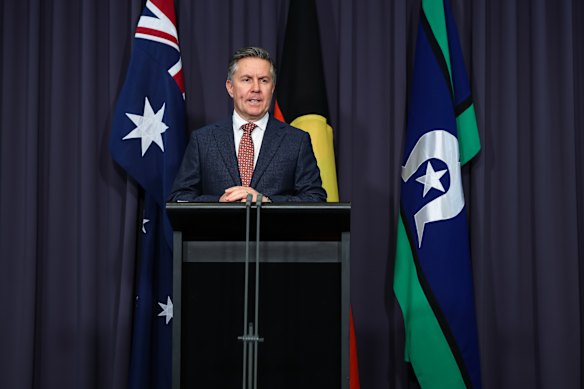
Health Minister Mark Butler has challenged states and territories that have banned puberty blockers for children to comply with new national guidelines which suggest gender-diverse teens should get access to the treatment.
Queensland and the Northern Territory immediately rejected the National Health and Medical Research Council (NHMRC) finding on Monday, insisting they would maintain bans despite being in conflict with the proposed non-binding national guideline.
The recommendations could prove a test for the Liberals in the Victorian election after One Nation said the party would fight to ban the treatment if elected.
The federal Coalition also sounded the alarm that Australia’s review deviated from a 2024 UK health service commission, which found there was little scientific evidence to support the treatment.
The conflict is the latest example of the politically charged debate in countries around the world regarding the medical treatment of a growing number of children identifying as trans and gender-diverse. Proponents of puberty blockers say it is crucial healthcare to give adolescents time to consider more serious interventions, while critics argue there is not enough evidence the treatment is safe.
The health council released an interim recommendation on Monday almost two years after it launched a review into the medical treatment of transgender youth at the request of the federal government.
The peak body recommended puberty blockers, or suppressants that delay hormonal development, be permitted across Australia for children whose gender identity and sex recorded at birth don’t match. Prescriptions would have to be made in consultation with clinicians and parents as children begin to show physical signs of puberty.
Queensland banned puberty blockers in January 2025, prompted by the United Kingdom’s decision to stop the treatment. Two days later, Labor ordered the review into the prescription of gender transition drugs.
The guideline handed down on Monday do not require a child to be diagnosed with gender dysphoria – the psychological distress about a mismatch of gender identity.
The review acknowledged the “low-certainty” evidence for puberty blockers, but said guidelines must be provided for best practice, noting the treatments were reversible.
Gender identity is proving a key campaign issue for conservatives in Australia. Opposition Leader Angus Taylor in May pledged to rewrite the Sex Discrimination Act to enshrine a definition of biological sex, a day after One Nation’s Pauline Hanson said she would do the same.
The issue could become a point of contention in the Victorian election this month, where the Resolve Political Monitor shows One Nation on a primary vote of 23 per cent, the Coalition on 30 per cent and Labor on 22 per cent.
A One Nation spokesperson said the minor party would ban puberty blockers if elected both nationally and in Victoria, raising the pressure on the state Coalition to respond. The Liberal Party did not respond to Butler’s comments in time for deadline.
Butler said on Monday governments had a responsibility to ensure the highest-quality care for all Australians, and the guidelines were important for the “contested, evolving area”.
“I’m very confident that those state governments running these services will consider this advice very closely and make sure that their services are aligning with it,” Butler said in Canberra.
He emphasised the “unimpeachable” reputation of the NHMRC in setting medical guidelines, saying it made decisions at arm’s length from government.
Butler said the UK findings were influenced by “pretty questionable private prescribing practices” and a different model of care to Australia.
Australia’s largest gender clinic, in Melbourne, prescribed 64 young people puberty suppressants in eight years, with an average wait of 530 days, Butler said.
Opposition health spokeswoman Anne Ruston raised concerns the recommendation did not require a gender dysphoria diagnosis or determine which clinicians should be involved.
“It does so while relying on evidence that the NHMRC itself rates as low or very low certainty,” she said.
Advocacy groups and the federal Greens welcomed the recommendation and demanded Queensland and the Northern Territory comply with the non-binding advice.
Queensland Health Minister Tim Nicholls said the state government had made a clear decision on the provision of treatment based on its own independent review.
“Our position remains unchanged, and we will continue to prioritise the health, safety and wellbeing of young Queenslanders,” he said.
“Trans young people in Queensland are being denied access to healthcare that Australia’s peak medical research body recognises as an appropriate treatment option,” she said.
A spokesperson for the Northern Territory government said: “Our decision is consistent with Queensland, the United Kingdom and Finland, which have all taken a cautious approach.”
New Zealand’s High Court last month struck down a national ban on puberty blockers, ruling that it amounted to unjustified discrimination and had not been subject to sufficient consultation.
The NHMRC advice on puberty blockers, out for public consultation until January 18, is an interim guideline ahead of its broader recommendations on gender-affirming care such as the prescription of hormones, expected in 2028.
Cut through the noise of federal politics with news, views and expert analysis. Subscribers can sign up to our weekly Inside Politics newsletter.
 Brittany Busch is a federal politics reporter for The Age and The Sydney Morning Herald.Connect via email.
From our partners
Disclaimer : This story is auto aggregated by a computer programme and has not been created or edited by DOWNTHENEWS. Publisher: www.smh.com.au