
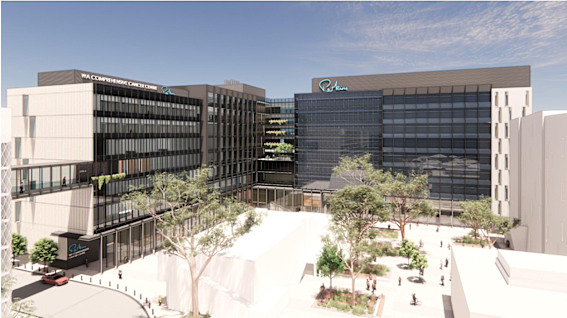

Western Australia will soon be able to provide state-of-the-art care to cancer patients after the announcement that a comprehensive centre will soon be built at the Queen Elizabeth II Medical Centre in Nedlands.
The news was delivered on Saturday, revealing that world-leading research will now be available in the state in the same way that it is at the Chris O’Brien Lifehouse in Sydney and the Peter MacCallum Cancer Centre in Melbourne which integrate cancer treatment, world-class cancer research and clinical trial capacity in one place.
Once constructed the Perkins WA Comprehensive Cancer Centre will include inpatient and outpatient services, research and education services including expanded clinical trial beds and a Cancer Care Coordination Centre (CCCC) providing care coordination, patient navigation and patient information services.
Harry Perkins Institute of Medical Research CEO, Professor Peter Leedman, said the Perkins WA Comprehensive Cancer Centre would transform the way cancer research and care is delivered throughout the state.
“Around the world, comprehensive cancer centres that truly integrate cutting-edge research with patient care are life-changing for so many people,” he said. “The difference between a truly comprehensive cancer centre, like the Peter MacCallum Cancer Centre in Victoria, and existing cancer services in WA, stems from deep integration of world-leading medical research and clinical trials into the treatment and care provided to patients. Research shows that strong collaboration between scientists and clinicians leads to significantly better patient outcomes and a more coordinated, less fragmented cancer journey.”
In WA, one in three people will die from cancer and more than 14,000 cases will be diagnosed each year.
Premier Roger Cook made the official announcement that the state government would be backing the centre on Saturday. He said the facility that will transform care and support for Western Australians facing their toughest challenge.
“Most Western Australians have experienced the hard road that is cancer treatment – either themselves or a loved one,” he said. “Our backing of the Perkins WA Comprehensive Cancer Centre is about ensuring that when a family faces their toughest fight, they have the very best medical technology, research, and support services right here at home.
“This project cements Western Australia’s reputation as a global leader in medical research and innovation, attracting the world’s brightest clinical minds to our state while creating hundreds of local jobs during construction and beyond.”
The investment comes at the same time as the Cook Labor Government is boosting the Building Hospitals Fund by $500 million to $2 billion in the 2026-27 Budget, as part of the Government’s $5.5 billion hospital constriction program over the next four years.
Planning for the Perkins WA Comprehensive Cancer Centre, including the final scope and design, will start following a masterplan for the QEII Medical Precinct, to guide potential future projects at the Nedlands Health Hub.
Perkins Chair, Ben Morton, said helping people with cancer live better and longer was at the core of the Perkins WA Comprehensive Cancer Centre.
“This centre will help deliver better research outcomes targeted at finding cures and better treatments – while at the same time improving the care of people fighting cancer,” he said. “We take our responsibility for developing the Perkins WA Comprehensive Cancer Centre very seriously and are honoured to be entrusted by both the WA State and Federal Governments to deliver this transformational project.”
The centre will include 90 multi-day beds, plus expansion for a further 30 beds, 40 same-day beds and chairs including chemotherapy and haematology and up to eight intensive care/high dependency beds.
Outpatient services will include 36 ambulatory care / specialist clinics, space for two radiation oncology bunkers, four operating theatres, as well as space for two further theatres, two procedure rooms, and seven imaging services including CT, MRI and PET.
The research and education services will include expanded clinical trial beds in addition to the existing six beds and 18 chairs in Linear Clinical Research at QEII Medical Centre, a variety of wet laboratory and dry research spaces, function-specific embedded research units and a cancer tissue biobank.
The Cancer Care Coordination Centre (CCCC) will provide care coordination, patient navigation and patient information services including virtual health services providing support for regional, remote and Aboriginal patients living with cancer, and working with WA Country Health Service (WACHS) Command Centre.
From our partners
Disclaimer : This story is auto aggregated by a computer programme and has not been created or edited by DOWNTHENEWS. Publisher: www.smh.com.au


