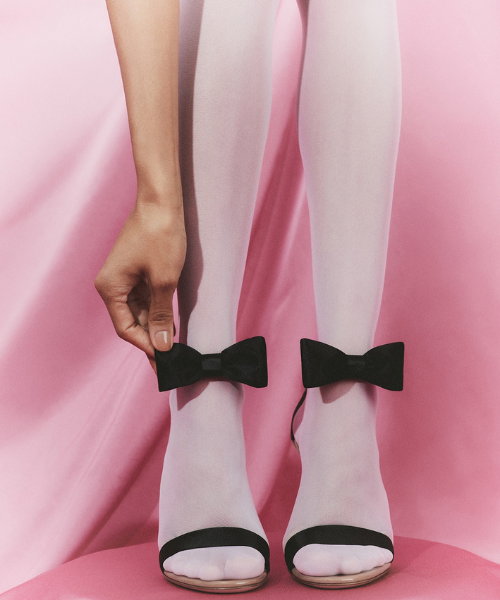
Gianvito Rossi doesn’t work in a design studio, at least not in the way most people might imagine it. No glamorous sunlit atelier, no artfully curated mood boards, no opera playing softly in the background. He prefers being boots on the ground in his factory. That is where he has spent the better part of two decades, and where he intends to stay. “Me and my team are here every day collaborating with the technical department, with the production department,” he says. “I look hard at each step of the process, from the first prototype to every modification along the way. It’s very important to follow each step to understand what is behind every decision, because it really influences the results. I know a lot of designers who just send sketches and then see the finished result. That is not my way.”
This year marks the 20th anniversary of the Gianvito Rossi brand, and, as is customary when these sorts of anniversaries arrive, a commemorative book is about to be published. It’s the sort of project that forces a man to sit down and take in his entire body of work in one go. What stood out for Rossi is quite telling about him and his relationship with shoes. “I’m happy about the consistency of our work,” he says matter-of-factly. Not a breakthrough design, not a signature shoe, not a red-carpet moment. Consistency. He explains it as a kind of survival instinct. “Since the beginning I wanted to focus on a clear identity of what I was doing, because it was essentially what I liked. So it’s kind of easy to keep doing what you like,” he explains. “The problem could be everything that happens in the market, whatever may drive you a little bit away from that identity over years and decades.” Going back through his archive in preparation for the book, he found the proof he was after. The idea had been, in his words, constant, consistent, and evolving – and still recognisably the thing he set out to make two decades ago. To understand why that matters so much to him, you have to go back further than 20 years, to his formative apprenticeship alongside his father, Sergio Rossi. It was an education in an industry, and in a set of constraints. When he finally stepped out on his own, there was a sense of newfound independence. “Now I’m free to do what I want,” he recalls of that moment. “This is a great opportunity, and I wanted to do what I like.” What he liked, it turned out, was creating shoes that looked modern and very feminine while never sacrificing comfort. It’s this vision of footwear he has been refining ever since with his eponymous label.
What Rossi carries with him from the time he spent toiling next to his father had less to do with aesthetics than it does with something more profound. The importance of quality and how success starts with a well made last (the form a shoe is built around) and the way a shoe is conceived in the first place. And beyond that, an almost protective respect for the people doing the work. “It really depends on the hands that do the job,” he says. “It’s very important to have people who know what to do. Experienced people, trained people, supported people.” It takes a long time, he adds with some feeling, to become an expert.
There is also a perfectionist streak in Rossi. “You have to keep working, because there’s always a way to improve,” he says. “So every new style that we do, we try to improve versus what we did in the past.” The result he’s chasing is harder than it sounds. “I’m most satisfied when I can do something that is very simple and original,” he says. But like almost anything that looks effortless, it’s usually not. “That is what I am always looking for, and when I am able to find that balance, that is a design achievement.”

As for the evolution of footwear over the past 20 years, Rossi homes in on a shift towards comfort across the board, though one being executed in very different ways. Sneakers became, as he puts it, “one of the most important new elements” of a woman’s luxury wardrobe. But they are not the only addition. Easy shoes, summer styles, flats, and casual pieces are all in heavy rotation now, transforming the landscape of high-end design and moving it away from appearance and towards physical ease.
There is also another, more nuanced, change, and this one has to do with power. “I think that we have more space for freedom and expression in fashion than we had before,” Rossi says of the wider move away from trends and towards more individual dressing. “Before, it was more like kind of dictated. Now I think there are no more strict guidelines everyone has to follow, which is better for me,” he says with a smile.
That freedom extends to the feet themselves. Rossi is refreshingly blunt about the old bargain women were expected to accept when it came to their shoes. “In the past, it was like: to look beautiful, you have to suffer.” He shakes his head. “I think it’s completely changed nowadays. You have the right to demand both beauty and comfort. I mean, if you pay a lot, you need to ask for a lot.”
Delivering both is the engineering problem of Rossi’s life, and he is clear-eyed about why a shoe is unlike anything else you put on. “Different from other ready-to-wear elements or accessories like handbags, you actually walk with the shoe,” he says. “All your weight is in there.” Push a heel higher or sharpen a toe, and you are usually taking something away from the woman wearing it. There is no shortcut. “It’s not a secret. It’s a matter of time you spend to perfect what you do. It’s a matter of research,” says the founder. When pressed, Rossi admits to a soft spot for the Gianvito, a pointed stiletto pump that carries his name and has become, logo-free, one of the most identifiable shoes in luxury. He calls it the archetype of his silhouette, and a must-have for any woman looking for impact and elegance while still being able to walk for miles. As for the more conceptual footwear currently being proposed by some luxury houses, he is polite yet immovable. Fantasy is fine, he says, but you still have to arrive at beauty. Provoking conversation for its own sake is, in his words, “not quality in terms of design”.
So where does a man this devoted to the classic go next? Inward, mostly. His idea of innovation is not reinvention but the quiet upgrading of something already settled: keeping the classic “super classic”, as he puts it, while introducing transparency into a sandal, or carbon fibre into a heel, or a shift of shape so slight that most people register it only as making sense in their bones. “I want these shoes to make women feel confident, because they feel good in them,” he says simply.
– For more on luxury lifestyle, news, fashion, and beauty, follow Emirates Woman on Facebook and Instagram.
Images: Supplied
Disclaimer : This story is auto aggregated by a computer programme and has not been created or edited by DOWNTHENEWS. Publisher: emirateswoman.com