The newest installment of the movie that made Pixar a powerhouse and Steve Jobs a billionaire just secured the biggest opening weekend in the history of the Toy Story franchise.
Just over 30 years after the original movie was released, Toy Story 5 amassed a staggering $312 million for its opening weekend, toppingToy Story 4’s $238 million debut in 2019.
The newest film, which follows Woody and Buzz Lightyear as they battle a shiny new tablet for the attention of their owner, Bonnie, has already trumped its eye-popping budget of $250 million.
Another $100 million worth of marketing costs means the film is not yet profitable. But if its opening weekend is any indication, Toy Story 5 is set to break records.
Since the first film was released in 1995, the franchise has driven $16 billion in revenue to Disney, which bought Pixar in 2006, thanks in part to retail sales for consumer products, games, and publishing, which add to the franchise’s massive box office receipts.
While Toy Story has defined itself as one of Pixar’s biggest success stories, less well known is the role that Apple cofounder Steve Jobs played.
Job’s role at Pixar
After Jobs was forced out of Apple in 1985, he was looking for new projects at the intersection of creativity and technology. Through a connection, Jobs stumbled upon what was then the computer animation division of Star Wars creator George Lucas’ production company Lucasfilm and was immediately impressed, wrote Walter Isaacson in his biography of the Apple cofounder.
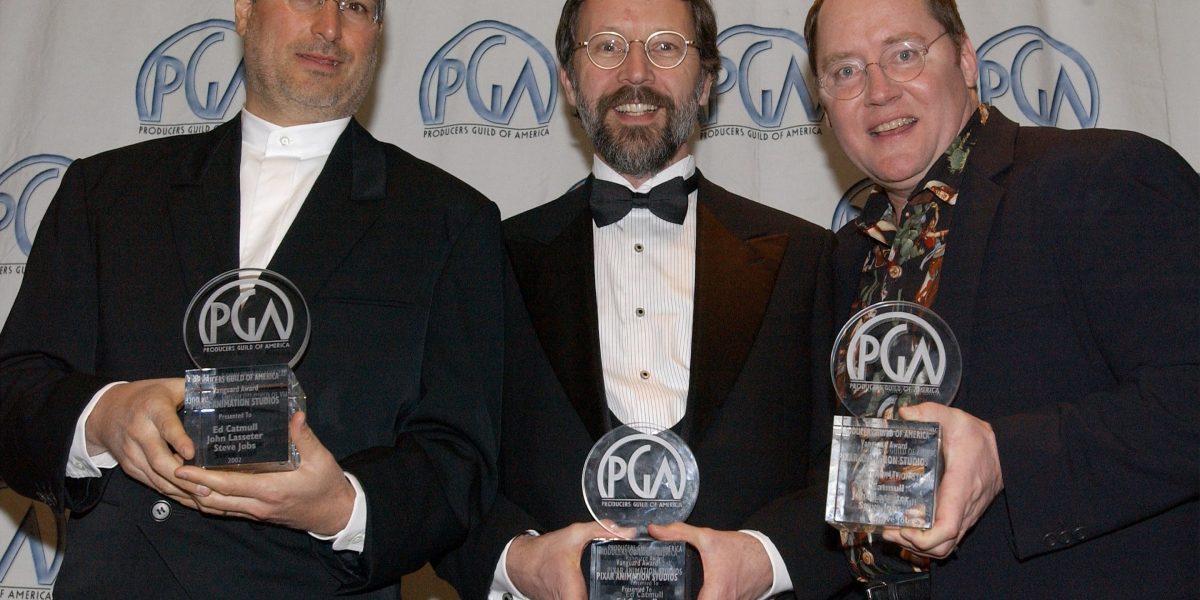
This rag-tag crew inside Lucasfilm was focused on making hardware and software for rendering digital images, but it also had a team making short films led by the cartoon-loving creative John Lasseter, who later became the chief creative officer at Pixar and Walt Disney Animation Studios.
Lucas was going through a divorce at the time and wanted to offload the division, but was having trouble finding a buyer. So Ed Catmull, who would later become president of Pixar, sought out Jobs hoping he would invest in the company so it could be run by its employees. For Jobs, it wasn’t a hard sell.
“I wanted to buy it because I was really into computer graphics,” he told Isaacson. “I realized they were way ahead of others in combining art and technology, which is what I’ve always been interested in.”
In the end, Jobs paid $5 million to Lucasfilm for the division and invested another $5 million into the company. Although it was less than Lucas was asking for, the two struck a deal that saw Jobs get 70% of the company that would become Pixar, with the rest of the stock distributed to its employees.
Jobs originally saw hardware as Pixar’s potential cash cow. The company in 1986 released the Pixar Image Computer, which gained some traction in the medical industry for its ability to render CAT scan data, among other uses.
Yet, in that same year, the short film Luxo Jr., a story from Lasseter about two animated lamps, was nominated for an Academy award, convincing Jobs that Pixar could become an animation leader.
“Our film was the only one that had art to it, not just good technology,” Jobs told Isaacson. “Pixar was about making that combination, just as the Macintosh had been.”
By 1990, Jobs had sold off the company’s hardware business to Vicom Systems for a measly $2 million.
The remaining company wasn’t without its issues. Jobs reportedly had to put in his own money many times to make ends meet. He reportedly considered selling Pixar on multiple occasions, including to Microsoft or even Hallmark.
Joining forces with Disney
Meanwhile, Disney and Pixar had been working together for years, and Disney had licensed Pixar’s Computer Animation Production to modernize its animation division, making it Pixar’s biggest customer at the time. Building on this partnership, the two companies decided in 1991 to work together on a film pitched by Lasseter: Toy Story.
But the film wasn’t always seen as a guaranteed success. A series of changes to make the story edgier even led Disney at one point to halt production. When this happened, Jobs kept the work going with his own personal funding and advocated for Pixar.
After multiple script changes, Jobs was eventually thrilled with the film and frequently invited friends like Larry Ellison over to his house to watch scenes from the movie as they were finished, according to Isaacson.
For all his reputation as a control freak who meddled in every detail of every product at Apple, Jobs largely kept his hands off Pixar’s creative process.
In 1995, Toy Story became the first full-length computer animated film and an instant success. The film brought in about $400 million at the time, more than 12 times its production budget.
Pixar went public just after the movie was released and exceeded expectations. Its stock, which was initially expected to debut at between $12 and $14, closed its first day of trading at $39 a share, and made Jobs a billionaire on paper overnight.
By 1997, Jobs had returned to Apple, eventually transforming the company into a global tech behemoth. But it was Pixar that initially propelled Jobs into billionaire status.
In the years after its IPO, Pixar made some of its most memorable films including Monsters, Inc., Finding Nemo, and The Incredibles. And after the Disney acquisition, Pixar has continued its success with films like Inside Out, Coco, and most recently Hoppers, which debuted earlier this year.
Jobs would later sell Pixar to Disney in 2006 for $7.4 billion in stock, and his shares alone were worth about $4.6 billion, making him Disney’s single largest individual shareholder with a 7% stake at the time—an even larger holding than any member of the Disney family.
Disclaimer : This story is auto aggregated by a computer programme and has not been created or edited by DOWNTHENEWS. Publisher: fortune.com