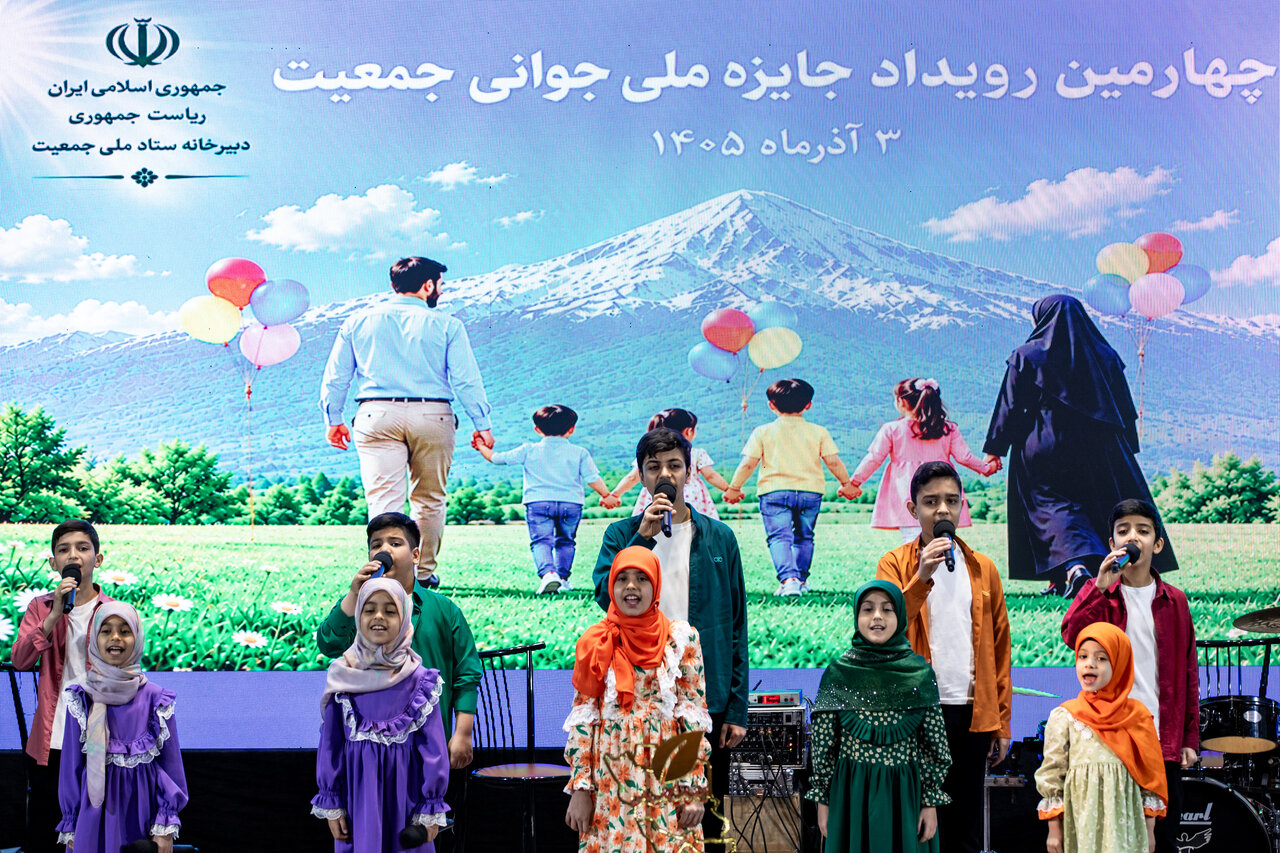
TEHRAN – The closing ceremony of the Fourth National Population Rejuvenation Award was held on Tuesday, Nov. 24, with the participation of the head and officials of the National Population Headquarters, families, executive managers, population activists and journalists.
The highlight of the ceremony was the message of Leader of the Islamic Revolution Ayatollah Seyed Mojtaba Khamenei to the event, which was read by Secretary of the National Population Rejuvenation Headquarters Marzieh Vahid Dastjerdi.
Fourth award puts population future on agenda
Organizers said the annual award is intended to promote discourse, synergy and exchange of successful experiences in population and family, and to honor families, managers, institutions and media outlets that have helped remove obstacles to marriage and childbearing.
Officials present stressed that the event should not be seen as a ceremonial gathering alone, but as part of the country’s strategic planning to correct the population curve and secure national survival.
Leader: increasing young population shapes power and repels threats
In his message, the Leader described the event as a good opportunity to discuss the critical issue of population, stressing that increasing the future population, while preserving all desirable quantitative and qualitative dimensions, is of paramount importance among factors contributing to national strength, progress and a stronger-than-ever Iran.
The full text of the Leader’s message is as follows:
“The Fourth National Event on Population Rejuvenation is a good opportunity to discuss the critical issue of population. Among the key factors contributing to national strength, progress, and the attainment of a stronger-than-ever Iran, the imperative of increasing the future population of our dear Iran, while preserving all desirable quantitative and qualitative dimensions, is of paramount importance. This strategic issue that helps to shape the future, which our illustrious, martyred Leader (may God exalt his noble rank) had repeatedly emphasized over the past decades, is highly effective both in actualizing the nation’s capacities and in creating and enhancing many opportunities in science, culture, economics, and society. It’s also influential in repelling and removing the threats and malicious intentions of the enemy.
It appears that after a lengthy, detrimental period of negligence that had dominated the landscape of national planning and management in this respect, certain recent measures have now created an opportunity for both the public and for officials to address this matter with deeper insight.
In considering the various aspects of population and its requirements and needs in different fields, the criterion for assessment is sometimes the family and sometimes its the individual. In some matters such as housing and for many goods and services, the consumer and user is the family, and in other matters such as food, clothing, and health-related needs, the individual is considered to be the unit of criterion. The issue of achieving a desirable population is one of the matters in which both aspects (the family and individuals) are involved. Therefore, improving various infrastructures and aspects related to strengthening the foundation of the family must be a permanent element in the effort to correct the country’s population curve, just as giving due attention to related individual concerns is also necessary.
Giving serious, comprehensive attention to the matter of facilitating marriage at a young age; ensuring individual health, which depends on multiple factors; supporting childbearing; promoting a family-centered culture; and introducing successful examples in this area are all effective steps on the path to making Iran stronger. Furthermore, giving a proper explanation of these matters to the entire nation, especially the youth, will serve as another useful step in this direction.
Without a doubt, every patriotic Iranian who hopes for a bright and glorious future for this land and its people will have a strong determination and resolve to ensure the continuity of future generations of the Iranian nation in a manner befitting the New Islamic Civilization. I sincerely hope that by remedying the shortcomings arising from certain past population policies, and by earnestly pursuing the sound, strategic policy of increasing the young population and placing the family at the center of this effort, our dear homeland will safely navigate this critical juncture and stage, which it now finds itself in and which will shape the future.
May divine grace, together with the blessed prayers of our Master [Imam Mahdi (may God hasten his noble reappearance)], cause God’s blessings to descend upon the Iranian people, who are standard-bearers of truth and justice in this day and age. We pray He will grant us this by His grace and generosity.”
Pledge to martyred leader and fallen martyrs
After reading the message, Dastjerdi asked the martyred Leader, who had repeatedly stressed population as a fundamental concern, to cast a benevolent glance upon his children and pray for the cause of childbearing and population.
She said: “We believe that if he favors us, his blessed soul turns soil into alchemy. We ask him to look upon these children of his, for he was our father and the father of this nation, and to pray for childbearing and population, which was one of his most essential concerns.”
Dastjerdi also paid tribute to the country’s martyrs, naming Dr. Ali Larijani, martyred commanders of the IRGC, Armed Forces and Army, and the innocent martyred children of Minab, saying the nation remains in mourning for them.
“Our commanders, our Armed Forces, our youth, these lions of the day and ascetics of the night, and our lion-hearted women and youth who are soldiers of Imam Mahdi, are in the field and on the scene,” she said, adding that the enemy should take to the grave its vain illusion, as Iran will become stronger and will spread the new civilization worthy of great Islamic Iran across the world.
Health minister warns of existential crisis
Health Minister Mohammadreza Zafarghandi told the ceremony that the meeting was not a simple gathering but a strategic session for national survival, aimed at synergy, exchange of views, culture-building and transfer of experiences.
“Today the population issue is no longer an annual matter. We face an existential crisis and a paradigm shift,” he said, warning that the rapid shift from a young society toward an aging society is not only a demographic challenge but a threat to national security, economic sustainability and social continuity.
He said the total fertility rate has fallen to about 1.35, far below replacement level, warning of a deep gap in the labor force, social support structures and economic issues in the near future if the demographic transition is not managed today.
The population crisis cannot be solved with one-dimensional, project-based solutions, he said, calling for scientific and comprehensive interventions and a move from transient, superficial support toward a sustainable ecosystem for family formation.
Zafarghandi said about 13 million young people of marriage age are single, citing economic and cultural problems and instability and uncertainty about the future as main obstacles, noting that any uncertainty about the country’s future conditions can reduce marriage rates.
He stressed the role of universities in providing precise analyses and new models for managing the crisis, and called for sustained follow-up with governors, district governors and all executive bodies. The national award, he said, should be regarded as part of the country’s strategic programs, not an isolated event, to keep Iran young, powerful and proud.
Easing childbearing path with mother hope card
Deputy for Planning of the National Population Headquarters Seyed Hamed Barakati said families must be supported on the path of childbearing, noting that while incentives and awards matter, the process itself must be facilitated.
He pointed to the “Mother Hope Card” pursued by the headquarters as one of the measures to meet mothers’ initial needs.
Barakati said the event honors those who have supported families — families, managers and institutions that by reforming a procedure have lifted a burden from families or eased difficulties where childbearing was hard.
He described media as another influential group, saying media should be the voice of the people and write about people’s problems in population so officials are informed, a criterion used in selecting top media.
Referring to the president’s emphasis on neighborhood-based, mosque-based and people-centered governance, he said executive bodies must remove stones from the people’s path to smooth support for family and childbearing, and that actions by companies and managers that can be replicated across the country should be promoted.
Housing and jobs as decisive bottlenecks
Secretary of the Supreme Council of the Cultural Revolution Abdolhossein Khosrowpanah said population governance structures have taken shape: the council approved the population document, parliament passed the Family Support and Youth Population Law, and the National Population Headquarters was formed to lead, coordinate and supervise policies, while national events have helped discourse-building.
He said Iran’s population is about 93 million, with a fertility rate of 1.9, some 9 percent over 65 and 69 percent aged 15 to 64, warning that given aging trends, population growth is not favorable and more effective action is needed.
Khosrowpanah cited expensive housing, unemployment and unstable social and economic conditions as the most important barriers to childbearing, alongside changing attitudes toward marriage, individualism, multiplicity of responsible bodies and weak coordination.
He also pointed to women’s employment, childbearing and child-rearing, and shortage of quality, affordable kindergartens, criticizing incomplete implementation of support laws. Even if the Ministry of Roads and Urban Development cannot provide owner-occupied housing for families eligible on condition of childbearing, he said, rent-to-own capacity can be used.
He stressed support for women after maternity leave so no obstacles block their return to work, and called for strengthening financial support alongside revising faculty promotion advantages for women to account for family and child-rearing responsibilities.
Khosrowpanah proposed that all headquarters and responsible bodies, including the ministries of roads, labor, education, science and health, focus for one to two years on key effective factors in solving the population issue and act in coordination.
Disclaimer : This story is auto aggregated by a computer programme and has not been created or edited by DOWNTHENEWS. Publisher: tehrantimes.com