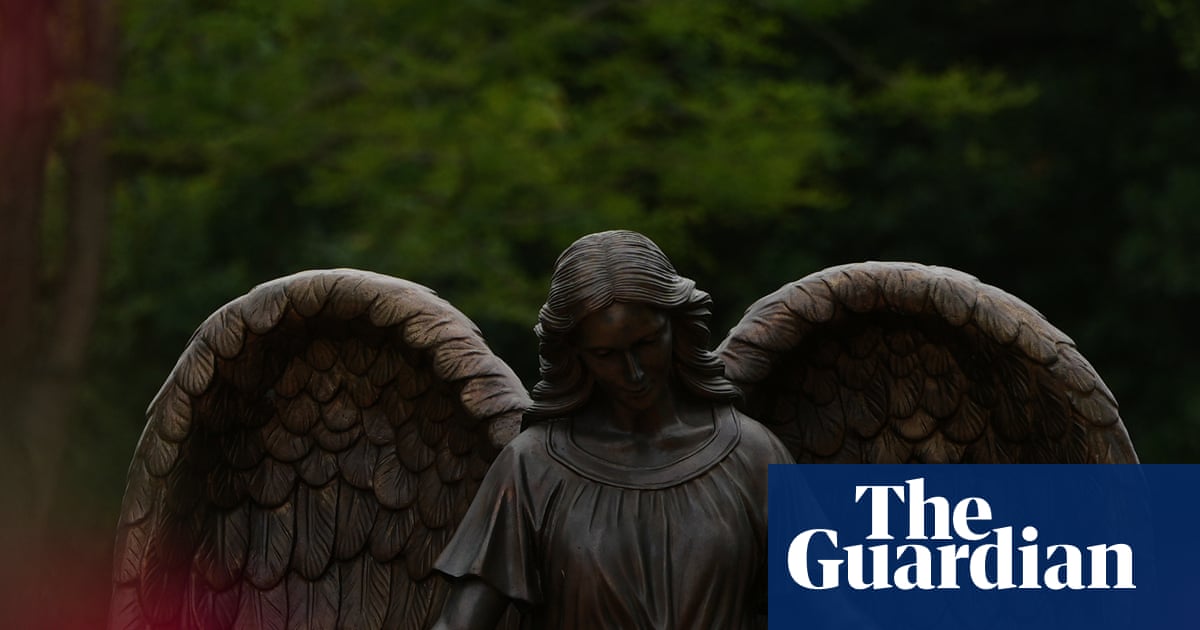
The Chicago archdiocese has recognized the Rev Charles Rubey’s work supporting families whose loved ones died by suicide this year by dedicating in his honor a memorial to the lives lost to suicide and the victims’ surviving families.
In 1979 Rubey founded the Loving Outreach to Survivors of Suicide, a counseling and support program run by Catholic Charities of the archdiocese of Chicago.
The archdiocese says the memorial, titled At Peace, at the Queen of Heaven Catholic cemetery in Hillside, Illinois, is the first of its kind by any US archdiocese.
The Catholic church historically banned funeral rites and burial on consecrated grounds for those who died by suicide.
To Rubey, the memorial is a sign of the church’s shift toward a more compassionate understanding of suicide.
“They’ve made a complete turnaround embracing families who have lost a loved one to suicide,” Rubey said. “They’re no longer condemned or thought to be in hell.”
Catholic teaching still considers killing oneself a sin, but it acknowledges that mental health problems can lead people to suicide and says salvation is possible for those who take their own lives.
Chicago-born Pope Leo XIV has dedicated some of his monthly prayer intentions to people suffering from mental health problems and suicidal thoughts.
He called on the church to become “a safe space where everyone has a place – a community that accompanies and never excludes, that listens without judging and draws near without fear”.
The memorial is located in a cemetery that is also home to the world’s largest Catholic mausoleum.
“We did not want this memorial hidden away and we were intentional in every detail,” Sullivan said when the memorial was announced. “This is not something we are ashamed of.″
Until a 1917 church law was revised in 1983, those who died by suicide were denied Catholic burials on consecrated grounds.
In recent decades, a greater understanding of mental illness has helped shift the cultural view on suicide and influenced Catholic teaching.
The Rev James Martin, editor at large of the Jesuit magazine America, says the Catholic church’s approach mirrors that of the broader society with more sympathy for all affected by suicide.
“To be able to extend pastoral care to the family members is extremely important, and to not make them feel any sense of shame or isolation, or judgment on them from the church,” he said.
Ed Shoener, whose daughter Katie died by suicide in 2016, co-founded the Association of Catholic Mental Health Ministers to “educate parish communities to break down the stigma around mental illness and to accompany people in the midst of these struggles”.
The global association advocates for the Catholic church to do more to improve mental health care.
In January, Shoener met with Pope Leo to thank him for his interest in mental health and told the pontiff that he hoped the church could issue an in-depth statement about mental health in the form of an apostolic letter or an encyclical.
This month, he returned to the Vatican for an event coinciding with Leo’s monthly prayer intention and World Mental Health Day on Saturday. Religious leaders and health professionals will gather to examine how parishes respond to mental health issues and how to best answer Leo’s call to establish mental health ministries to overcome stigma and discrimination.
That′s also Shoener’s hope. “I’d love to see this become just a fully integrated ministry into the church – that it’s a common ministry in every parish around the world, just like youth ministry.”
Disclaimer : This story is auto aggregated by a computer programme and has not been created or edited by DOWNTHENEWS. Publisher: theguardian.com