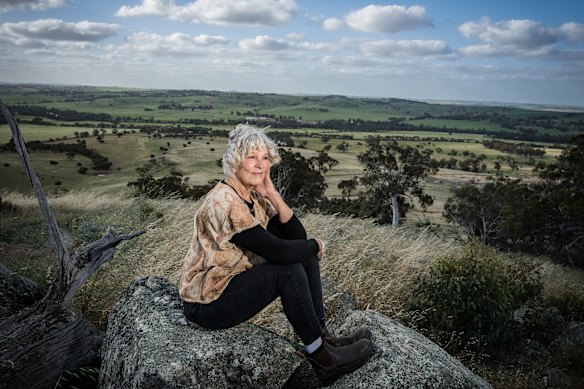
After decades spent delivering babies in remote deserts, 76-year-old retired obstetrician Dr Susan Downes is taking on a new challenge on her remote farming property.
When conservation of our natural environment seems like a mammoth task, it’s easy to forget that it begins with a single effort: a decision to revegetate a creek line, a campaign to protect a swamp in a migratory bird’s flight path, or a commitment to conserve a patch of bush.
Dr Susan Downes doesn’t consider herself unusual or heroic in the decision she made 11 years ago to buy a rural property and turn most of it over to nature. It simply started out as a vague retirement plan to spend time in nature, as she had as a child.
For decades, she’d won accolades for delivering babies and tending to women’s gynaecological needs in desert communities and on remote islands. She’d raised two sons and a stepson, nursed her husband with lymphoma, then her mother, then her late partner, who developed sudden-onset dementia. In between, there was the arrival of four grandchildren.
A busy life, but her new property, 20 kilometres north of York, in Western Australia’s wheat-belt, would host the birth of a new vocation. She felt especially drawn to a 300-metre-high hill at the back of her 200-hectare farm. It was called Mount Mackie [named after William Henry Mackie, an early settler in the Swan River Colony], and from its summit in 1830 a European explorer, Ensign Robert Dale had his first sighting of the fertile Avon Valley, which he hoped might one day be farmed to feed Perth’s colonists, who were starving through their first year.
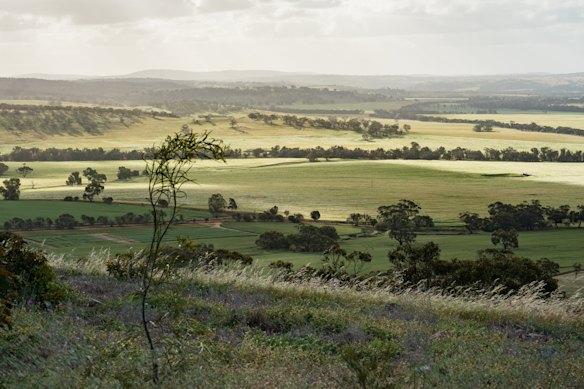
A plaque on the road to Downes’ property was installed by the York Historical Society to commemorate Dale’s “discovery”. “It wasn’t until I’d bought the farm that I noticed this old rusty sign saying ‘Historic site, 500 metres’. It said, ‘You are looking at Mt Mackie’ and then it gave the history of it. I thought, ‘The agent didn’t tell me that.’ It made it even more important that I should be a custodian of this place.”
When Downes stood on the summit, she saw what the colonists had envisioned – a mosaic of fields and healthy crops stretching to the horizon, vivid green with barley and wheat and fluorescent yellow in canola harvest time.
But Downes’ intention is to take her land back to the colonial vista of Dale’s era and the intact landscape he saw, covered with bushland of incredible diversity that sustained unique birds and animals. The former GP obstetrician has become a full-time conservationist in her small corner of a district that, over a century, was almost entirely cleared for agriculture. She’s joined a network of bush carers and organisations – Landcare, BirdLife, the WA Wildflower Society. She’s grown to admire this mass movement of people caring for nature, seeing herself as a foot soldier in a growing army.
At 76, she knows she has limited time to make her contribution. But it feels right to have come full circle, back to the WA wheatbelt where she spent many summers as a child on relatives’ farms. “My uncle Athol was a glorious man who taught me about animals,” Downes says. “He would kill a sheep and dissect it for me, show me all the organs. And down at my uncle Jack’s farm they had a dairy stud; the vet would come out for a tricky delivery of a calf and I used to help out.”
When her brother noticed a farm for sale in the Avon Valley, she went to look. The clincher was that hill behind the homestead that her Indigenous friends told her was a spiritual place. “It’s very significant for them as Ballardong country – they all say it’s spiritual healing land, which plays into my own life theme as a doctor. So the land became an even bigger draw to me than the house, even though it’s rocky and degraded from being grazed for 150 years.”
Downes is quietly nurturing an ambitious dream. In 2030, exactly 200 years after Dale’s first sighting, she hopes to stand on the summit of Mount Mackie and see a restored landscape from fence-line to fence-line.
Downes was busily dividing her time between an emergency department role and flying to remote desert communities for women’s clinics when she thought: “‘I want to live rurally, I want an old house with a little bit of land, maybe an acre.’ But I didn’t realise my farm had 500 acres [200 hectares] attached to it – I thought, ‘I can’t possibly deal with all that! What am I going to do with it?’ ”
For several years, she found herself restoring the old stockyards, repairing the historic shearing shed and successfully running a flock of 500 sheep, including up to 300 lambs. “Mostly, I did a lot of sheep obstetrics,” she says, laughing at the irony. “I only sold the sheep last year. The barley crop in the lower paddocks is sharecropped by a neighbour, so that works out well.”
It has left Downes with time to tackle the tougher job of restoring the farm’s denuded paddocks. It’s challenging terrain, which we drive around in a 4WD utility that strains its way up steep slopes and around rock outcrops. As we jolt past, she points out stands of vegetation. “This is remnant York gum bushland, with jam wattle and wandoo eucalypt growing on the upper parts – gradually, we’ll fill it all in.”
She started out alone in her tractor, spraying and then ripping the soil in order to hand-plant seedlings in the furrows. “You can only do that in little pockets, little mosaics, because higher up it’s just too rocky. Otherwise, it’s pickaxe stuff. There’s a lot of people who think I’m stupid,” she adds, with an expression that suggests she doesn’t much mind.
‘I’m not advocating that [all agricultural land] goes back to bush. I’ve just realised that you can treat the land differently.’Susan Downes
Downes has grown to rely on a small army of volunteers, aged eight to 80, who have assembled around the restoration project. “We’ve got about 80 on our Friends of Mount Mackie list. I’m grateful – I couldn’t do this without them.”
“We’ve planted about 45,000 trees already, over five planting seasons. I would say survival is more than 40 per cent. It’s daunting at times, but I believe if we concentrate on small areas at a time, eventually we’ll fill it all in with York gum and jam wattle and two or three types of melaleucas. We’re aiming for tree cover. You can see all the trees coming up through the native grass, and see these seedlings here? We planted them last year. It’s so exciting that they’re goers now – they’ll survive the summer.”
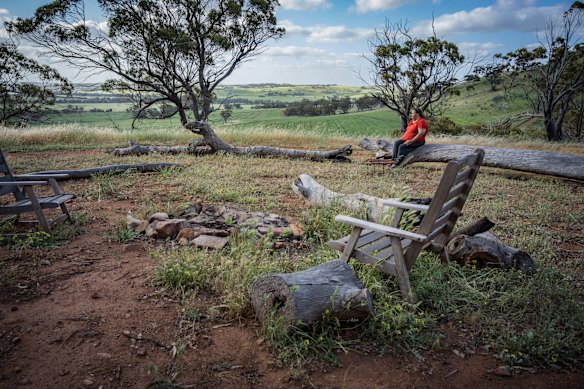
visited by a local women’s group, who gather there to share stories.Tony McDonough
The main planting and seed-spreading is conducted on five planting weekends a year, when dozens of helpers turn up from as far away as Perth. One weekend, an entire women’s soccer team brought their partners. “One of the mothers of a soccer player has been coming here for a few years with her daughter,” explains Downes. “And then the whole team brought their men – we got a huge amount done that weekend. We’ve also got a group called Intrepid Landcare, who come from Fremantle. And they are the most enthusiastic, fabulous young men and women who come and camp and tackle the toughest jobs on the hardest slopes.”
A visiting ecologist urged her to be patient and “let the land settle”. He told her not to use fire to clean out weeds before planting, “so for now, I’m treating the weeds as my friends, protecting the ground from erosion and heat.”
“I remind myself that over 90 per cent of Western Australia’s wheat-belt region has been cleared,” she adds. “If we could replant a third of it, the temperatures would go down and rainfall would go up. And the productivity levels might well be the same. But it’s very difficult to get broadacre farmers to think that way. They’ve spent a lot of money and time getting this land cleared, and unless they’ve got a crop in, they’ve wasted that money.”
Downes strides up the slope to a cluster of boulders, and motions for me to sit on a smooth one, shaped oddly like a seat. She says a local Indigenous man told her the site was probably an Aboriginal “workshop”, where men would sit making tools. She adds that in her kitchen dresser at home is a large, heavy stone that fits in her palm and has grooves that are perfect for grasping. “It’s a grinding stone, which we found on the property,” she says.
“Some farmers around here don’t like my sign on the back gate that refers to a shared history. It says ‘Site of Aboriginal heritage and European history. Enquiries and volunteers welcome.’ ” Among regular visitors are a group of Aboriginal women from a nearby town, led by Downes’ friend and author Dr Marion Kickett, who was raised in an Aboriginal reserve near York. The women’s group, called the York Yorgas, arrive and camp for the day around a huge fire pit with log seats on a secluded slope. It’s a yarning circle in a spot that Downes and Kickett decided was a perfect place to swap stories about family and country. “I built it because it felt right to me,” Downes says simply.
She’s working to put a covenant over a large part of the property to protect it in perpetuity, leaving only the homestead on a sliver of land under separate title. “Basically, I want it to be no logging, no clearing, no stock. But who looks after it when I’ve gone? That is the question that I’m trying to answer myself. Do I just leave it to my grandchildren? I don’t know yet. I’ve got to go down that track somehow.”
Downes has been down many tracks in her life, most of them leading to out-of-the-way places. She even featured in Outback magazine’s “20 Living Legends of the Bush”, published by footwear and clothing company R.M. Williams. The article depicts her leaning on the wing of a two-seater Boomerang at sunrise, holding a portable ultrasound machine. On the day that photo was taken, she and her Royal Flying Doctor Service [RFDS] pilot were headed north to visit remote women’s health clinics, such as at Jigalong in the Little Sandy Desert, 165 kilometres east of the mining town of Newman.
“I used to go out bush every month on the Rural Women’s GP program, to the Martu people of the Eastern Pilbara, to Jigalong, then Parnngurr, Kunawarritji and Punmu,” Downes says. “I did all the women’s business stuff. I used to arrive and I’d say, ‘Where is everybody?’ and be told, ‘Oh, they’ve gone out hunting for goanna.’ So, I’d go out hunting. And I’d find the women and then we’d come back and sit round the fire. And then I’d say, ‘Who needs to come and see the doctor?’ We’d sometimes do clinics late into the night.”
Downes’ trajectory into medicine was as tangential as her later move into conservation work. As a young woman, she’d wanted to be a veterinarian but opted for science, majoring in botany at the University of Western Australia. During a stint working at the WA Herbarium, she made a research trip to the UK to study prototype specimens of Western Australian plants (many collected by Dale’s colonial contemporaries) held at Kew Gardens. She met and married Ray, a teacher, and they set up home in Cumbria, in north-west England, restoring a 17th-century ruin. Her interest in medicine was inspired by a job as a research assistant investigating a local cluster of leukaemia cases in children, some of whose parents worked at the nearby Sellafield nuclear power station.
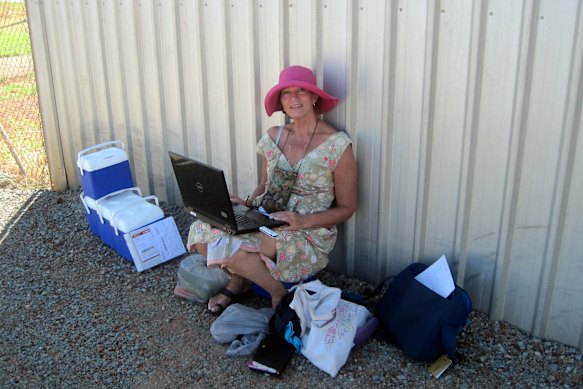
Realising that her vocation was to become a doctor, she began studying at Nottingham University. By then, she was a 35-year-old mother of two sons and a stepson. “I’d be sitting in lectures trying to concentrate and I’d think, ‘Oh my god, I didn’t take dinner out of the freezer.’ ” She graduated with first-class honours aged 42 – at the time, she was the oldest woman to graduate from a British medical school.
When the family moved back to Downes’ home town of Perth in 1993, she worked in a busy maternity hospital. When that hospital was closed, Downes eagerly accepted an RFDS offer to perform remote medical care for women.
“The conditions were extraordinary, the pushing, shoving and lumping gear in and out of planes and trucks – it’s hot, and dusty as hell sometimes, but there were magic times that made everything worthwhile.” She treated young Aboriginal women for teen pregnancies and sexually transmitted infections, and older women for cervical cancer and menopause, “real cradle-to-grave medicine”. Downes also promoted the use of ultrasound so that pregnancy dates were more accurate, as well as the wider use of contraceptive implants. “They gave young women a better chance to mature and allow their bodies and minds to develop before falling pregnant.”
“In the Western Desert, where I visited for 25 years, there were amazing changes. Women began to understand their reproductive anatomy; they knew what to look out for, they understood what makes a child sick and when to seek help.”
Regular flights to distant Christmas and Cocos (Keeling) islands to attend pregnant Malay, Chinese and Muslim women earned her a General Practice Prize for Excellence in Population Health. She even found herself performing emergency brain surgery on a man on Christmas Island, drilling a hole in his skull to relieve pressure after he fell down concrete steps. It was the first – and last – time she carried out such a procedure.
In 2017, Downes was awarded an Order of Australia for “significant service to rural and remote medicine and Indigenous health”. Her love of remote and rural obstetric care saw her continuing to fly north even after she purchased the farm. “There’s a fine balance between working less and retaining my credentials. But last year, I found a wonderful doctor who I felt could take over from me. It was incredibly sad to leave, but I did it. The mob still rings me and asks me things.”
The thrill of delivering babies or chasing goannas with her patients has given way to other unexpected pleasures at Mount Mackie, Downes tells me over a pot of tea at the 100-year-old homestead. “I’m not advocating that it all goes back to bush,” she says. “I’ve just realised that you can treat the land differently.”
As if giving their approval to her efforts, animals like echidnas, a carpet snake and families of wallabies, or euros, have reappeared. Understorey plants, not seen for decades due to stock grazing, are poking their heads up again – yellow buttercup (hibbertia) flowers, tufty mulla mulla and a strange, spiky acacia that turns out to be a threatened species. BirdLife Australia has selected Mount Mackie as a site for one of its “Birds on Farms” surveys and is already documenting an increase in species.
Mount Mackie is representative of hundreds of landcare projects occurring across the nation, says Paul Della Libera, head of natural capital at Landcare Australia. “While individually they may be small, cumulatively they add up to a significant amount of good-quality work, but we don’t often see it.”
Established in 1989 by former prime minister Bob Hawke to spearhead a national movement, Landcare Australia supports 6000 landcare and community-led environmental groups, and more than 140,000 volunteers. “There is plenty of good work like this happening with community groups, First Nations groups, not-for-profits and farming communities,” says Della Libera. “We also make sure farmers are involved in the process of what works for them. Some areas that are non-productive could be put to a better use, like creating windbreaks, vegetating ridgetops and creek lines, things they can’t get a dollar out of but may enable them to have a greener conversation with people they sell their produce to.
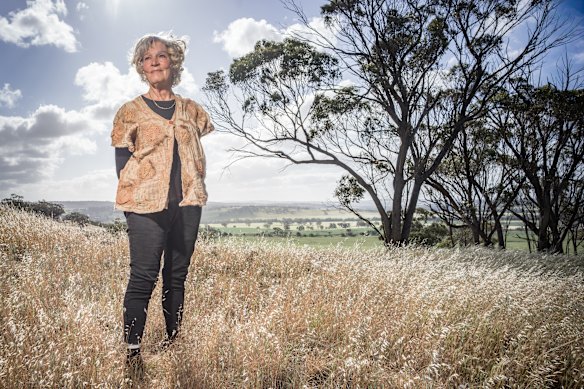
“When we look at the scale of land across Australia that needs some sort of rehabilitation, it’s in the millions of hectares. While a lot has been put into national parks, covenants, reserves and the like, the private land estate – including Indigenous-owned land – occupies about 60 per cent of our land mass.”
Meanwhile, Downes says she’s happy she no longer has to contend with medical clinics or operating-theatre lists, but life doesn’t seem any less busy. “I have ordered 1000 litres of herbicide to honour the contract of 52,200 seedlings [supplied by her local Landcare group] for next year,” she tells me on a call after my visit. “I’ve just hitched my six-wheel trailer now to collect it.”
Downes knows nature can’t be hurried, but a date looms in her mind. “Even if it’s just my family and friends, we’ll gather at the summit on August 7, 2030 to acknowledge the 200th anniversary of Dale standing there. By then, I’m hoping that the whole fenced area will be planted with native species, that Aboriginal elders will make this place part of reconciliation and healing, and that there will be public access to share the beauty and spirit of Mount Mackie.”
Read more from Good Weekend:
Get the best of Good Weekend delivered to your inbox every Saturday morning. Sign up for our newsletter.
Disclaimer : This story is auto aggregated by a computer programme and has not been created or edited by DOWNTHENEWS. Publisher: www.smh.com.au