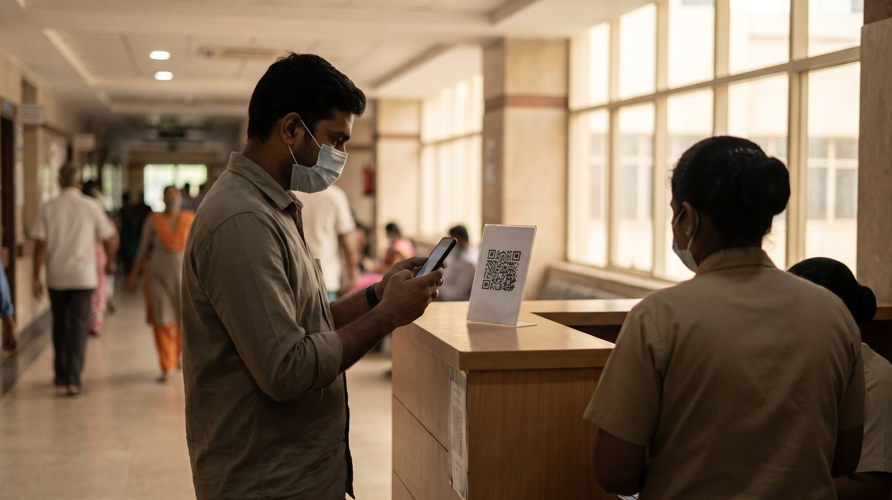
An ABHA ID links your prescriptions, lab reports and discharge summaries from different hospitals to one free 14-digit health number. When you switch hospitals in Bengaluru, the new doctor sees those records only after you approve the request on your phone.
What an ABHA ID Does When You Change Hospitals
An ABHA ID carries your medical history to a new hospital when you change hospitals, so you do not need a paper file. ABHA stands for Ayushman Bharat Health Account. It is part of the Ayushman Bharat Digital Mission (ABDM), run by the National Health Authority.
Each person gets a 14-digit ABHA number and can also pick an ABHA address, a username that looks like name@abdm. Creating one is free and voluntary.
The records are not stored on the card or in one government computer. A Press Information Bureau note on ABHA says each hospital or lab keeps the records it creates. ABHA only connects them to you.
For example, say you had blood tests and a scan at a hospital in Jayanagar and now move to a hospital in Whitefield. The new doctor sends a request through the ABHA system, and you approve it on your phone. The old reports then reach the new doctor’s screen. This can save you from repeating the same tests.
ABHA works only at hospitals and labs that have joined the ABDM network. Private hospitals can choose whether to use it, so ask before your first visit.
Creating an ABHA ID and Linking Past Records
Creating an abha id online is quickest if your mobile number is linked to your Aadhaar. You can use the official ABHA website or the ABHA mobile app.
1. Open the ABHA website or app and choose to create an ABHA number using Aadhaar.
2. Enter your 12-digit Aadhaar number and accept the consent message.
3. Enter the six-digit OTP (one-time password) sent to your Aadhaar-linked mobile.
4. Confirm your details and choose an ABHA address.
5. Download the ABHA card with your 14-digit number and save it on your phone.
If you do not want to use Aadhaar, you can start with a driving licence. You then visit an ABDM-enabled hospital once so the staff can verify who you are. A participating hospital or a Common Service Centre can also create the ID for you at the counter.
Records from the old hospital get linked in two ways. If that hospital is on ABDM, it sends a link request to your ABHA app after a visit, and you approve it. For old paper files, scan or photograph each report and upload it in the app.
Using ABHA Records with Your Health Insurance Policy
ABHA makes it easier to keep your papers ready for a health insurance claim. ABHA is a health record ID. It does not pay for treatment.
It is also different from the Ayushman card. The Ayushman card is for families eligible under Ayushman Bharat Pradhan Mantri Jan Arogya Yojana (PM-JAY), a free treatment scheme. Having an ABHA number does not enrol you in PM-JAY.
A hospital that accepts ABHA is not cashless for your policy for that reason alone. Cashless care still depends on your insurer’s list of network hospitals. The insurer must also approve it before admission.
The records help in two practical ways:
• When you buy a policy, your linked history helps you answer the health questions on the form correctly.
• When you claim, discharge summaries, test reports and prescriptions are already in one place on your phone.
The National Health Authority has also built the National Health Claims Exchange (NHCX). This digital system passes claim papers between hospitals and insurers. It was built with input from IRDAI, the insurance regulator. Your claim is still settled under the terms and waiting periods of your policy.
Records a New Hospital Can Open with Your Consent
A new hospital can open only the records you agree to share, and only for as long as you allow. The Press Information Bureau note says no doctor or hospital can view your records without your consent.
The records that can be linked to ABHA and shared include:
• Notes from outpatient visits (OPD consultation notes)
• Prescriptions
• Lab test and scan reports, such as blood tests and X-rays
• Discharge summaries from hospital stays
• Vaccination records
• Reports you upload yourself in the ABHA app
Each request from a hospital shows these details on your phone. You can change most of them before you approve.
What the request shows What you can do
The doctor or hospital asking Approve or deny the request
The purpose, such as a follow-up visit Deny it if the purpose does not match your visit
The types of records asked for Untick records you do not want to share
The date range of old records Share only recent years
How long the hospital can view them Pick a short period, then revoke
access any time
Consent does not have to cover everything. The Press Information Bureau note says you can share selected records one by one. After the access period ends, the hospital can no longer open the shared records.
Sharing all relevant records with your treating doctor still helps. A heart doctor who has your old ECG and medicine list can plan your care with fewer gaps.
Scan and Share at Bengaluru Hospital Counters
Scan and Share lets you register at a Bengaluru hospital’s OPD counter with a QR code. You do not need to fill a paper form. The National Health Authority started the service in October 2022.
C V Raman General Hospital in Indiranagar began QR code registration on 28 October 2022. The service was later added at Jayanagar General Hospital and KC General Hospital. In 2022, The Indian Express reported that KC General Hospital had linked over 20,600 patient records to ABHA, the highest in India.
At the counter, the process is short:
1. Scan the QR code at the registration counter with the ABHA app or another ABDM-enabled app.
2. Share your profile: name, age, gender and ABHA number.
3. Get a token number on your phone.
4. Collect your OPD slip when your token is called.
The system does not always run smoothly. In February 2026, the medical head of Jayanagar General Hospital said many older patients bring phones not linked to Aadhaar. For them, the OTP never arrives. Server downtime has also slowed registration.
More government hospitals in Karnataka should join soon. In June 2026, state health officials said new hospital software would let doctors view past files after an OTP consent. They said the rollout could start in early 2027.
Steps Before Your First Visit to the New Hospital
The steps before your first visit decide whether your old records reach the new doctor. Do these a week before the appointment.
• Ask the new hospital’s front desk if it is on ABDM, or look for a Scan and Share QR code at the counter.
• Make sure the mobile number on your Aadhaar is the one in your hand, so the OTP reaches you.
• Approve any pending link requests from your old hospital in the ABHA app.
• Collect paper copies of discharge summaries and recent reports from the old hospital, and upload them.
• Keep your ABHA number or the downloaded card on your phone, along with a photo ID.
If the new hospital is not on ABDM yet, register through its normal process. Carry the paper copies, and ask for printed copies of new reports so you can upload them later.
Frequently Asked Questions
Is the ABHA card useful in private hospitals?
Yes, at private hospitals that have joined the ABDM network and use ABDM-enabled software. Joining is optional for private hospitals, so ask the front desk or look for the Scan and Share QR code before your visit.
Can I stop a hospital from seeing my records after I give consent?
Yes. You can revoke an active consent from the ABHA app at any time, and further sharing stops right away. Each consent also has an end date, after which the hospital can no longer open the records.
Is the ABHA card the same as the Ayushman card?
No. The ABHA card is a free health ID open to everyone. The Ayushman card is for families eligible under PM-JAY, a free treatment scheme, and only that card gives treatment cover.
Can I create an ABHA ID without a smartphone?
Yes. Staff at an ABDM-enabled hospital or a Common Service Centre can create the ID for you with Aadhaar or another accepted identity proof. At the counter, they can also scan your printed ABHA card for registration.
Where are my records stored under ABHA?
Your records stay with the hospital, clinic or lab that created them. ABHA does not keep a central copy. It only connects the records to your account and passes them on when you approve a request.
Key Takeaways
• An ABHA ID connects records from different hospitals to one 14-digit number, so a new doctor can open your history once you approve.
• A hospital opens only the records and dates you allow, for the period you set, and you can revoke consent any time in the app.
• ABHA is a health record ID. It does not pay for treatment or make a hospital cashless for your insurance policy.
• Before switching, confirm the new hospital is on ABDM, keep your Aadhaar-linked mobile handy and upload old paper reports.
Disclaimer: No Deccan Chronicle journalist was associated with the creation of the content. The Group also takes no responsibility for the content.
Disclaimer : This story is auto aggregated by a computer programme and has not been created or edited by DOWNTHENEWS. Publisher: deccanchronicle.com