
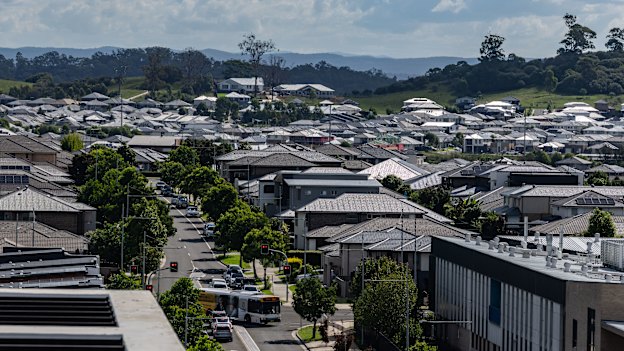
Urban sprawl isn’t new to Sydney – but planning new suburbs properly is rare.
From its very beginnings as a penal colony, Sydney’s growth has never been particularly well-organised. It was sporadic, uncontained, rising in spurts.
But the urban growth that produced suburbs like Surry Hills and Paddington – once slums, now among the most in-demand in the city – is now producing areas like Box Hill and Austral, suburban areas lacking in adequate roads, schools, hospitals and community facilities.
After more than 200 years of expansion, can Sydney build new suburbs better? Is it too late to improve the ones that have already been built? In the final part of the Herald’s Stranded Sydney series, we look at how to fix one of the greatest blights on our city.
1. Plan everything
Of all the greenfield developments in Sydney, Oran Park in the city’s far south-west is among the better examples of getting it right. Different types of homes, including townhouses, large and small freestanding homes, and some apartments, all appear around each other. The suburb’s mostly walkable town centre features a large shopping centre, multiple schools, a swimming pool, a library, a church, an aged care home and, at 7500 square metres, Sydney’s largest pub. There are even rules about avoiding contributing to the urban heat island effect by making builders put in white, not black, roofs.
How is it that Oran Park has these facilities while suburbs a few kilometres away struggle to access the most basic amenities? A large part of its success comes down to the fact that the land on which the suburb was built was owned almost entirely by the Periches, a wealthy dairy farming family that transformed much of its business into a major development company.
It meant the family’s business, Greenfields Development Company, was able to plan for how to make the suburb as a whole a desirable place to live, not just for the immediate financial return a small landholder would get if they sold just a few blocks.
“We’re here for long term, not for short term, so we have stick to that initial masterplan, and the result then is much better,” said Mark Perich, the company director, giving the Herald a tour of the suburb.

It took time for Oran Park to become a success story. On Tuesday, the Herald reported that Oran Park Public School, the first primary school in the suburb, had 13 demountables in 2015 and 27 by 2020. Today, there are no demountables at the school and the number of students enrolled has decreased.
Since 2005, the developer and Camden Council worked on a masterplan for the area, one that is still not complete. Construction began in 2008, and the developer expects the suburb to be completed in the 2040s.
A car park in the centre of the town has been set aside for a future metro station, an extension of the new Western Sydney Airport line. Main roads are becoming shaded by large Port Jackson fig trees, having been planted early in the process.
The problem, though, is that Oran Park is no longer easily replicable. Sydney has very few large lots of land that have not already been turned into homes. The remaining parcels of land are disparate, with few incentives for remaining landholders to prioritise amenity.
2. Infrastructure, then homes
The solution seems obvious: build infrastructure first, then the homes – but that only happens if long-term planning is done correctly. A 2025 report by the Urban Development Institute of Australia NSW and planning group Urbis recommended the timely provision of enabling infrastructure – such as transport, utilities and community facilities – be aligned with zoning, land-use planning and developer intentions.
“If you build it, they will come, but we can’t build apartment towers in paddocks and expect there to be an immediate market. People want to live near services and be part of a community,” Urbis director Carlos Frias said.
The report points to Thornton, adjacent to the Penrith train station and CBD, as an example of housing in a greenfield setting that was successfully built around existing infrastructure, while also prioritising the establishment of new social facilities such as open spaces and community centres.

“This integrated, holistic planning approach has delivered a well-balanced, thriving community that enhances the overall liveability of Penrith and contributes to the long-term sustainability of the suburb,” it said.
In Oran Park, a supermarket and large shopping centre have been operating since 2014, before most residents moved in. “We’re motivated to [put infrastructure in] early,” said Mick Owens, the company’s general manager. “It helps people living in homes, and it helps sales rates as well, because people think it’s a great place to live.”
It’s something the government has admitted it needs to do better. Putting infrastructure in after homes is “more expensive and takes longer to do it after the communities have been established,” Premier Chris Minns said in February.
3. Spend our money better
The way councils fund infrastructure is fundamentally broken. There are two main issues. First, councils cannot levy developers for infrastructure such as community centres, pools or libraries because only “essential” infrastructure is allowed to be levied. For the most part, only the cost of the land upon which such facilities might be built can be levied from developers, not the cost of building the actual facilities.
Second, there’s money sitting in the bank for many infrastructure projects, but it can’t be used. Developer contributions have to be used for specific projects, which councils also contribute towards. The money can only be accessed when the full amount is in the bank. Cash-strapped councils often struggle to put in their share of the money, leaving contributions for major projects unusable.
The Urban Development Institute of Australia, a developer lobby group, estimates about $4.7 billion in unused funds for projects is sitting in these accounts.
It is calling on the state government to tip in the difference to unlock the hundreds of projects across the city.
The state government has introduced a series of reforms to the way contributions are organised. “We’ve replaced an ad-hoc infrastructure contribution system with a housing and productivity contribution scheme that is purpose-built to fund roads, schools, transport, open space and active transport so that communities get the infrastructure they need,” Planning Minister Paul Scully said.
4. Greenfield can’t go on forever
“The Australian dream has always been the big backyard, the big house, the large driveway, the garage, this kind of self-sufficient independent living in your own dwelling. That’s worked for decades,” said Sharath Mahendran, an engineering student and the creator of the popular Building Beautifully YouTube channel. “The thing is, our cities have just kept growing and growing, so we’ve run out of well-located land for that type of dwelling.”
Sydney’s growth has natural limits: the Blue Mountains to the west, the national parks to the north and south, and the Pacific Ocean to the east. So what happens when we use up all the land in low-density housing?

Most greenfield development this century has occurred in western Sydney, which has been growing at almost double the rate of the rest of the city, surging past government forecasts.
The infrastructure, as revealed this week, never caught up.
“We’re talking about the must-haves, the basic expectations of life in a civilised, wealthy society like ours in Australia,” Premier Chris Minns said at an event last week. “If you don’t have a school to send your kids to, if you’re worried about giving birth on the side of a road, if you’re sitting in traffic all morning along Fifteenth Avenue, then those plans, the plans for a city like this, have a massive hole in them.”
Part of the government’s strategy is to introduce caps on homes in some new growth areas until infrastructure arrives: the far south-west suburb of Appin, for instance, is capped at 2499 homes.
The harder, more significant part of the strategy is to break the cycle of suburbs opening with no infrastructure: “We’ve consciously made a decision to build more houses closer to the city, so all that wasn’t being piled in the western Sydney suburbs,” Minns said. “We did it to give these communities, particularly in western Sydney, a chance to breathe. A chance to establish themselves, and most importantly, a chance to catch up on much-needed infrastructure.”
That decision has its critics. But the complaints of inner-city residents about new developments in their established suburbs cannot be separated from the reality of poor infrastructure in new suburbs, said Mahendran.
“To me, NIMBYism and urban sprawl are intertwined,” the 24-year-old said. “We have more urban sprawl because so much of the time, NIMBYs don’t want apartments in their neighbourhood. I don’t think they think about the impact.
“The impact is that people are then forced to move out to places with no infrastructure.”
Disclaimer : This story is auto aggregated by a computer programme and has not been created or edited by DOWNTHENEWS. Publisher: www.smh.com.au


