NEW YORK –
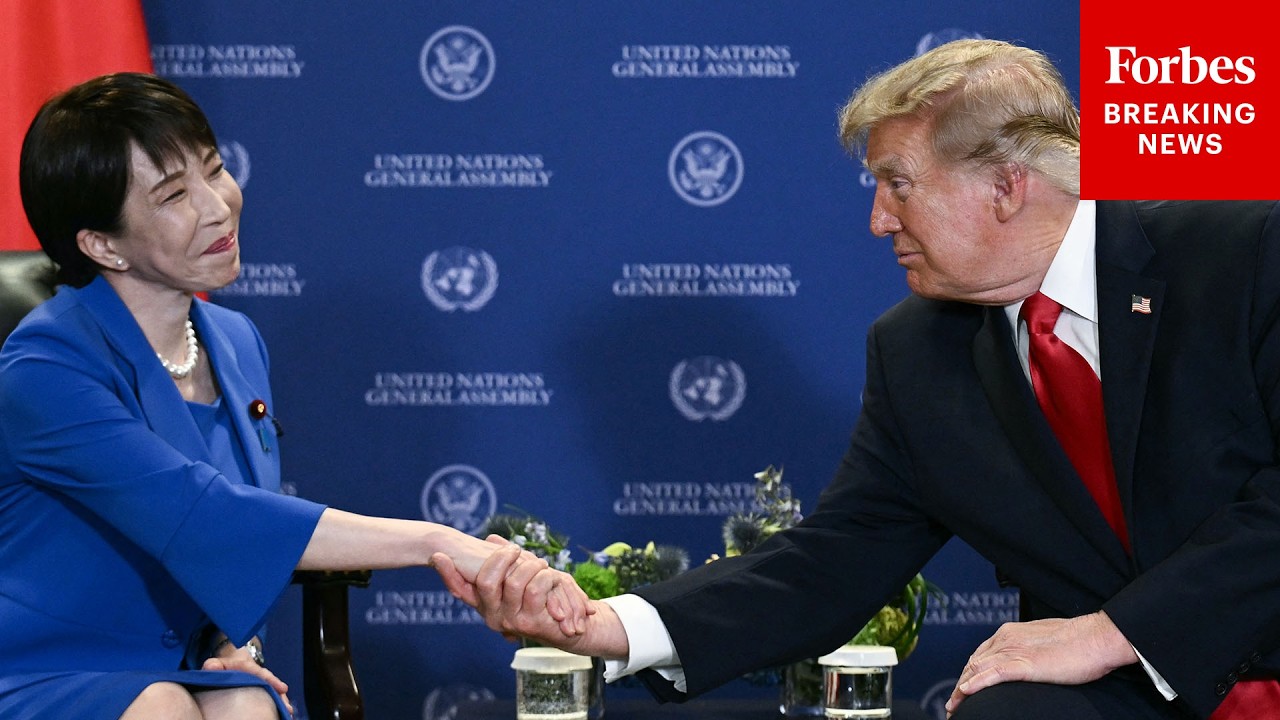
Prime Minister Sanae Takaichi and U.S. President Donald Trump met in New York on September 22, confirming close cooperation on security and economic issues ahead of Trump’s planned summit with Chinese President Xi Jinping.
The meeting took place at the United Nations headquarters on the sidelines of the U.N. General Assembly. It came two days before Trump’s scheduled talks with Xi, giving Takaichi an opportunity to convey Japan’s position directly to the U.S. president before Washington and Beijing hold their own high-level meeting.
At the start of the meeting, Trump praised Takaichi, saying he was proud to sit with the Japanese prime minister and describing her as a strong leader. He also said he pays attention to her approval ratings, adding that she was doing well politically.
Takaichi said the meeting itself sent an important message at a time when the security environment in Asia has become more severe. She said the sight of the Japanese and U.S. leaders meeting at the United Nations showed the strength of the Japan-U.S. alliance.
The two leaders confirmed that Japan and the United States would continue working closely on regional security, including deterrence and response capabilities under the bilateral alliance. They also discussed economic-security cooperation, including artificial intelligence, semiconductors and critical minerals.
The timing of the meeting made China the central background issue. Trump is due to meet Xi on September 24, and Japan is watching closely to see how the United States handles Taiwan, trade, technology restrictions and Chinese economic pressure.
Takaichi has taken a firmer line on China than many previous Japanese leaders. She has said that a Taiwan contingency could amount to a survival-threatening situation for Japan, a remark that drew a strong reaction from Beijing. China has also taken measures affecting Japanese exports of strategic materials, adding to tension between the two countries.
Japan has become increasingly concerned about China’s military activity around Taiwan and the East China Sea, as well as Beijing’s use of trade and regulatory measures involving rare earths, chip-related materials and other strategic goods. These concerns have pushed economic security higher on Tokyo’s policy agenda.
The Trump-Takaichi meeting followed trilateral talks among the foreign ministers of Japan, the United States and South Korea on September 21. In those talks, the three countries reaffirmed U.S. defense commitments to Japan and South Korea and stressed the importance of peace and stability across the Taiwan Strait. They also agreed to strengthen consultation on economic security and critical technologies.
For Takaichi, the New York meeting was intended to show that Japan is closely aligned with Washington before Trump meets Xi. Japanese officials are expected to monitor the U.S.-China summit for any signs of shifts in Washington’s position on Taiwan, export controls, tariffs or supply-chain policy.
Trump has placed heavy emphasis on direct leader-to-leader diplomacy with China, while also pressing U.S. allies on trade, investment and defense spending. That has made Japan eager to ensure that its security and economic interests are clearly reflected in U.S. policy before major talks with Beijing.
The meeting also covered the International Criminal Court. Takaichi explained Japan’s position on the Trump administration’s sanctions against ICC President Tomoko Akane, a Japanese judge. Japan has emphasized the importance of the rule of law and has maintained support for the ICC, while seeking to avoid friction with Washington over the issue.
The discussion was politically sensitive because Takaichi is trying to maintain a close relationship with Trump while also defending Japan’s institutional position. Raising the matter allowed Tokyo to show that it can speak directly to Washington on issues involving Japanese nationals and international law.
The summit came shortly after Takaichi reshuffled her cabinet, retaining key ministers including Finance Minister Satsuki Katayama, Foreign Minister Toshimitsu Motegi and Defense Minister Shinjiro Koizumi. The reshuffle was designed to keep policy continuity while preparing the government for a difficult autumn Diet session.
Takaichi’s administration is facing domestic pressure over food prices, the yen, rising bond yields and the funding of a planned food-tax cut. Her government has promised to lower the consumption tax on food from 8% to 1% for two years from April 2027, while also providing household payments to offset the remaining 1%.
The Bank of Japan’s recent rate policy has also added pressure. Higher interest rates can support the yen and ease import-driven inflation, but they also raise borrowing costs for the government and businesses. That complicates Takaichi’s plans for tax relief, defense expansion and a 370 trillion yen public-private investment roadmap through fiscal 2040.
Against that domestic backdrop, the meeting with Trump gave Takaichi a chance to highlight foreign-policy leadership and the strength of the Japan-U.S. alliance. Her government has made economic security one of its central themes, linking defense, supply chains, advanced technology and industrial policy.
Semiconductors are a key part of that strategy. Japan is trying to rebuild its chip industry and strengthen supply chains for materials and equipment, while working with the United States to reduce dependence on China. Critical minerals have also become a major issue as China controls large parts of global processing capacity for rare earths and other materials used in high-tech manufacturing and defense systems.
The United States has encouraged Japan to play a larger role in regional security and supply-chain resilience. Japan, in turn, relies on the U.S. security guarantee and wants to ensure that American policy toward China does not weaken deterrence in the Taiwan Strait or around Japan’s southwestern islands.
No major new agreement was announced after the Trump-Takaichi meeting. The significance of the talks lay mainly in timing and political messaging. Takaichi was able to meet Trump immediately before the U.S.-China summit, while Trump was able to show that he remains closely aligned with one of Washington’s most important Asian allies.
The next focus will be Trump’s meeting with Xi. Japan will watch whether the U.S. president maintains strong language on Taiwan Strait stability, keeps pressure on Chinese economic coercion and protects allied interests in technology and supply chains.
For Takaichi, the outcome of the U.S.-China summit could shape the political value of her meeting with Trump. If Washington holds firm on security and economic-security issues, she can present the New York talks as part of successful alliance coordination. If Trump reaches a deal with Xi that leaves Japan uncertain, the meeting may be seen more as a diplomatic signal than a concrete achievement.
The talks nevertheless showed that Takaichi is seeking to place Japan at the center of U.S. strategy in Asia. With China, Taiwan, technology and trade all on the agenda, the Japan-U.S. alliance is no longer only a defense framework. It has become a platform for economic security, supply-chain policy and regional diplomacy.
What To Watch Next
Trump is scheduled to meet Xi on September 24, with Taiwan, tariffs, export controls, rare earths and technology cooperation expected to be closely watched by Japan.
Japan will monitor whether Washington maintains its emphasis on peace and stability across the Taiwan Strait.
Economic-security cooperation between Japan and the United States may deepen in AI, semiconductors, critical minerals and supply-chain resilience.
China’s response to the Trump-Takaichi meeting could affect Japan-China relations, especially if Beijing views the talks as part of a stronger U.S.-Japan front.
The ICC issue may remain sensitive if U.S. sanctions against Tomoko Akane continue.
Takaichi’s domestic political standing will depend on whether the foreign-policy success helps offset pressure over prices, taxes, the yen and bond yields.
Disclaimer : This story is auto aggregated by a computer programme and has not been created or edited by DOWNTHENEWS. Publisher: newsonjapan.com