-
Key insights: Walmart is supporting Apple Pay after a long holdout, creating new opportunities for banks and payment companies.
-
What’s at stake: The move resulted from a shift in consumer preference for more digital options.
-
Expert quote: “Even a retailer with the scale to promote its own payment experience has recognized the value of accepting the methods customers already use. Banks, merchants, and payment providers that fail to support those preferences risk losing transaction volume and everyday relevance,”—Ed Dean, Nuvei.
There is a broader urgency around immediate fund availability in consumers’ day-to-day financial lives.
Walmart’s change of heart regarding Apple Pay and Google Pay acceptance is a major coup for mobile wallets. For banks, it’s also a wake-up call.
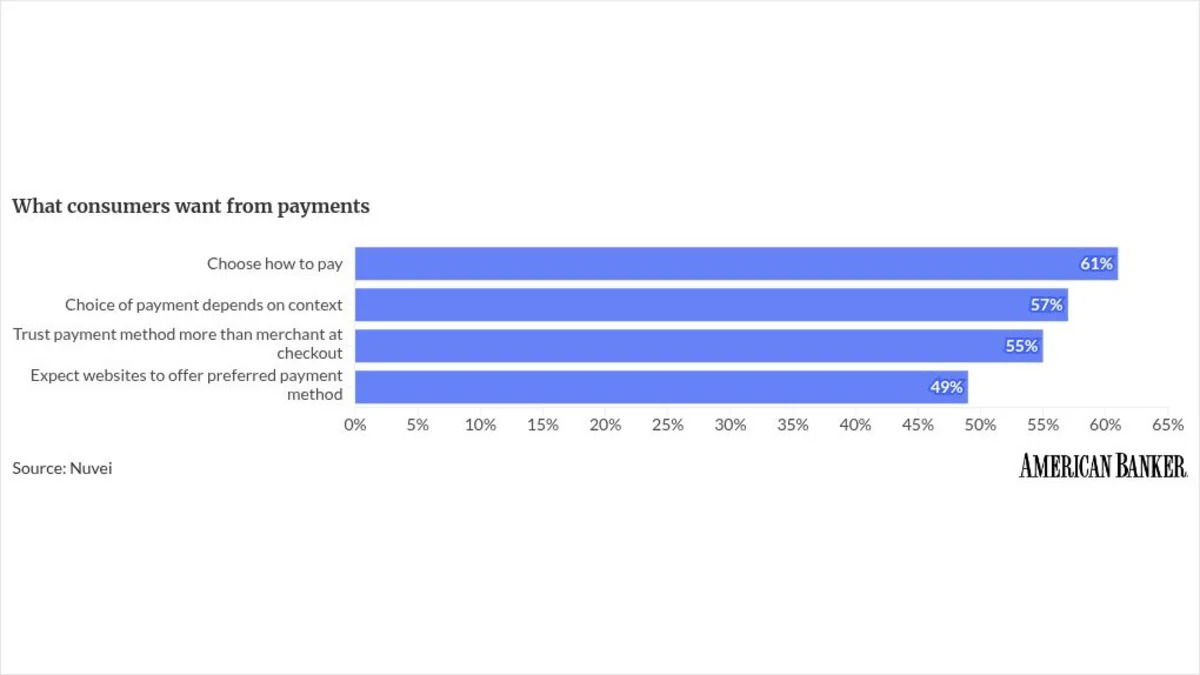
Recent research from payments software company Nuvei found that 57% of respondents feel meaningful differences between payment methods and expect to find the one they prefer waiting for them. Mobile wallets are one of those payment methods, with more web-based and in-person businesses asking for Apple Pay and Google Pay, according to Eric Cohen, chief executive of Merchant Advocate, a merchant services consulting firm. “Banks can’t fight this movement,” he told American Banker.
Here are several lessons banks can glean from Walmart’s latest move:
The shift is customer-driven
Walmart’s shift ultimately reflects consumer preference, Ed Dean, vice president of product at Nuvei, said in an email. “Even a retailer with the scale to promote its own payment experience has recognized the value of accepting the methods customers already use. Banks, merchants, and payment providers that fail to support those preferences risk losing transaction volume and everyday relevance.”
Owning the account isn’t owning the relationship
Banks may still be holding on as a customer’s primary financial institution, but the attack is actually happening on payment primacy, Prashant Shah, vice president of product management at SoFi Tech Solutions, said in an email. The financial technology company’s transaction data reinforces the shift: tap-to-pay gained more share than any other payment method in the second quarter, and Walmart, the biggest holdout until now, will be a game-changer.
“If your card isn’t the one the customer is actually using, you’re losing spend and interchange to another issuer, even if that customer still keeps their checking account with you,” Shah said. “Over time, you can end up being where the paycheck lands, but not the card they reach for.”
Ignoring the problem doesn’t make it go away
Community banks have largely neglected mobile wallet usage for many years, and large banks also haven’t been on top of things to the extent they should, Tony DeSanctis, vice president at Cornerstone Advisors, told American Banker. In some cases, they aren’t focused on payments. Also, “there’s a generational lack of understanding of the ubiquity of mobile wallets in the younger generation,” he said.
A recent report from Worldpay found that digital wallets in the U.S. represent 40% of online transaction value and 17% of in-store point-of-sale value, underscoring where the trend is headed. Certainly, banks don’t want to be disintermediated by cash loaded into a Venmo wallet, another card, or another payment method, Scotty Perkins, executive vice president and head of product management and market strategy at ACI Worldwide, told American Banker. “They want to make sure it’s their card that gets used because they’re earning the interchange on it.”
Be intentional
Banks should start by measuring what percentage of their customer base uses their card in their digital wallet—a step many banks don’t take, DeSanctis told American Banker. Vendor reports from the bank’s payments processor can help. The next step is to develop a target marketing strategy around digital wallet adoption. This could include email campaigns to remind customers to add their card to their wallet and incentive programs such as cash or gift cards to encourage usage. Then, after taking these steps, banks need to monitor usage to ensure their card stays in top position.
“It’s not enough to win the account; you have to keep winning the spend,” Shah said.
Fifteen percent of consumers said they changed cards because a store or app made paying easier, while 21% switched to a card with better rewards, Shah noted, citing research from SoFi Tech Solutions. “It can start with something as simple as a card being selected as the default in a mobile wallet, getting saved in a retailer or travel app, or offering a better reward on a purchase. Once a card is saved or set as the default, the customer may not reconsider that choice every time they pay.”
Staying in top position matters
Staying in that position matters, too. If a card expires, is lost, or has to be reissued, requiring the customer to manually re-add it creates friction and another opportunity for a different card to become the default. Keeping that credential current helps preserve the position the issuer has already earned, Shah said.
“Banks should look beyond whether their cards support mobile wallets and think about how well the experience actually works,” Louis Hoch, chief executive of payments company Usio, said in an email. “How easy is it to add a card? What happens if verification fails, the customer replaces their phone, or their card is reissued? Those details can determine whether someone keeps using your card or switches to another one.”
The hard part is keeping everything working when something changes, according to Phil Bruno, chief strategy and growth officer at ACI Worldwide. “Someone gets a new phone or a replacement card, or loses their phone and needs to stop payments from it. The bank has to handle that without breaking anything else,” he said in an email. “With tokens, a bank can pause the card on a lost phone and keep the physical card working. That only helps if customer service can do it when the customer calls.”
There’s also a fraud question at enrollment that needs addressing. “A token protects the card details during a payment, but it doesn’t tell you whether the person adding the card to their phone is allowed to use it. Banks need to get that identity check right without making setup a struggle for legitimate customers,” Bruno said.
It’s not just about credit cards
A 2026 report from Pulse found that 17% of all debit transactions were initiated through a mobile wallet. That’s 11.7 CNP transactions a month, up 8.3% from the previous year, and 19.7 monthly card-present transactions, up 0.2% from a year earlier. The lesson for banks is clear, DeSanctis told American Banker. “If your card’s not top of wallet, you’re not getting that business.”
Disclaimer : This story is auto aggregated by a computer programme and has not been created or edited by DOWNTHENEWS. Publisher: finance.yahoo.com